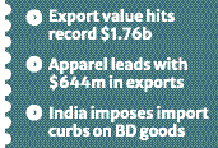
Bangladesh's exports to India rose by 11.05 per cent year on year in the fiscal year 2024-25, reaching a record $1.76 billion, up from $1.57 billion in FY24, despite non-tariff barriers, port restrictions, and regulatory bottlenecks.
According to data from the Export Promotion Bureau (EPB), the growth reflects the resilience of bilateral trade amid increasing logistical and procedural challenges that, exporters say, are slowing down market expansion and eroding competitiveness.
Month-wise data show consistent gains throughout most of FY25, with notable growth in September (23.07 per cent to $202 million), November (24.11 per cent to $158 million), and December (17.38 per cent to over $161 million).
However, in June - the final month of the fiscal year - exports plunged by 18.63 per cent, mainly due to port restrictions, shipment inspections, and delays at the border.
Sharif Zahir, managing director of Ananta Group, told The Financial Express, "Due to land port closures, apparel export lead time has risen to 30 days from the earlier 16. Our lingerie exports to India, worth nearly $3 million, are growing steadily, but this momentum cannot be sustained under the current circumstances."
"Earlier, we could export through all land ports, but now only a few are operational," said Kamruzzaman Kamal, marketing director of PRAN-RFL Group, a major exporter to India.
"We're forced to reroute shipments through sea ports and Bhomra land port in Satkhira to reach different Indian states, which increases both cost and transit time," he added. Mr Kamal noted that transport costs have risen by 8-9 per cent, affecting PRAN's $60 million annual exports of agro products to India. Despite having a manufacturing facility there, PRAN exports a variety of goods including juices, confectioneries, biscuits, and noodles from Bangladesh.
He also flagged stricter inspections. "Each shipment is now thoroughly checked, delaying the entire process. If such restrictions persist, exports may decline in the coming months."
Apparel and textile products dominated Bangladesh's exports to India in FY25. According to EPB data, apparel exports surged by 17.39 per cent to $644.25 million, up from $549 million in FY24. Of this, woven garments accounted for $428.48 million, while knitwear stood at $215.77 million.
Among other key export items were vegetable textile fibres, paper yarn and woven fabrics of paper yarn ($187.53 million), footwear ($112.31 million), and home textiles ($107.84 million).
Despite the growth, Bangladesh's trade balance with India remains heavily tilted. In FY24, Bangladesh imported $9 billion worth of goods from India against exports of just $1.57 billion - resulting in a $7.43 billion trade deficit.
The gap has widened significantly over the years, from $4 billion in FY11 to a peak of $11.7 billion in FY22, though it narrowed slightly in the past two fiscal years. In the closing months of FY25, India imposed a series of restrictions on imports from Bangladesh via land ports.
On May 17, India restricted entry of products including ready-made garments, processed food, plastic items, wooden furniture, yarn and its byproducts, and fruit-flavoured beverages.
While sea ports such as Nava Sheva and Kolkata remained open for these products, and Bhomra was allowed for food exports, the disruptions severely affected trade.
newsmanjasi@gmail.com
© 2026 - All Rights with The Financial Express

