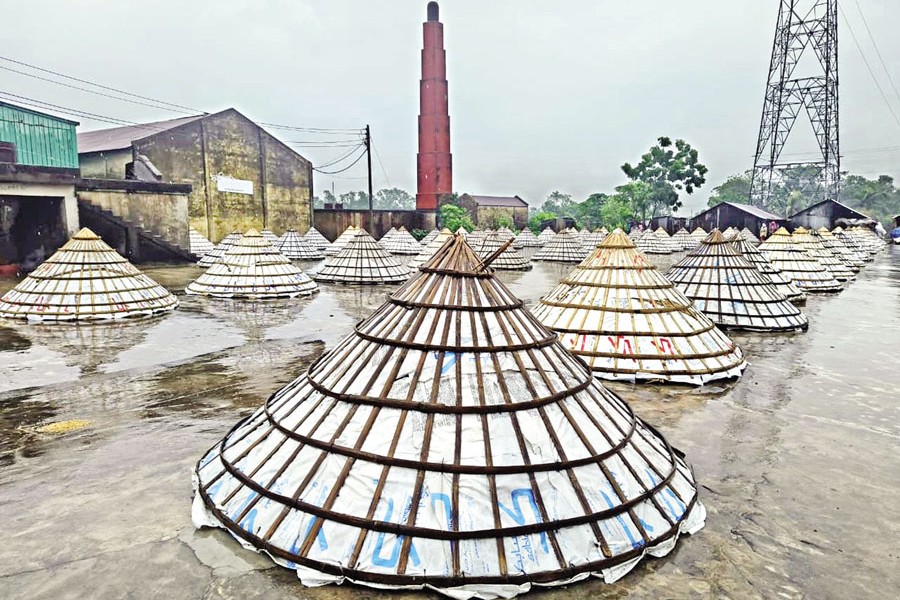
 The traditional rice drying yards, known as chatals, in Ashuganj of Brahmanbaria remain closed for the past few days due to heavy rains, causing the paddy to spoil. The photo was taken on Monday. — Focus Bangla
 At least 54 people have died and 39 others injured so far in floods, flash-floods and landslides triggered by downpours across Bangladesh's southeastern and northeastern regions, as the disaster gradually shifts towards northern districts.
 Flood forecasts have it that fresh inundation is threatened over the next 24 to 48 hours, as rain and runoff from across the border continue.
The floods and landslides have affected more than 1.5 million people, according to the latest update released Monday by the Ministry of Disaster Management and Relief.
The ministry says seven districts-Khagrachhari, Rangamati, Bandarban, Cox'sbazar, Chattagram, Moulvibazar and Habiganj-are currently affected by flooding.
The monsoon rain-driven disaster has impacted 59 upazilas, 334 unions and 12 municipalities.
Of the 54 fatalities, 31 were reported in Cox'sbazar, 13 in Chattagram, six in Bandarban, three in Rangamati and one in Moulvibazar. Among the injured, 24 were from Cox'sbazar, 12 from Chattagram, two from Bandarban and one from Khagrachhari.
To accommodate displaced residents, the government has opened 1,049 flood shelters across the seven affected districts, where 38,422 people are currently taking refuge.
As part of relief operations, the government has allocated rice, dry food, cash assistance, baby food and other emergency supplies to the affected districts.
The assistance is being distributed through local administrations, while additional financial support has also been provided from the Prime Minister's Relief and Welfare Fund to several districts.
The Disaster Management and Relief Ministry has said rescue, relief distribution and rehabilitation activities are continuing with the coordinated efforts of district administrations, the armed forces, Fire Service and Civil Defence, voluntary organisations and other relevant agencies.
"Necessary support will continue according to the evolving situation," it says.
Meanwhile, the Flood Forecasting and Warning Centre (FFWC) of the Bangladesh Water Development Board warns that low-lying riverine areas in nine districts of the northeastern and northern regions may experience fresh flooding or a further deterioration in the flood situation over the next 24 to 48 hours.
According to Monday's forecast, riverbank areas in Sylhet, Sunamganj, Netrakona, Sherpur, Mymensingh, Nilphamari, Lalmonirhat, Rangpur and Kurigram could witness short-term flooding as water levels continue to rise.
The FFWC says water was flowing above the danger level at four monitoring stations on four rivers: the Surma River at Chhatak in Sunamganj, the Kushiyara River at Markuli in Sunamganj and Fenchuganj in Sylhet, and the Someswari River at Kolmakanda in Netrakona.
However, the agency forecasts gradual improvement in the flood situation in the hill districts, saying that water levels along the Sangu and Matamuhuri rivers in Bandarban, Chattagram and Cox'sbazar are likely to continue receding over the next 24 hours.
The crisis has also severely affected public health and humanitarian conditions.
The health ministry has supplied 21,000 vials of antivenom to hospitals in flood-affected districts to tackle the growing incidence of snakebite, while health teams remain on the alert to prevent outbreaks of waterborne diseases.
Despite the ongoing relief operations, many people staying in flood shelters continue to suffer from shortages of food, safe drinking water, sanitation facilities and hygiene kits, according to field reports.
The prolonged raining also disrupted the Higher Secondary Certificate (HSC) examinations, with thousands of candidates facing severe difficulties in reaching examination centres due to inundated roads, transport disruptions and persistent rain.
The agricultural sector has also suffered extensive losses. According to the Department of Agricultural Extension (DAE), more than 0.12 million hectares of standing crops in nine districts have been inundated by floodwater. Among them, over 25,000 hectares of Aus paddy have gone under water, raising concerns over crop losses if floodwaters do not recede quickly.
The capital, Dhaka, also continued to struggle with severe waterlogging on Monday despite the return of sunshine around midday.
Water remained stagnant in several neighbourhoods, while damaged roads disrupted traffic across Dhaka.
Commuters travelling to offices and educational institutions faced renewed hardship as public transport remained scarce in Mohammadpur, Karwan Bazar and Mohakhali, where battery-run rickshaws and CNG auto-rickshaws charged several times the normal fares.
Waterlogging persisted in New Market, while roads from Nilkhet intersection to Bangladesh-Kuwait Maitree Hall of Dhaka University remained submerged for hours. Although water receded from Mohakhali, numerous potholes emerged, making travel difficult for motorists and pedestrians alike.
tonmoy.wardad@gmail.com
© 2026 - All Rights with The Financial Express

