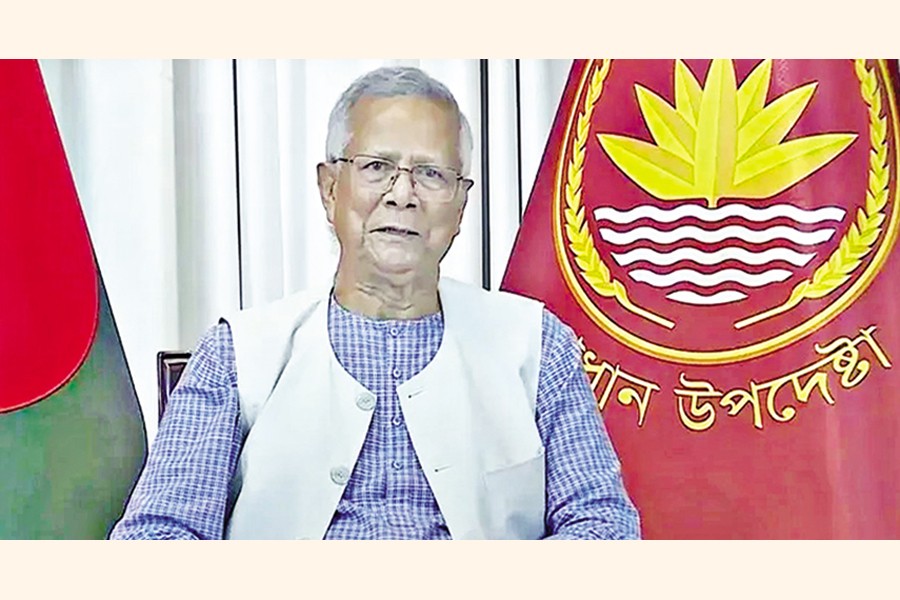
 Chief Adviser Professor Muhammad Yunus delivers his farewell address to the nation on Monday night.
 Professor Muhammad Yunus concludes his mission as the head of interim government with a focus on economic opportunities and vast growth potential of a broader regional bloc encompassing Nepal, Bhutan and northeastern India.
In a televised address to the nation Monday ahead of Tuesday's handover of power to an elected government, Chief Adviser Yunus outlined Bangladesh's maritime access as a strategic asset and stressed port capacity enhancement.
"Our open sea is not merely a geographical boundary -- it is a gateway to the global economy," he said, highlighting connectivity as central to the country's next phase of development.
Prof Yunus said through economic zones, trade agreements and access to duty-free markets, a strong foundation will be established for this region to become a global manufacturing hub.
"We have come a long way in signing agreements with the best international port-management companies to take the efficiency of our ports to the international level. If we cannot increase its efficiency, we will lag behind in economic achievements," he said, in defence of dos of his 18-month stand-in administration after the July-August 2024 uprising.
The Chief Adviser said they had been able to firmly restore these three fundamental foundations of Bangladesh's sovereignty, national interests, and the country's dignity in foreign policy.
"Bangladesh is no longer a country with submissive foreign policy or dependent on the instructions and advice of other countries -- today's Bangladesh is confident, active and responsible in protecting its independent interests."
Prof Yunus mentioned their commitment to building relations with all countries of the world based on mutual respect and interests.
At the same time, he said, Bangladesh has established itself today as a state capable of taking necessary strategic decisions for the future while maintaining balance.
The Nobel laureate for peace said the Rohingya crisis created a serious and long-term strain on the national security, regional stability and economy.
Unfortunately, he said, for a long time, no effective and coordinated international initiative was visible to resolve this crisis. "Since assuming office, we have been able to bring this issue, which was moribund in the international arena, back to the centre of global attention."
Realising the importance of this crisis, he said, the United Nations has stood by Bangladesh.
The UN Secretary-General himself has visited Bangladesh and pledged to help find a sustainable solution to the problem, he mentions in his valedictory speech, adding that at his request, a special conference on the Rohingya issue was held at the UN.
He billed the July National Charter as the biggest achievement of the interim government, on the basis of which the people of the country decided to implement it with a huge majority in a referendum.
"If the July Charter is implemented, the paths to the return of fascism will be closed forever. I hope it will be implemented within the stipulated timeframe," Prof Yunus said.
Even if the interim government forgets many things, big and small, good and bad, the nation will never forget the July Charter, Prof Yunus notes.
"Today, I congratulate all the political parties, social organisations, and human-rights organisations who worked tirelessly to draft this charter and get it passed in the referendum," he said.
For the first time, Prof Yunus said, the opportunity has been created for expatriates to vote in this election.
"When a voter proudly shares his experience of voting in this election and the referendum on social media, as a citizen, I cannot contain my joy. I hope that many more expatriates will be able to participate in this process safely in the future," he said.
(Inputs taken from UNB, live telecasts)
© 2026 - All Rights with The Financial Express

