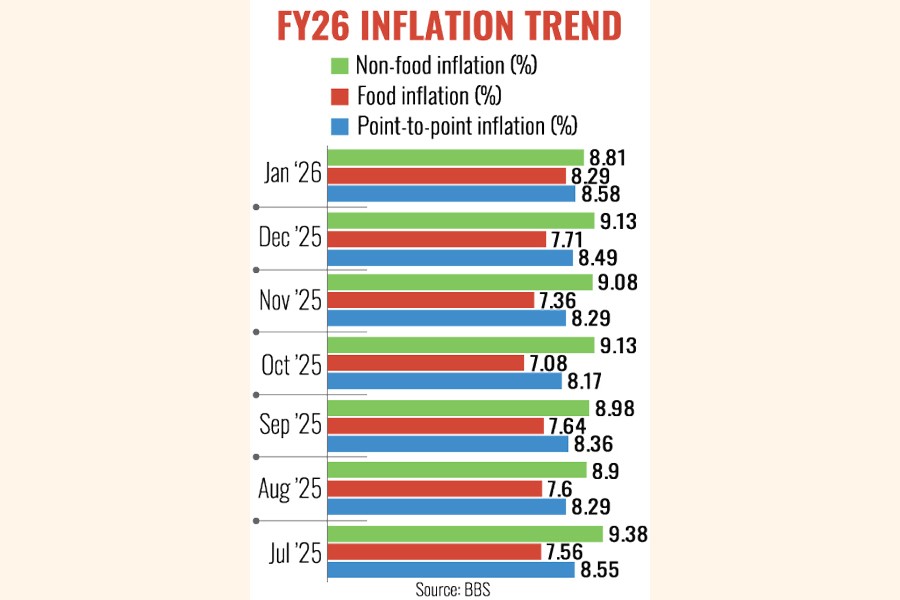
Point-to-point inflation, measured by the Consumer Price Index (CPI), rose to 8.58 per cent in January, up 0.10 percentage points from 8.49 per cent in December, driven largely by a sharp rise in food prices, according to the latest Bangladesh Bureau of Statistics (BBS) data.
The CPI and Wage Rate Index (WRI) report released on Sunday, showed January's inflation at an eight-month high, marking the third consecutive month of increase, despite notable easing in the non-food index.
Experts said inflationary pressures were exacerbated by higher food prices ahead of the holy month of Ramadan and expanding flow of money in the pre election period.
The report found food inflation in January at 8.29 per cent, up 0.58 percentage points from December's 7.71 per cent.
On the other hand, non-food inflation eased to 8.81 per cent, down 0.31 percentage points from December's 9.13 per cent.
Looking back, overall inflation fell to 8.48 per cent in June 2025 from 9.05 per cent in May 2025, but January's figure is the highest since last June. Food inflation in January was also the highest in the past eight months.
The 12-month moving average, from February 2025 to January 2026, reached 8.66 per cent, significantly lower than the previous period's average of 10.34 per cent.
Point-to-point inflation, which measures the change in prices of selected items compared with the same period last year, reflects the change in the cost of living. The 8.58 per cent inflation in January indicates that the cost of living increased at the same rate over the last year, meaning consumers would need to reduce consumption if their income did not rise correspondingly.
However, according to the WRI report, the income of wage earners increased by 8.08 per cent, slightly below the inflation rate, eroding the purchasing power of wage earners.
The overall WRI in December was 8.07 per cent which increased by 0.01 percentage points in a month.
Inflation in rural areas increased by 0.14 percentage points in the last month. It reached 8.63 per cent in January from 8.48 per cent in December.
Food inflation in rural areas reached 8.18 per cent in December with an increase of 0.52 percentage points from December inflation of 7.67 per cent.
On the other hand, inflation in urban areas reached 8.57 per cent in January with a rise by 0.01 percentage points from December inflation.
"Ahead of the elections, the flow of money has increased, and with Ramadan approaching, rising demand and hoarding by traders have pushed up prices. These two factors have driven inflation higher," said Dr Fahmida Khatun, Executive Director of Centre for Policy Dialogue CPD.
When money reaches poor households, demand for food items generally rises, which aligns with the inflation data, she told the FE.
On the effectiveness of monetary policy, she said, "The central bank's tight policy is not working. Inflation depends not just on money supply but also on addressing supply-side issues and maintaining competition in the market-and the current government has failed in this regard."
jahid.rn@gmail.com
© 2026 - All Rights with The Financial Express

