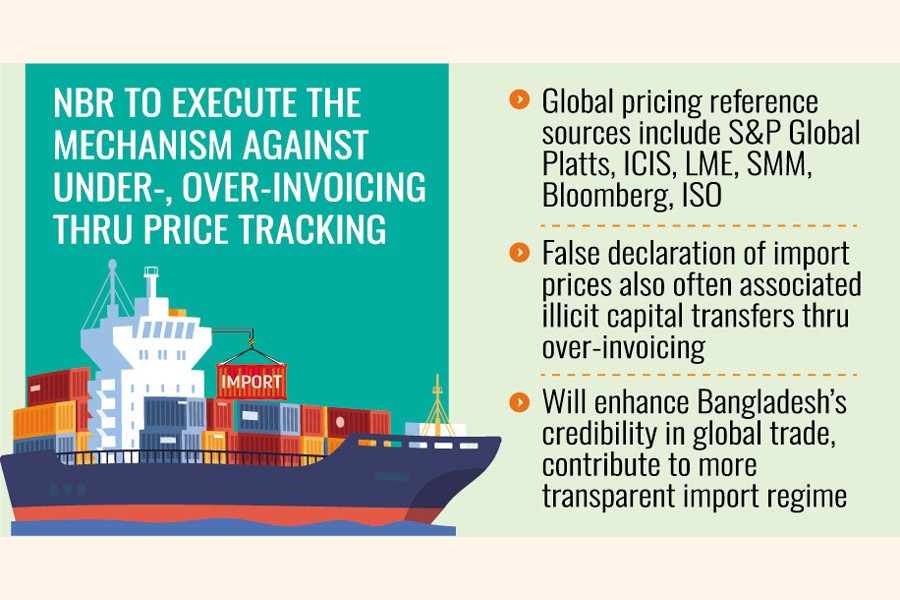
Government's revenue authority has moved to ensure accurate customs valuation by using internationally recognised price benchmarks to verify import prices and thus prevent duty-dodging through trade misdeclaration.
Officials say the mechanism will be executed to prevent under-invoicing and over-invoicing of commodities while facilitating hassle-free legitimate trade.
The National Board of Revenue (NBR) has issued an order to this effect. Through this general order, issued on June 11, the revenue authority has directed customs officials to compare prices declared by importers with information available from globally recognised and independent price-reporting agencies, commodity exchanges and market-intelligence platforms.
According to the order, reference sources include S&P Global Platts, Independent Commodity Intelligence Services (ICIS), London Metal Exchange (LME), Shanghai Metals Market (SMM), Bloomberg and the International Sugar Organization (ISO).
Under the new framework, customs officials may accept the value declared by an importer as the transaction value if it is consistent with prices available from these international sources and there is no specific evidence indicating that the declared value differs from the actual price paid or payable.
The order, signed by Md Tariq Hassan, First Secretary (Customs Policy and ICT) at the NBR, was issued under Section 266 of the Customs Act 2023 and came into effect immediately.
Seeking anonymity, revenue officials say businesses have long complained that customs authorities often assess imported goods at higher value, resulting in increased duty payments.
"The move is intended to bring greater transparency and consistency to customs valuation and address concerns over misdeclaration of import prices--a practice often associated with duty evasion through under-invoicing and illicit capital transfers through over-invoicing," says one official.
The NBR says customs officials frequently face difficulties in determining the assessable value of imported goods, often leading to disputes and delays in the clearance process.
To reduce such complexities and support trade facilitation, the new guidelines provide a structured framework for incorporating international market data into customs valuation.
Officials also say the measure would benefit compliant businesses while tightening scrutiny of non-compliant ones.
According to the order, benchmark prices must be based on pro forma invoices issued within 90 days prior to the submission of the import declaration.
The directive also introduces "greater accountability" in customs assessments. If a customs official rejects a declared transaction value despite its consistency with internationally recognised price references, the decision must be backed by specific evidence and approved by an officer not below the rank of Assistant Commissioner of Customs.
The order further reiterates that where a minimum customs value has been prescribed through a government notification, imported goods cannot be assessed below that threshold.
"However, if an importer declares a value higher than either the international reference price or the notified minimum value, customs duties will be assessed on the higher declared value," the order reads.
Speaking to The Financial Express, Snehasish Barua, a chartered accountant and partner at SMAC Advisory Services Ltd, has said the adoption of a modern, data-driven valuation model would reduce "bureaucratic red tape and discretionary decision-making" in customs assessments.
"This approach aligns domestic customs valuation with prevailing international market prices, protecting compliant importers from unfair competition. A system-guided process will ensure greater uniformity in assessments and help reduce cargo-clearance time, improving Bangladesh's business environment," he says.
He adds that the use of real-time market data could help plug revenue leakages caused by under-invoicing, strengthen revenue collection and support the transformation of Bangladesh Customs into a more digital and efficient revenue administration.
"Ultimately, it will enhance Bangladesh's credibility in global trade and contribute to a more transparent import regime," he added.
newsmanjasi@gmail.com
© 2026 - All Rights with The Financial Express

