Amid overlapping developments over Trump tariff revocation by court and fresh duty imposition by the president, Bangladesh government awaits official notification from the United States for the next course about the country's trade deal.
Experts think the latest developments may create room for Bangladesh to renegotiate its trade arrangement with Washington, as the US apex court has struck down the Trump administration's reciprocal tariffs.
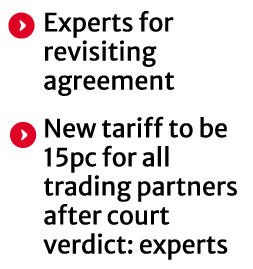 They made these observations Sunday while talking with The Financial Express as the US President, Donald Trump, has raised duty to a flat 15 per cent after the court rejected the validity of reciprocal tariff framework that upset world trade regime.
Referring to the recent court verdict in the US, Commerce Secretary Md Mahbubur Rahman said the new tariff would be set at 15 per cent for all trading partners following the US court verdict, but Bangladesh has yet to receive any official notification in this regard.
He notes that the 20-percent tariff imposed in August remains in effect, while the proposed 19- percent rate under the new agreement has not yet come into force.
He adds that the government is also awaiting formal communication on the agreement's status, which is expected in the coming days.
Bangladesh will continue its communication with the US authorities for further updates, says the Commerce Secretary.
Shovon Islam, Managing Director of Sparrow Group, says that so far, all countries have to face an equal tariff of 15 per cent.
He holds the hope that the government would renegotiate with the United States to secure a more favourable rate for Bangladesh, helping make its exports more competitive.
Fazlee Shamim Ehsan, executive president of the Bangladesh Knitwear Manufacturers and Exporters Association (BKMEA), has criticised the timing of the tariff deal signed by the interim government just three days before the national elections.
"The ill-timed move has created uncertainty. Had the deal not been signed, we might have had greater room. Instead, we are now facing a state of uncertainty," he says the export-industry leader.
Alleging that certain individuals in the previous government might have pursued personal interests through the agreement, Ehsan says those responsible should be held accountable.
He sees the ongoing US tariff turmoil as one of the major challenges confronting the new government.
"The government should explore possible avenues to revoke or revisit the agreement," he says, noting that trade agreements should ideally be structured around HS codes to ensure clarity and secure customs and other duty benefits.
Reciprocal tariff arrangements, he argues, tend to carry inherent uncertainty.
Given the proximity to the election, the interim government should have deferred the decision or left it to the elected government, particularly as the deal reportedly contains undisclosed clauses, he says.
Professor Mustafizur Rahman, distinguished fellow at the Centre for Policy Dialogue (CPD), says the flat 15-percent tariff will now apply to all trading partners, meaning Bangladesh would neither gain special privileges nor face disadvantages under the previous deal.
He notes that the trade agreement was reached on the basis of reciprocal facilities, reducing the tariff to 19 per cent from 37 per cent under the earlier reciprocal tariff structure.
"With the reciprocal tariff framework nullified, the relevance of the agreement no longer exists," he says, suggesting that the government should initiate fresh discussions with the US as the deal has not yet taken effect.
He also opines that the interim government should not have signed the agreement in haste ahead of the national parliamentary election.
If the reciprocal tariff framework is formally scrapped, he says, Bangladesh should seek a review of prior commitments within the legal provisions of the agreement.
There is typically a 60-day window between the effective date of such deals and the exchange of letters and notifications, he notes, urging the government to utilise the time-lag efficiently.
"A number of clauses in the tariff agreement appear largely one-sided. Bangladesh must respond with strategic caution and careful calculation in the face of shifting US trade policy," he adds.
Dr Abdur Razzaque, chairman of RAPID, says all such agreements must be ratified by parliament. He adds that the US Congress may not ratify the reciprocal tariff component through its parliament.
Asked whether Bangladesh could ignore its trade agreement based on reciprocal tariffs, he said it would depend on legal interpretation. "None of the weaker countries have been able to do so, as even the European Union has not taken such a step."
He advises the Bangladesh government to be cautious in forming its official position on the issue. Otherwise, he warns, the US government might exert pressure on Bangladesh in various ways.
He further says the Supreme Court ruled that the US president has no authority to impose tariffs. However, the ruling allows tariffs to remain in place for up to 150 days.
newsmanjasi@gmail.com
© 2026 - All Rights with The Financial Express

