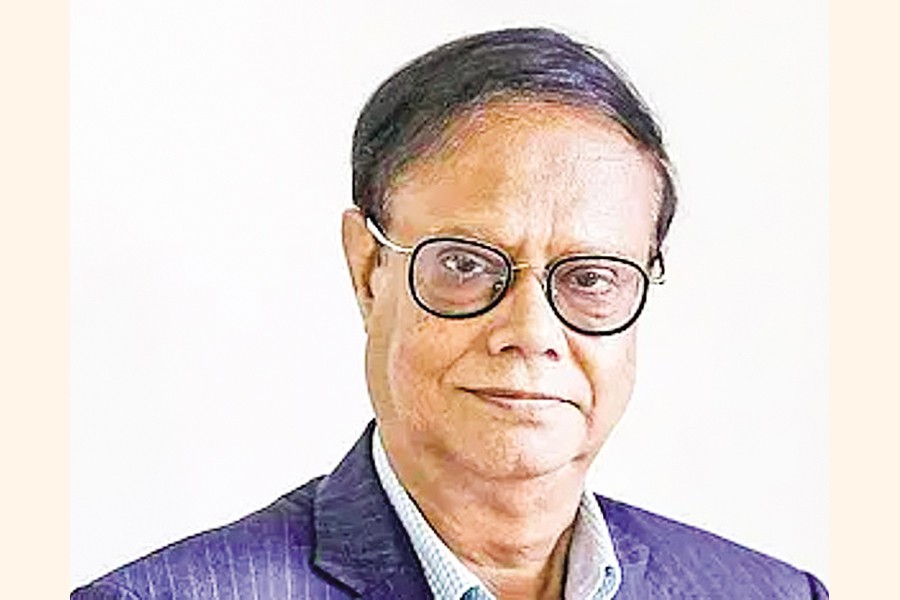
 Dr Ahsan H. Mansur
 Keeping only two larger public-sector banks through merging the rest is under government consideration to manage them well, the central bank governor said Wednesday while unveiling latest banking-sector overhaul packages.
 Dr Ahsan H. Mansur, the Bangladesh Bank Governor, was speaking as chief guest at a public lecture titled 'Banking Sector: Current Situation and Future Challenges', jointly organized by the Bangladesh Economic Association (BEA) and Jagannath University.
Economists at the event called for full disclosure of funds unlawfully withdrawn from banks during the Awami League's tenure in power as they think it would expose how powerful groups within state authority exploited the system to amass wealth that created a new wealthy class--better known as oligarchs.
They urged greater transparency and structural reforms in the banking sector, emphasizing the need to strengthen social and moral oversights along with formal legal frameworks to restore public confidence.
The event at the central auditorium of the university was chaired by BEA convener Prof Dr Mahbub Ullah, with speeches from Jagannath University Vice-chancellor Dr Md. Rezaul Karim and Economics Department Chairman Dr Sharif Mosharraf Hossain and BEA Member-Secretary Prof Dr Mohammed Helal Uddin, among others.
Dr Mahbub Ullah urged the government to publish a comprehensive financial statement showing who withdrew funds from banks during the previous administration to expose misuse of state power.
"It was possible to open bank vaults and remove money because signals came from the highest levels of government. Without political backing, such large-scale withdrawals could not have occurred," he told the meet.
He also claimed that many individuals withdrawing funds under the pretext of investment had no genuine intent to invest, which contributed significantly to the rise of non-performing loans in Bangladesh.
He highlights that legal frameworks alone have failed to prevent plundering, as banks have not fulfilled their fundamental purpose of reducing financial-transaction costs, leaving the system highly inefficient and vulnerable.
The economics professor stresses that public confidence is central to recovery, and gradual repayment of depositors' funds will restore trust, encouraging people to once again deposit money into the formal banking system.
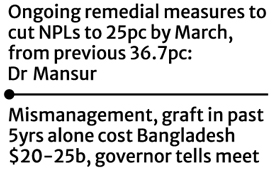
The Bangladesh Bank Governor also said ongoing restructuring and provisioning measures are expected to bring down non-performing loans in the banking system to around 25 per cent of total loans by next March.
He said governance failures occurred at every level, with politically directed loans, family-controlled banks, and lack of oversight resulting in hundreds of thousands of taka being misused.
Dr Mansur estimates that mismanagement, corruption, and irregularities in the past five years alone cost Bangladesh at least $20-25 billion, highlighting the need for accountability and comprehensive reform in the banking system.
The NPL situation will improve gradually but not overnight, governor told the audience, adding: "Previously, non-performing loans were reported at around 9.0 per cent, which was unrealistic. In reality, they reached nearly 36.7 per cent, likely the highest level."
With restructuring and provisioning, NPLs may gradually fall to around 30 per cent by December and 25 per cent by next March.
Identifying a plenty of banks as a major obstacle in bank regulation, the central bank governor said the country has too many banks-61 in total-and managing them all creates inefficiency and excessive supervisory pressure.
He suggests that the number of state-owned banks should be drastically reduced, leaving perhaps two large public banks, while private banks could also consolidate.
He compares the situation with India, which manages a much larger economy with only four state-owned banks, and argues that fewer, stronger banks would reduce overhead costs, improve governance, enable better management of large assets, and support long-term development.
He mentions that a Bank Resolution Fund has been created to support future bank mergers and resolutions. Some Tk300-400 billion will be deposited into this fund, providing the legal and financial capacity to resolve failing banks efficiently and prevent systemic crises.
Mansur stresses granting autonomy to Bangladesh Bank, arguing that independence from political interference is essential to ensure policy continuity, effective supervision, and the prevention of future large-scale banking crises.
jahid.rn@gmail.com
© 2026 - All Rights with The Financial Express

