The government does not take into cognizance the opinion of nearly 73 per cent of the population about establishing good governance, an official survey shows, which indicates roots of graft and recurrent political crisis.
If political interference is added, the rate of indifference rises to 78 per cent, according to Bangladesh Bureau of Statistics (BBS) findings published Wednesday.
Besides, nearly three-quarters of the country's population believe they have no influence or persuasion over government decisions as the political decision in the country "is not inclusive and responsive".
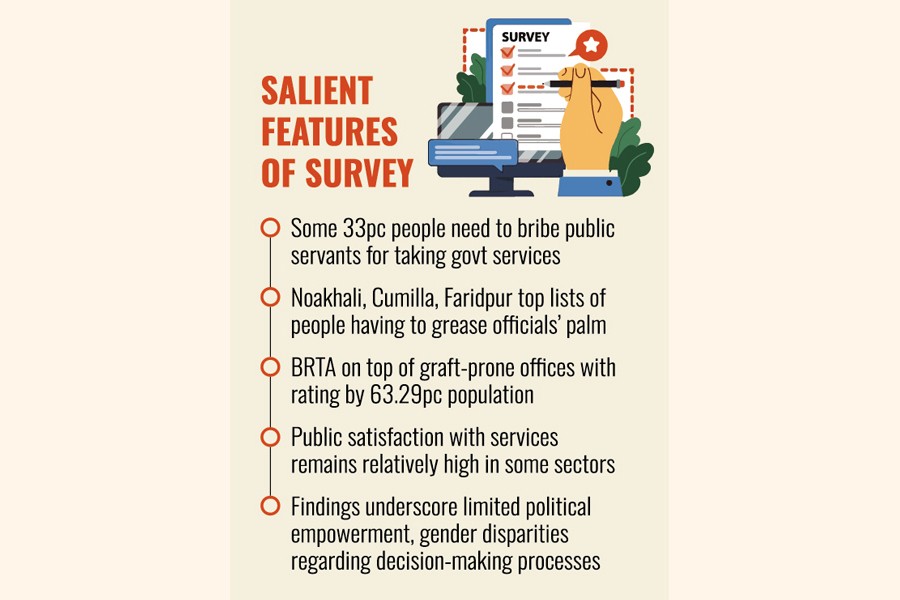
It also shows 33-percent people need to bribe public servants for taking government services across the country.
The government statistical agency rolled out outcome of the survey titled 'Citizen Perception Survey (CPS) 2025' at a function in Dhaka-at a time when Bangladesh is espousing governance and overall systemic overhaul following last year's mass uprising at the climax of latest political crisis.
People from Noakhali, Cumilla and Faridpur are on top of the lists for having to bribe public servants as their 57.17 per cent, 53.47 per cent and 51.70 per cent populations respectively are bound to grease officials' palm in offices, the BBS perception survey reveals.
On the other hand, people in Chapainawabganj, Magura, and Gaibandha districts are in the better position with 10.49 per cent, 13.98 per cent and 14.50 per cent having to bribe in taking public services in government offices.
The survey, conducted in February 2025, interviewed 84,807 people aged 18 and above from 45,888 households across all 64 districts.
Only 24.62 per cent of population believes that decision-making in the country is inclusive and responsive.
Urban respondents showed slightly higher confidence (24.91 per cent) than their rural counterparts (24.47 per cent), while men (29.21 per cent) were more confident than women (20.42 per cent).
The survey highlights bribery as a major concern in accessing government services.
About 31.67 per cent of citizens reported experiencing bribery within a past year while seeking government services, with men facing it more frequently (38.62 per cent) than women (22.71 per cent).
In terms of highly corrupt offices, the CPS has shown that the Bangladesh Road Transport Authority (BRTA) is on top of the list as 63.29 per cent population recognised this government office, while 57.96 per cent people selected the law- enforcement agencies as the 2nd one, 57.45 per cent placed the passport offices in the 3rd position and 54.92 per cent selected the Land Registry office on the 4th rung of graft ladder.
Despite these concerns on the downside of sociopolitical order, satisfaction with public services remains relatively high.
Among those who accessed services, 72.69 per cent expressed satisfaction with public healthcare, 81.56 per cent with primary education, and 78.20 per cent with secondary education. Satisfaction with other public services was lower at 66.91 per cent, the BBS data show. The findings underscore limited political empowerment and persistent gender disparities, pointing to ongoing challenges in inclusive governance and citizen trust in Bangladesh's political and decision-making processes.
Interestingly, the survey has found a sharp contrast between physical safety and political agency. Over 84 per cent of citizens feel safe walking in their neighbourhoods at night, and 92.5 per cent feel safe at home after dark.
However, experts argue, "good governance" requires more than just order-it requires a participatory framework. The CPS 2025 findings suggest that while the streets may feel safe, the democratic space feels closed to the majority.
Officials at the publication ceremony, including Planning Ministry secretaries, emphasized that the CPS 2025 will serve as a baseline for government' efforts to meet SDG 16 (Peace, Justice, and Strong Institutions).
The CPS 2025 is expected to "play a vital role in shaping the reform agenda of the current administration as it seeks to rebuild institutional integrity and public trust", guests participating in open discussion said at the function.
© 2026 - All Rights with The Financial Express

