The government has no immediate plan to cut domestic prices of petroleum products despite the fact that the international prices of the same have declined substantially.
The international prices of oil have declined by nearly half since the latest upward adjustment in the domestic prices of the same was made effective on January 03 last year.
The price of oil on international market has slumped to a five-year low this week at $66 a barrel. When the hike was made effective in Bangladesh the price was around $120 barrel.
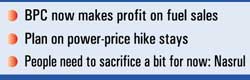
The Bangladesh Petroleum Corporation (BPC), the state oil-marketing entity, is now earning profit from all the products it is selling domestically.
Official sources said the government would monitor the oil-price indices for a certain period before taking any decision on price adjustments.
"We shall keep an eye on the price movements of petroleum products on the international market and see how long the declining price trend continues to prevail," State Minister for the Ministry of Power, Energy and Mineral Resources (MPEMR) Nasrul Hamid told the FE.
Mr Hamid, however, wouldn't say how long the wait may last.
"We are interested to adjust the subsidy first," he said, indicating that the spin-off from the global market fall will be used to make up, to some extent, the loss incurred on account of subsidy government paid on fuels.
If the downward rally of oil prices continues for long, the government might consider a downward adjustment in domestic petroleum prices, said Mr Hamid.
The price of Brent crude--the major trading classification of sweet light crude oil that serves as a major benchmark price for purchase of oil worldwide--plummeted to US$66 per barrel this week. It marks the lowest level of rates since 2009.
The government raised the domestic prices of petroleum products in the latest by up to 11.47 per cent on January 3, 2013 by an executive order to offset the mounting losses the state-owned Bangladesh Petroleum Corporation (BPC) was suffering then.
The government then increased the prices of diesel and kerosene by Tk 7 per litre each to Tk 68 per litre and petrol and octane by Tk 5 per litre each to Tk 96 per litre and Tk 99 per litre respectively.
Despite the hike, BPC incurred an estimated loss of Tk 11.77 per litre on the sale of diesel and Tk 12.15 per litre on kerosene sale, said sources.
BPC had estimated that its financial deficit might balloon to Tk 85 billion in fiscal year 2013-14.
The government finally provided BPC Tk 24 billion in subsidy to offset the loss during the last fiscal year.
If the downtrend of petroleum prices on the international market continued, BPC might pocket some profit in the current fiscal year, a senior official of the state corporation said.
The sharp fall in the prices of petroleum has reduced the import bill of the corporation significantly, BPC Chairman Md Eunusur Rahman told the FE.
The import cost of diesel fell by 31 per cent to $82 per barrel recently from $119 per barrel as of July, he said.
Furnace-oil import cost slumped by 31.40 per cent to $413 per tonne recently from $602 per tonne in July, he said.
"We are making profit of around Tk 16 per litre against sale of furnace oil," the BPC Chairman said about the turnaround banking on global downturn. The corporation is making profit of around Tk 2-3 per litre against its diesel sales, he added.
The BPC imports around 1.0 million tonnes of furnace oil from the international market and sells it to the BPDB for electricity generation in oil-fired power plants.
It imports around 3.0 million tonnes of diesel per year on average to meet mounting local demand, including that of the oil-guzzling power plants.
Taking advantage of the global price slump, coupled with value-added tax (VAT) and tax-waiver facilities from the National Board of Revenue (NBR), the import cost of furnace oil under private sector currently stands at Tk 30 per litre, said sources.
Currently, the country has a total of 39 oil-fired power plants: 11 diesel-run and 28 feeding on furnace oil.
Their combined electricity-generation capacity is 2,987 megawatts (MW)--2,133 MW coming from furnace-oil combustion and 854 MW from diesel.
Despite lower import costs of petroleum products, the BPDB along with other state-run electricity-distribution companies, however, sought further hike in electricity prices. They have submitted proposals separately to the Bangladesh Energy Regulatory Commission (BERC) to hike retail electricity tariffs, ranging from 14.75 per cent to 18.50 per cent.
BPDB has sought a raise in power tariffs at bulk level by 18.12 per cent or Tk 0.81 per unit (1 kilowatt hour).
The energy regulator is scrutinising proposals before inviting them for public hearings prior to raising electricity tariffs at user-ends, a senior official said.
Regarding hike in electricity tariffs the state minister said the government wants that the adjustments be rational and tolerable to consumers.
"People must have to sacrifice a bit as we are at a crossroads," said Mr Hamid to corroborate the corporations' pleas. "There will be no requirement of adjusting upward the tariffs when the base-load power plants come online," he added.
azizjst@yahoo.com
© 2026 - All Rights with The Financial Express

