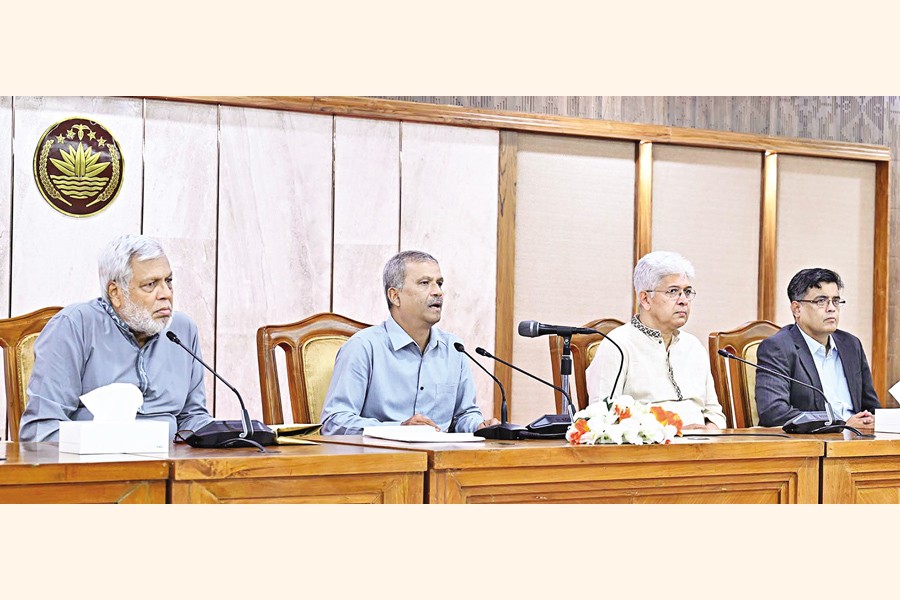
 Law, Justice and Parliamentary affairs Adviser Dr Asif Nazrul speaks at a press conference at the Chief Adviser's Office in Tejgaon, Dhaka, on Monday. — PID
 Prolonged national-consensus consultations exhausted, the interim government Monday urged political parties to give it a unanimous decision on the July Charter implementation at the shortest-possible time, 'preferably within a week'.
Parties failing such consensus within the tentative timeframe, the government will take its own decisions, the Council of Advisers of the post-uprising government decided in a special meeting.
"The government will no longer initiate further rounds of political dialogue," said Law Adviser Dr Asif Nazrul while briefing the press following the special interim-cabinet meeting, chaired by Chief Adviser Dr Muhammad Yunus.
He clarified that the government was not setting any ultimatum but expected prompt progress-as the execution process of the national charter on statecraft recast ramble around modus operandi of referendum.
"We are not issuing an ultimatum. We will wait. But if they fail to provide a unified directive, the government will take its own decisions," the law-ministry custodian said on a note alike an ultimatum.
Reiterating the administration's position, he concludes: "If the political parties reach a consensus, our work becomes much easier. If they cannot, the government will act in national interest and proceed accordingly."
He mentions that the government has organised many dialogues. "It will not hold any more. We now expect the political parties to engage among themselves and give us a unified directive," he told reporters.
The law professor-turned law adviser notes that parties involved in the long struggle against "fascism" had a strong record of collective decision-making and mutual sacrifice. "Those who fought together against fascism for the past 15 years have taken many crucial decisions through discussion. They have endured persecution together. We hope they will once again reach a consensus and give the government a united message."
He welcomes recent calls from a political party for inter-party dialogue, describing the move as "a positive and timely gesture".
According to Mr Nazrul, the Advisory Council expressed the view that final decisions must now be taken urgently, based on the recommendations of the National Consensus Commission.
The Council called upon the longstanding pro-democracy allies to hold consultations and present a common policy direction to the government-preferably within a week.
"Such guidance would greatly facilitate the government's decision-making. We must all recognise that there is no room for delay," he added.
The Law Adviser also reaffirmed government commitment to holding the next parliamentary election in the first half of February 2026.
During the meeting, the Advisory Council discussed the finalization of the proposed July National Charter and the Constitutional Reform Order, including the holding of a national referendum and its possible content.
The Council thanked the National Consensus Commission and the political parties for their extensive dialogue and for achieving broad agreement on several major reform issues.
However, Dr Nazrul acknowledged that differences persisted over certain recommendations of the Commission, including the timing and content of the referendum.
"The council noted with concern that, despite prolonged discussions, some reforms still lack unanimity. Questions remain as to when the referendum will be held and what issues it will address," he said.
In response to a question, he stressed that the government would give the democratic alliance some time to reach internal agreement. "They have fought together for 15 years. We want to give them space to deliberate among themselves," he remarked.
mirmostafiz@yahoo.com
© 2026 - All Rights with The Financial Express

