Finance Minister Amir Khosru Mahmud Chowdhury says the government is preparing the budget for the next fiscal year with interests of people from all sections of society in mind.
"We are preparing the budget taking all relevant issues into consideration," he told reporters when asked about the persistently high rate of inflation that has been putting pressure on people for a prolonged period.
The minister was responding to questions at his office at the Bangladesh Secretariat in the capital, preceding an elaborate statement in parliament on economic and revenue situation, and banking-sector reforms later in the day.
Mr Chowdhury, who is scheduled to place a Tk 9.38-trillion budget in parliament tomorrow (Thursday), says that despite limited resources, the budget seeks to cover all citizens of the country.
"No one has been left out. The circumstances of all people, their advantages and disadvantages, and their living standards have been taken into account," he told the reporters.
Responding to another question, he added: "Had we had more resources, we could have undertaken even more welfare- oriented measures for the people."
While addressing parliament on Tuesday, the finance minister said political uncertainty, weak investment, sluggish trade and industrial activity, and supply-chain disruptions were among major factors behind government's failure to meet revenue targets over the past two fiscal years.
He apprised the parliament of the deficient revenue situation and also banking-sector woes and remedies being applied now.
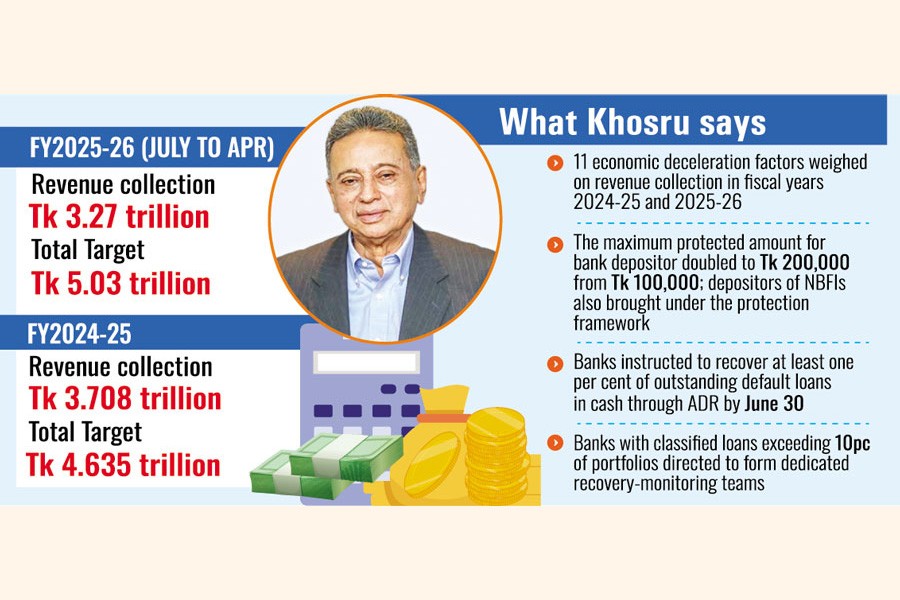
He notes that a gamut of 11 economic deceleration factors, including declining purchasing power, business losses, lower industrial output and falling corporate profits, had weighed on revenue collection in fiscal years 2024-25 and 2025-26.
Replying to a question from reserved-seat lawmaker Nilofar Chowdhury Moni during a question-answer session in the Jatiya Sangsad, the minister said revenue collection up to April in FY2025-26 had come to Tk 3.27 trillion (326,928.16 crore) against a target of over Tk 4.31 trillion (Tk 431,461.27 crore), which accounts for 75.77 per cent of the target.
The National Board of Revenue (NBR) was assigned a revenue target of Tk 5.03 trillion (Tk 503,000 crore) for the fiscal year.
In FY2024-25, revenue collection stood at over Tk 3.71 trillion (Tk 370,875.04 crore) against a target of Tk 4.63 trillion (Tk 463,500 crore).
Mr Chowdhury, who is also in-charge of the planning ministry, says economic activity remained subdued following the political transitions, while supply-chain bottlenecks, high production costs and weak business confidence further constrained revenue growth.
He says prolonged high inflation, which hovered near double digits for an extended period, eroded consumers' purchasing power and reduced the taxable surplus income of middle-income earners and salaried employees.
Disruptions in industrial production, weakened supply chains and sluggish wholesale and retail trade also reduced business earnings, hurting corporate-tax collection.
The minister says shortages of gas and electricity prevented many industries, including the ready-made garment sector, from operating at full capacity, leading to lower production and profitability.
Higher lending rates and the depreciation of the taka against the US dollar further increased operating costs, squeezing profits of large corporate taxpayers, one of the government's major sources of income-tax revenue.
On the trade front, imports of goods subject to 25-percent and 10-percent customs duties fell by 18 per cent and 37 per cent respectively in FY2025-26 compared with the previous year, reducing customs revenue.
Mr Chowdhury also says government measures aimed at keeping fuel prices stable -- including cuts in duties and taxes on petroleum products and the withdrawal of VAT on imported liquefied natural gas (LNG) -- had affected revenue collection.
Tax incentives for capital-machinery imports and a decline in luxury-vehicle imports also contributed to the shortfall.
The finance minister further states that the economic disruption caused by the July-August 2024 student-led mass uprising and the subsequent change in government led to prolonged stagnation in economic activities, disrupted supply chains and weakened business operations, resulting in lower corporate earnings and tax payments.
However, he says, ongoing automation of tax administration and stronger anti-evasion measures by the NBR were helping improve revenue collection and narrow the gap in recent months.
Meanwhile, the finance minister said, the government has intensified banking-sector reforms, strengthened deposit protection and tightened measures against loan defaulters in an effort to restore public confidence and improve financial stability.
Responding to a question from Cox's Bazar-3 lawmaker Lutfur Rahman in the Jatiya Sangsad, the minister says the reforms are being implemented under a comprehensive bank-resolution framework established through the Bank Resolution Act 2026.
He says the framework was first introduced through the Bank Resolution Ordinance 2025 and operationalised under the Bank Resolution Scheme 2025 before being enacted into law this year.
As part of the resolution process, five troubled Islamic banks have been merged to form Sommilito Islami Bank PLC, "a key step aimed at strengthening the banking system and addressing longstanding weaknesses in the sector".
The minister says depositor protection has also been expanded under the Deposit Protection Act 2026, with the maximum protected deposit amount doubled to Tk 200,000 from Tk 100,000.
In a significant policy shift, depositors of non-bank financial institutions (NBFIs), who were previously outside the safety net, have also been brought under the protection framework.
"A clear legal framework, transparent resolution mechanisms and stronger depositor safeguards will play an effective role in rebuilding confidence among depositors and stakeholders," Mr Chowdhury told the House.
The finance minister says the government and Bangladesh Bank have simultaneously stepped up efforts to recover defaulted loans and curb the accumulation of non-performing loans (NPLs).
The measures include policy support for recovering overdue loans, special resolution strategies for banks burdened with high levels of classified loans and stricter action against willful defaulters.
Banks have been instructed to strengthen their legal divisions and recover at least one per cent of outstanding default loans in cash through alternative dispute- resolution mechanisms by June 30, he says.
Bangladesh Bank has also updated credit-risk management guidelines, while the recovery progress from top 20 defaulters is being reviewed regularly at bankers' meetings.
Banks with classified loans exceeding 10 per cent of their portfolios have been directed to form dedicated recovery-monitoring teams.
To strengthen credit discipline, the central bank is implementing Expected Credit Loss (ECL)-based loan classification and provisioning under IFRS 9, a move aimed at improving governance and reducing lending risks.
The minister says licensed collateral valuation firms have also been authorised to independently assess pledged assets alongside banks' own valuations.
Mr Chowdhury says the government's broader reform agenda includes updating agricultural loan-rescheduling policies, publishing lists of defaulters and willful defaulters, revising incentives for regular borrowers and setting sector-wide borrowing limits for individual clients.
"Legal reforms are also being pursued to impose tougher penalties on habitual defaulters."
The government is considering including experienced bankers on the jury board of the Artha Rin Adalat and introducing measures to prevent defaulters from delaying recovery proceedings through writ petitions.
The minister says large companies seeking financing above Tk 10 billion would be encouraged to raise funds through bond issuance instead of relying heavily on bank borrowing, helping ease pressure on the banking system.
He also discloses that legislation is being prepared to facilitate the establishment of private-sector asset-management companies (AMCs) to help resolve distressed assets and strengthen long-term financial-sector stability.
syful-islam@outlook.com
newsmanjasi@gmail.com
© 2026 - All Rights with The Financial Express

