A "poisonous" oligarchic grip over Bangladesh's energy sector ought to be dismantled, says the Prime Minister's finance adviser, alleging that successive policies have entrenched import dependence, distorted market structures and weakened long-term energy security.
Rashed Al Mahmud Titumir, the Prime Minister's Finance and Planning Adviser, made the articulated statement as a CPD study found "deep fossil-fuel bias" in the energy sector that passes through problems.
Speaking at a dialogue titled 'Renewable Energy in the Upcoming Budget: Expectations and Reality', jointly organised by the Centre for Policy Dialogue (CPD) and Dhaka Stream in the capital, the adviser delivered a strong critique of past energy strategies, arguing that the system had evolved into an "oligarchic structure" dominated by a small group of vested interests.
A handful of agencies, companies and individuals had effectively "tied up" the energy sector, creating what he terms a "poisonous circle" and "structural poisoning" that continues to obstruct reform.
According to him, earlier arrangements by the fallen regime provided an "illegal legal cover" for contracts and agreements that bypassed standard procedures, contributing to excessive public expenditure through capacity payments and related mechanisms.
He notes that import dependency had been promoted under the guise of energy security, leaving the economy exposed to global price volatility and inflationary pressures, particularly during recent geopolitical tensions over the Middle East.
"We want to ensure energy security through domestic means, by increasing renewable electricity and diversifying the portfolio," he told the audience.
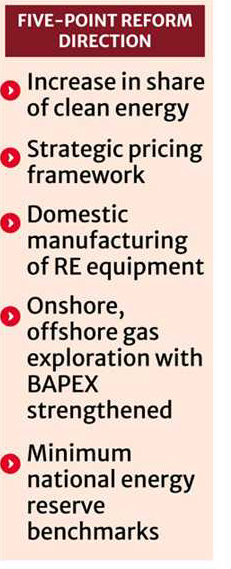
The adviser outlines a five-point reform direction for the upcoming national budget, including: significantly increasing the share of renewable energy in the national energy mix; introducing a strategic pricing framework balancing industrial competitiveness with consumer affordability; promoting domestic manufacturing of renewable-energy equipment; accelerating both onshore and offshore gas exploration while strengthening the capacity of Bangladesh Petroleum Exploration and Production Company Limited (BAPEX); and establishing minimum national energy reserve benchmarks comparable to strategic food and fertiliser stocks.
At the event, a CPD study revealed a significant imbalance in Bangladesh's energy budget, showing that renewable energy accounts for only around 5.0 per cent of revised development allocation for the power and energy sector in the current fiscal year, while fossil fuel-based infrastructure absorbs nearly 80 per cent of total allocation.
The study, titled "Renewable Energy in the National Budget 2026-27: Overshadowed by Fossil Fuels?", was presented by Programme Associate Md Khalid Mahmud. It has found that renewable-energy projects represent only 3.0 per cent of the total power and energy-project budget, receiving just 5.0 per cent of revised FY2026 allocation-about Tk 79.5 billion-while fossil fuel-based projects account for 87 per cent of the total project budget and 79 per cent of actual allocation.
It also notes that Bangladesh spent over Tk 1,474 billion on fossil fuel-based power subsidies between FY2020-21 and FY2024-25. The subsidy burden rose sharply to Tk 620 billion in the revised FY2024-25 estimate, compared with an expected range of Tk 350-370 billion.
The study report says Bangladesh's energy subsidy accounts for around 34 per cent of the sector budget, the highest among selected Asian economies.
It further highlights that the FY2025-26 budget omitted Tk 10 billion previously allocated for renewable energy and introduced no new incentives for solar or clean technologies.
Bangladesh's installed renewable-energy capacity stands at around 1,745 megawatts, with solar photovoltaic accounting for 83 per cent. Renewables make up only 5.39 per cent of total installed capacity, while growth between 2016 and May 2026 averaged 15.78 per cent annually.
On private-sector progress, the study notes that 168 MWs of solar projects were completed in FY2024-25, while 321 MWs are under construction and over 5,254 MWs remain in planning or tender stages.
However, procurement delays have persisted, with four tender packages totalling 5,238 MWs attracting limited investor response and requiring repeated extensions. The government has also cancelled 31 letters of intent covering 3,287 MWs worth around US$ 6.0 billion, leading to 11 High Court petitions.
Special Adviser on ICT, Science and Technology, and Telecommunications Rehan Asif Asad told the meet that the government was working towards an integrated energy strategy combining renewable energy expansion, electric vehicle adoption and energy-storage technologies.
He mentions that incentives for lithium battery use are under consideration, including tax and duty benefits, while noting that electric vehicles would require significant investments in generation capacity, charging infrastructure and policy support.
The session was chaired by CPD Research Director Khondaker Golam Moazzem. Dhaka Stream Editor and Publisher Golam Eftekhar Mahmud said budgetary commitments often failed to reflect policy debates, citing regulatory bottlenecks that require renewable-energy producers to navigate multiple agencies.
Other participants included Investment Corporation of Bangladesh (ICB) Managing Director and CEO AlamgirMorshed, Bangladesh Power Development Board (BPDB) Renewable Energy and R&D Director Moniruzzaman, Dhaka University Associate Professor Mosahida Sultana, General Economics Division (GED) Member Manzur Hossain, and Bangladesh Knitwear Manufacturers and Exporters Association (BKMEA) President Mohammad Hatem, alongside researchers, policymakers and industry stakeholders.
bdsmile@gmail.com
© 2026 - All Rights with The Financial Express

