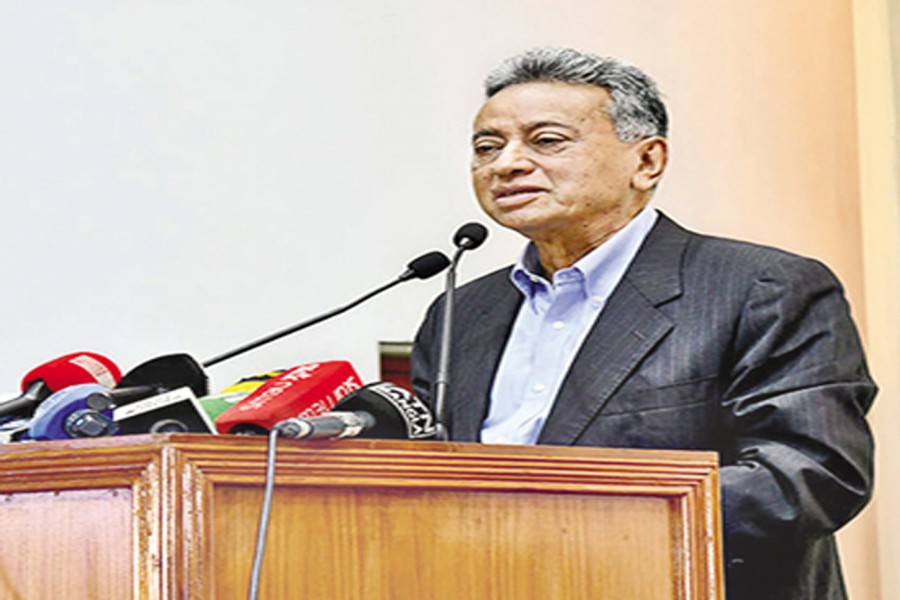
 Finance Minister Amir Khosru Mahmud Chowdhury speaks as the chief guest at the inauguration of the RAISE-2 project at the PKSF auditorium in the capital's Agargaon on Sunday. — PID
 The government has decided not to approve any development project unless it ensures economic value in terms of return on investment, employment generation and environmental sustainability, Finance Minister Amir Khosru Mahmud Chowdhury said Sunday.
He said many of around 1,300 projects under the current Annual Development Programme (ADP) lack viability against such criteria and those would be scrapped after evaluation.
The minister made the remarks while addressing as the chief guest the inaugural ceremony of the second phase of the Recovery and Advancement of Informal Sector Employment (RAISE-2) project, organised by the Palli Karma-Sahayak Foundation (PKSF) Auditorium in the city.
PKSF Chairman Zakir Ahmed Khan presided over the event while Financial Institutions Division Secretary Nazma Mobarek attended the programme as the special guest. Dr Gail H Martin, Acting Divisional Director of the World Bank in Dhaka, and PKSF Managing Director Md Fazlul Kader, among others, spoke on the occasion.
The minister said: "Many ongoing projects have little or no prospect of generating investment returns and fail to create employment opportunities. In view of these concerns many of such projects would be scrapped."
He also stressed the need for establishing democracy in the economy alongside political democracy.
"Due to oligarchic dominance, many people remain excluded from economic policy. They must be brought into the mainstream economic system also," he said.
To protect the livelihood and income of the poor people, he disclosed the fiscal measures of the government regarding increase of allocation for social protection in the budget for the next fiscal year.
Mr. Amir Khosru also expressed his regrets over the huge amount of out-of-pocket health expenditure in the country, which is higher than that of Afghanistan, and said the government plans to ensure universal primary health services.
"There will be a reflection of this in the upcoming budget. Allocations for health, education and social sectors will be increased" said the minister, adding that the government is avoiding approval of mega projects to ensure its focus on projects related to human capital and social protection.
Referring to the "One Village, One Product" concept, he said villages specialising in products such as "Shital Pati" would receive loans, skill development training, branding and online marketing support in order to help improve incomes and export potential.
Citing examples from Thailand, he said coordinated government support for local producers can transform rural economies and create globally competitive products.
Around 85 per cent of employment in Bangladesh are in the informal sector, which contributes more than 30 per cent to GDP, said PKSF chairman, adding the project is being used as a vehicle for formalising the informal sector.
He said the first priority in this process is to formalise the production system through value chain development, meaning that locally produced goods would gradually be upgraded at every stage of production and integrated into the national supply chain and eventually the international supply chain.
Md Fazlul Kader said PKSF has recently formulated a strategic plan for the 2025-2030 period, while one of the key pillars of such a plan is decent employment, supported by two other important implementation pillars, skills development and risk reduction in various forms. To achieve these objectives, PKSF is working through 13 ongoing programmes, he mentioned.
Referring to the RAISE project, he described it as a 'unique initiative' built on the "ustad-shagird" (master-apprentice) model, he said.
Under its earlier phase, a $250 million project had been implemented, of which $150 million was financed by the World Bank.
Officials at the event said the second phase of the project aims to provide skills development and financial support to another 0.2 million youths, following the successful support extended to 0.21 million beneficiaries under the first phase.
More than 0.42 million people are expected to benefit directly from the project by 2030, according to them.
Under the second phase, priority will be given to youths from climate-vulnerable areas, including chars, haors, hill tracts and coastal regions. Special emphasis will also be placed on the inclusion of Dalits, ethnic minorities and persons with disabilities, they added.
jahid.rn@gmail.com
© 2026 - All Rights with The Financial Express

