Next monetary policy of Bangladesh is going to be a bit bounteous with greater credit flows into productive sectors for much-needed job generation while exchange-rate regulation remains an inflation-combat tool.
Such a preview is obtained by The Financial Express as the central bank gets down to preparing the upcoming monetary policy with these two ostensibly paradoxical tasks in consideration,
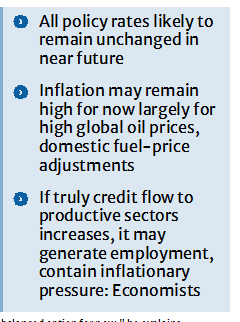
The existing monetary policy stance (MPS) may continue another six months, the Bangladesh Bank (BB) officials have hinted, adding that all policy rates are likely to remain unchanged in the near future.
"We still prefer to keep the policy rate unchanged, but it will be finalised in the next Monetary Policy Committee (MPC) meeting," a senior BB official told the FE in response to a query.
Inflation is expected to remain too high to cut rates, while growth is too weak to raise them further, says the central banker.
"So keeping rates unchanged is the most balanced option for now," he explains.
The BB's latest move comes against the backdrop of higher inflationary pressure that has hampered the country's overall economic growth for last few years.
Inflation, as measured by the consumer price index (CPI), rose to 9.04 per cent in April 2026 from 8.71 per cent of the previous month on the point-to-point basis, according to Bangladesh Bureau of Statistics (BBS)'s latest data.
However, overall inflation eased slightly to 8.59 per cent on a 12-month average during the period under review, down from 8.60 per cent a month earlier, the BBS data showed.
The central banker also predicts that inflationary pressures may intensify in the near term, largely driven by persistently high global oil prices and domestic fuel-price adjustments.
On the other hand, the central bank will focus on job creation in its upcoming monetary policy by boosting credit flow, which is also expected to support economic growth in the near future, another central banker told the FE, as it's a new government priority.
He also says the central bank will prioritise productive sectors through its policy support to enhance credit facilities.
"We may revisit our policy actions, particularly refinancing schemes, to help increase credit flow into the private sector," the central banker said in response to a query.
The central bank's observations come against the backdrop of lower private-sector credit growth in recent months, indicating weakening business confidence and tighter lending conditions.
Bangladesh's private-sector credit growth fell to a historic low of 4.72 per cent in March from 6.03 per cent in the previous month, reflecting slowing investment and rising economic uncertainty.
It was 3.78-percentage points lower than the central bank target of 8.50 per cent for the second half of the current fiscal year (FY) 2025-26.
As part of the preparations, an internal preparatory meeting on the upcoming monetary policy statement (MPS) was held at the central bank headquarters in the capital on Wednesday with Governor Md. Mostaqur Rahman in the chair.
All directors and officials above that station of the BB headquarters were eligible to attend the initial MPS-preparatory meeting, according to officials.
At the meeting, Mahmud Salahuddin Naser, an executive director of the BB, gave a presentation on the country's latest macroeconomic situation, focusing on inflation, interest rate, exchange rate and liquidity position.
The central bank will organise a stakeholder consultation at its headquarters on June 4 on the same grounds.
On June 06, another stakeholder-consultation meeting will be held at its Bogura office, according to an official announcement.
All opinions will be pleased at the next meeting of the MPC, which is scheduled to be held at the BB headquarters on June 21.
On June 25, a draft of the MPS will be submitted at the BB board meeting for final approval.
The next monetary policy is scheduled to be announced on June 30 through a press conference.
Talking to the FE, Dr Mustafa K Mujeri, executive director of the Institute for Inclusive Finance and Development (InM), suggests taking a coordinated approach by taking into consideration fiscal, monetary, marketing, supply-chain management and exchange-rate policies to curb the inflationary pressure on the economy.
Mr. Mujeri, also a former chief economist of the central bank, also says that it is not possible to contain the inflation through the MPS alone.
"If the central bank truly can boost credit flow to the productive sectors, then it may generate employments and contain the inflationary pressure on the economy," the senior economist notes.
Echoing Dr Mujeri's views, Md. Ezazul Islam, Director-General of Bangladesh Institute of Bank Management (BIBM), says it is a good decision by the central bank to enhance credit flow to productive sectors, which would help generate employment.
"The policy rate, generally known as the repo rate, should be kept unchanged as inflationary pressure in the country has remained stubbornly high for a long time," Dr. Islam, also a former executive director of Bangladesh Bank, told the FE.
siddique.islam@gmail.com
© 2026 - All Rights with The Financial Express

