Ramping up the tax incidence on high-net-worth individuals (HNWI) is under government strategy to narrow widening income inequality in Bangladesh as the Gini index is getting imbalanced.
Medium and Long-term Revenue Strategy (MLTRS) for the financial year 2025-26 to FY2034-35, published by the National Board of Revenue (NBR) in June 2025, indicates such taxing paradigm shift.
"Revisit of tax rates for the HNWI to ensure a higher tax incidence, effective management of their complex financial affairs, introduction of a system to monitor and enforce compliance are also in the pipeline under the strategic framework," it is stated in the strategy about ways of establishing tax justice.
The strategy, developed by a dedicated core group of NBR officials, primarily aims to enhance revenue collection and improve the tax-to-GDP ratio in the country.
Currently, individual taxpayers having annual income above Tk 3.8 million (Tk 38.50 lac) are subject to payment of 30-percent tax.
Also, well-off taxpayers have to pay a surcharge, ranging 10 to 35 per cent, on the basis of their wealth accumulation if it exceeds the ceiling at Tk 40 million.
Chartered Accountant Snehasish Barua says currently an HNWI individual with significant assets is required to pay Tk 4.05 for every additional Tk 100 earned.
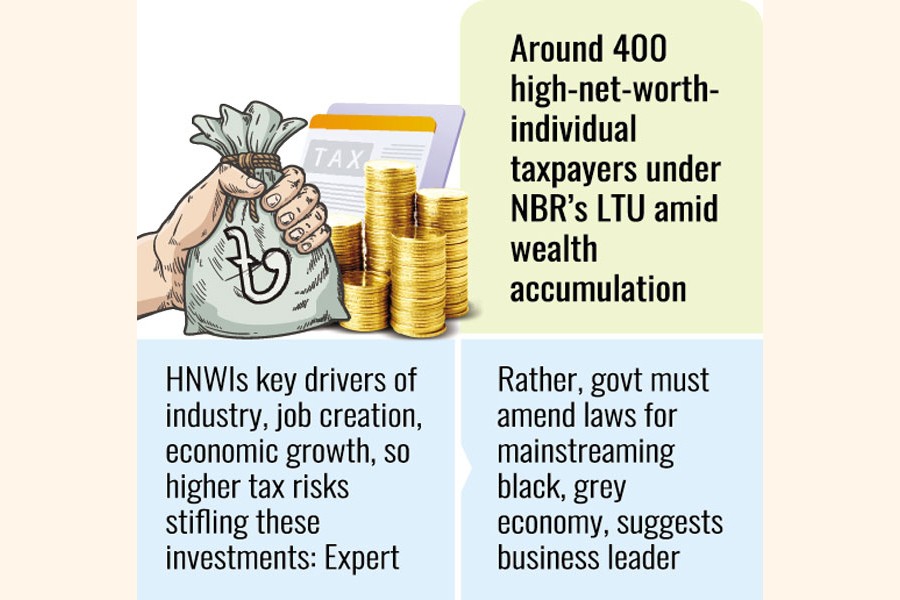
HNWIs are key drivers of industry, job creation, and economic growth, he says, and imposing higher taxes risks stifling these investments.
"We should therefore focus on assessing the current high-rate brackets and finding alternatives to the wealth surcharge instead of simply raising rates," he told The Financial Express.
Ikhtiarudduddin Mamun, commissioner of Large Taxpayers Unit (LTU), says the number of HNWIs is around in 23,000 in Bangladesh who have bank deposits of around Tk 400 million each as per Bangladesh Bank (BB) data.
He, however, says there are no compiled data of HNWI taxpayers and the volume of their paid taxes in the NBR, but all of those bank depositors are under tax net.
Under the LTU, there are around 400 HNWI taxpayers who are mainly sponsor directors and shareholders of large companies.
"If all of those 23,000 HNWIs pay proper taxes at the existing rates, then share of individual taxpayers' contribution could have been 80 per cent of total direct tax payment," he told the FE writer.
Mr Mamun, however, differs with the MLTRS framework to increase the tax rates for HNWIs, rather suggests plugging concealments by those well-offs.
The NBR may not have to chase small taxpayers to increase tax collection if well-offs pay proper taxes, he says on the question of tax justice.
"Currently, many individual taxpayers are bound to pay taxes despite having income below tax-able threshold," he adds.
The progressive taxation rules to ensure equity and fair judgment compromised if HNWIs evade tax, he remarks.
Abul Kasem Khan, Chairperson of Business Initiative Leading Development (BUILD), likens it to concept of 60-70s to increase tax rate for wealthy people that may raise the tendency to conceal actual income.
"HNWI may be forced to pay tax at higher rate but could not sustain for longer period," says Mr Kasem, who is former president of Dhaka Chamber of Commerce and Industry (DCCI).
Rather, the government must amend the laws to bring black and grey economy under formal channel, he suggests.
In the first half of the FY2025, the number of bank accounts with deposits exceeding Tk10 million rose by 5,255 despite a stagnant business environment, according to Bangladesh Bank data.
Recently, Finance Adviser Salehuddin Ahmed said the number of bank accounts having at least Tk 10 million is increasing as the undisclosed money stored inside houses for a long time, now being deposited with banks.
According to Bangladesh Bureau of Statistics, the number of bank accounts with at least Tk 10 million in 1972 was only five, while it was 47 in 1975 followed by 98 in 1980.
The Gini index is measured on a scale of 0 to 100, where 0 represents perfect equality and 100 signifies perfect inequality. Bangladesh's income inequality, which includes earnings, remittances, and returns on assets, worsened, with the Gini coefficient rising from 51 to 54 points, states the WB report on November 26, 2025.
The Gini coefficient increased from 33.1 to 34.5 in urban areas, while it decreased from 29.2 to 28.2 in rural areas.
doulotakter11@gmail.com
© 2026 - All Rights with The Financial Express

