The European Union has made it clear that ensuring human rights and fair election would be crucial for continuation of its Everything But Arms (EBA) facilities in Bangladesh, the largest beneficiary of the preferential trading arrangement.
The unilateral arrangement is conditional on respect of human rights, including labour rights, it told Bangladesh at the 10th Joint Commission meeting held in Brussels on Friday, officials said here on Saturday.
The EU also stressed that sustained reforms of labour rights standards by Bangladesh, and their full alignment with the International Labour Organisation (ILO) conventions are crucial in this regard, according to a joint communique issued on Saturday.
In this context, the EU welcomed the finalisation and publication of Bangladesh´s National Action Plan on the Labour Sector and stressed the need for its comprehensive implementation as per the stipulated timelines, for regular updates periodically on its implementation and for trying to advance the timelines of revising the labour law applicable in export-processing zones.
The EU said a vibrant civil society is an important component of democracy, but raised concerns over human rights in Bangladesh, particularly regarding reports of alleged violation of human rights, and emphasised the need to ensure accountability of such violations.
The EU also raised concerns over the issues of civic space and freedom of expression offline and online, notably in the framework of the Digital Security Act (DSA), noting the importance of legislation and its implementation in this area not to go beyond the stated purpose of fighting digital crime and to be in line with the international human rights obligations.
The meeting reviewed political developments on both sides and discussed the situation of democracy, the rule of law and good governance, including the importance of holding free and fair elections.
The EU welcomed the openness of Bangladesh regarding an international election observation mission for the next general elections.
It emphasised that promoting and protecting human rights of all, regardless of ethnicity, age, gender identity, sexual orientation, religious or political affiliation, disability or socio-economic background is crucial for stability, economic growth and development.
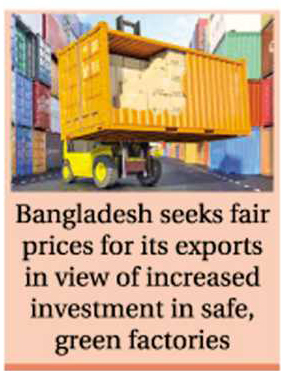
In the meeting, Bangladesh reiterated the need for ensuring fair prices for its exports, especially in view of the investment being made in the safer and greener factories.
In view of Bangladesh's graduation from least developed country (LDC) status, both EU and Bangladesh agreed on the importance of establishing a predictable and sustainable business climate that will make it easier for trade and investment, removing market access barriers and promoting a sustainable diversification of its economy.
The EU stands ready to provide increased cooperation in view of Bangladesh's next Universal Periodic Review in 2023.
The Bangladesh side stated that the government is committed to guarantee human rights of all as enshrined in its constitution.
It also mentioned that the government has a 'zero tolerance policy' on terrorism and violent extremism, and highlighted the remarkable success of the security apparatus in this regard.
The discussions focused on the EU's Multiannual Indicative Programme (2021-2027), valued at €306 million for the period of 2021-2024, three priority areas of Human Capital Development, Green Inclusive Development and Inclusive Governance, which will be implemented in a Team Europe approach, with joint European initiatives in the areas of decent work and green recovery.
The EU also underlined its interest to leverage investment with European partners and the private sector under Global Gateway through the European Fund for Sustainable Development plus (EFSD+) to maximise impact in line with Bangladesh's ambitions, notably in renewable energy.
The joint commission discussed the progress on joint commitments in the context of the EU-Bangladesh Standard Operating Procedures for the Identification and Return of Persons without Authorization to Stay.
The EU appreciated Bangladesh's efforts to implement the Standard Operating Procedures and encouraged Bangladesh to achieve further concrete results on the return of Bangladeshi nationals not entitled to stay in the EU.
The EU also informed Bangladesh of its inclusion in the recently adopted "Skills and Talent Package" and the upcoming launching of Talent Partnerships with specific partner countries.
Furthermore, the EU and Bangladesh discussed the political and security situation in the region, including maritime security, as well as counterterrorism and cooperation within the UN fora.
The meeting was co-chaired by Ms Paola Pampaloni, Deputy Managing Director of the External Action Service of the European Union, and Ms Fatima Yasmin, Secretary of the Economic Relations Division of Bangladesh.
The EU reiterated its appreciation for the continued generous role and action of the people and government of Bangladesh for temporarily hosting more than a million Forcibly Displaced Myanmar Nationals (FDMNs) / Rohingya for more than four years.
mirmostafiz@yahoo.com
© 2026 - All Rights with The Financial Express

