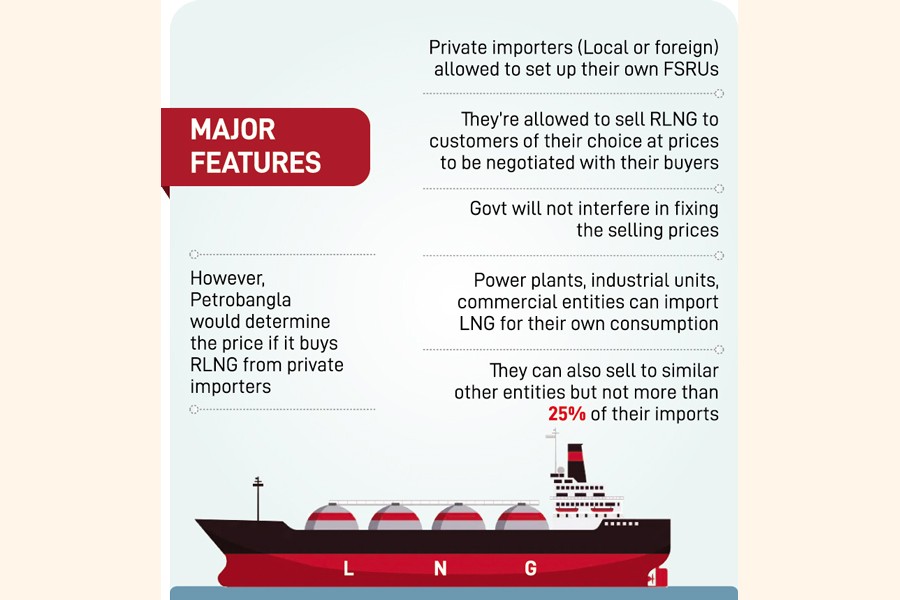
The private sector is now free to import re-gasified LNG (RLNG) through pipeline besides LNG under an amended policy, sources say, as the government importer looks hard up amid dollar dearth.
Private parties concerned will have the liberty to sell re-gasified LNG at the prices negotiated with their buyers under the amended LNG-import policy adopted by the government Wednesday.
Under "The LNG or RLNG Infrastructure Installation, Import and Supply Policy 2019 (amended 2023)', private parties, local or foreign, are free to import both LNG and RLNG, re-gasify LNG by building floating storage and re-gasification unit (FSRU) and sell the re-gasified liquefied natural gas to consumers of their choice.
Private sector was allowed only to import LNG, re-gasify it in their FSRUs and sell the re-gasified fuel to clients under the previous policy adopted four years back in 2019.
But not a single private entrepreneur came up to import LNG, build FSRU and sell the fuel under their liberty, a senior official of the Energy and Mineral Resources Division (EMRD) under the Ministry of Power, Energy and Mineral Resources (MPEMR) told the FE Thursday.
The government will not interfere in fixing the selling prices of the re-gasified LNG imported by the private parties, the policy spells out.
The private-sector LNG or RLNG importers would also be allowed to use the imported LNG or re-gasified LNG in their own power plants and industrial units and for other commercial purposes.
They would also have the liberty to supply the re-gasified LNG to others' power plants, industrial units and commercial entities.
The private importers will, however, be allowed to sell the 'surplus' re-gasified LNG, not exceeding 25 per cent of their total imported volume, to the state-run Petrobangla that markets petroleum products locally, the policy states.
But the price of the re-gasified LNG to be sold to Petrobangla should be determined by it, the policy notes.
To facilitate smooth import of LNG and supply of re-gasified LNG to consumers, the private sector will have to build international-standard jetties or platforms, storage tanks, re-gasification plants and pipeline networks.
The importers can also use the natural-gas pipeline or distribution network of the Petrobangla to supply their re-gasified LNG to the end-users with its prior permission and on payment of wheeling charge.
Any potential private party must have the experience of constructing or maintaining heavy industries in power and energy sector.
In case of any consortium, the third party must have a minimum of five years' experience in construction or maintaining any LNG project.
The LNG or RLNG importers must provide necessary documents about the potential buyers and the required volume of LNG before obtaining the import permission.
To continue import, the private sector will have to obtain no-objection certificates (NOCs) from the government department concerned every year.
Energy experts are yet in doubt whether any private-sector entrepreneur will still be interested to import RLNG taking the risk of marketing on their own.
"It is not clear in the policy who will lay down pipeline to import RLNG from abroad," Prof M Tamim told the FE.
There are also operational challenges to import and market this expensive fuel, says Mr Tamim, who was chief assistant of former caretaker government.
Sources have said the government has amended the LNG-import policy to allure private sector to import this expensive fuel as the state-run corporation, Petrobangla, has been struggling to clear outstanding overdue payments to LNG suppliers - both spot and term - and international oil companies (IOCs) due to US dollar crunch.
Petrobangla for the first time moved to borrow around US$500 million from the International Islamic Trade Finance Corporation (ITFC) at high interest to cover huge LNG-import bills amid forex crunch, sources say.
It has already initiated negotiation with the ITFC, a member of the Islamic Development Bank (IsDB) Group, to pay the way for uninterrupted LNG imports from the international market at least for the next six months.
If approved, it will be first-ever borrowing from the ITFC by the state-owned Oil, Gas and Mineral Corporation, nicknamed Petrobagla.
It previously spent around Tk 20 billion from Gas Development Fund (GDF) to import the liquid gas, which, analysts say, is in great demand because of limited natural gas exploration and output in Bangladesh.
The GDF was initially created to provide funding assistance for hydrocarbon exploration -- in potential onshore fields and almost virgin turfs in the Bay of Bengal.
Officials say the LNG suppliers and the IOCs have long been pressing for clearing back payments, with forewarnings of supply cease.
As the re-payment went worse, France's TotalEnergies and Gunvor Singapore issued notices to Petrobangla earlier in July to clear about US$113 million in outstanding payments for spot LNG cargoes or else forfeit monetary guarantees with the state bank.
The largest gas-producing company in Bangladesh, US's Chevron, also urged Petrobangla to clear all its dues, amounting to around US$280.72 million, by August 31, 2023, through a letter issued a couple of weeks back
Payments to the US oil major for gas purchases couldn't be cleared for over a year, from April 2022 to May 2023, amid dollar crunch, with the prospect of supply disruption from its largest producer, according to sources.
"The warnings prompted the state agency to ask the Ministry of Power, Energy and Mineral Resources to intervene and ensure that the state banks disburse dollars to avoid overdue interest on the outstanding amounts," said one official.
Navigate the crisis and settle the dues up to September 2023, Petrobangla Chairman Zanendra Nath Sarker, however, earlier had sought financial assistance worth Tk 71.81 billion from the MPEMR.
The state energy corporation also wrote to the Bangladesh Bank governor for support in clearing invoices against LNG purchases by way of providing US dollars to the commercial banks concerned.
Sources hope the mounting payment pressure on Petrobangla would ease if private sector starts importing LNG or RLNG for domestic consumption.
Bangladesh "has never defaulted on paying LNG-import bills since the initiation of LNG import in 2018 and gas bills to IOCs, including Chevron".
Global economic turmoil caused by the ongoing war between Russia and Ukraine, which has led to swelled prices for various commodities, including oils and grains, is the main cause of the country's eroding repayment capacity, says one official
Sources said until several months ago, the payment crisis had not affected Petrobangla's LNG import as it started to ramp up spot procurement in 2023.
In a bid to ensure uninterrupted gas supply to industries and power plants, the government issued an executive order raising domestic gas prices by up to 178.88 per cent, effective February 2023.
Bangladesh has been facing an acute dollar crisis since the beginning of the Russia-Ukraine war in February 2022. The country's foreign-currency reserves dropped to around US$ 23.57 billion following calculation in line with the International Monetary Fund (IMF) matrix mid-July from a record US$ 48.6 billion in August 2021.
Azizjst@yahoo.com
© 2026 - All Rights with The Financial Express

