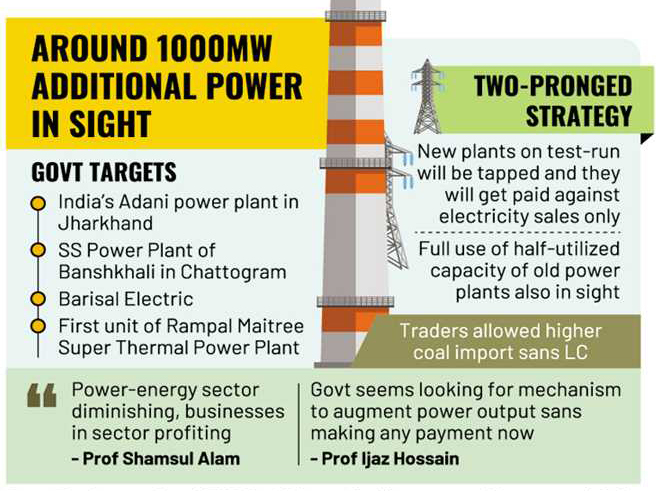
Incapacitated energy sector now plans to ease irritable load- shedding across Bangladesh by augmenting electricity generation from several piloting coal-fired power plants where the government has no payment liability yet, said sources.
Apart from cashing in on these newly built plants which are just in operation on a test-run basis, the government looks to make full use of half-utilized capacity of a number of old power plants.
The government does not owe any financial liability to the piloting power plants as they have yet to initiate electricity generation on commercial basis, they said.
The new coal-fired plants include India’s Adani power plant in Jharkhand, dedicated to cross-border supply, SS Power Plant of Banshkhali in Chattogram and Barisal Electric.
These facilities will be eligible to get paid by the government against electricity sales only after their official commissioning, which commences after successful test run, a senior official at the state-run Bangladesh Power Development Board (BPDB) told the FE Thursday.
The Power Division under the Ministry of Power, Energy and Mineral Resources (MPEMR) is expecting an additional 1,000 megawatts of electricity from these power plants shortly, riding on which it hopes to ease the countrywide nagging electricity crisis in high summer, said the sources.
The contingency course of remedies, designed after the sector stood on the horns of a dilemma created by payment default to power producers and fuel suppliers, extends further. It also has decided to increase electricity generation from the 617MW Maitree coal-fired power plant, which is a joint venture between Bangladesh and India.
This much-talked-about power plant has been running at around half the capacity of its first unit, generating around 320 MWs of electricity, due to coal crisis stemming from dollar crunch.
Since the commissioning of the first 660MW unit of the 1,320MW Maitree Super Thermal Power Project at Rampal in Bagerhat in September 2022, the plant has been in dollar crisis, which forced the plant into a grinding halt in operation at least in a couple of occasions, according official data available with the BPDB.
As per the latest plan, the power board will purchase more electricity from India’s Adani power plant in Jharkhand, which is now operational under test run supplying around 748MW electricity from the first of its two 800-megawatt units.
“Bangladesh has a power-purchase deal with Adani Power and now intends to purchase electricity as high as around 1050 megawatts during the current crisis period,” said a senior Power Division official, preferring anonymity.
The government also intends to get electricity as much as 320 MWs from a newly built coal-fired power plant — SS Power — in Chattogram.
The SS Power plant is currently in operation under test run, supplying around 200 megawatts of electricity.
And the government also mulls on buyout of electricity to be produced at full capacity at Barisal Electric’s 307MW plant.
Although commercial operation date (COD) of these power plants has not yet been fixed, the government is trying to mitigate the current electricity crisis riding on them, said the BPDB official.
The latest move from the government to ramp up electricity generation from the new coal-fired power plants came at a time when most of the already-commissioned power plants have either squeezed or shut operations due to energy crisis that resulted from US dollar crunch amid declining foreign- currency reserves and valuation of the local currency.
During peak-hour generation at around 12 noon Thursday, Bangladesh could pull in around 6,447 megawatts of electricity from gas-fired power plants against the overall capacity of such plants being double at around 11,500 MWs, according to official data of state-run Power Grid Corporation of Bangladesh (PGCB).
From the coal-fired plants around 1,919 MWs came against their aggregate generation capacity of around 3,400 megawatts.
Only around 3,052MW electricity was generated from the oil-fired power plants against their overall generation capacity of around 7,600 megawatts, according to the PGCB data.
“It is like the changing of shop to purchase essentials on credit after failing to pay the initial ones,” says energy adviser of the Consumers Association of Bangladesh (CAB) Prof M Shamsul Alam about the government move to make do with whatever around hand.
“This is not a permanent solution,” he said, adding that the government “must have to arrange funds to purchase primary fuels and continue electricity generation.”
He deplores that such situation has surfaced following unabated raising of costs and expenses in energy sector due to absence of ‘good governance’.
“Development without ensuring energy security does not make sense,” said Mr Alam.
It is unfortunate to see that the country’s power and energy sector is diminishing, while the businesses of this sector are profiting, he bemoaned.
“It seems that the government is looking for the mechanism to ramp up electricity generation without making any payment now,” said energy specialist professor Ijaz Hossain on the latest government move.
Sources have said the government’s overdue payments to energy-providers and power-plant owners, both local and foreign, have ballooned over US$2.76 billion.
If the late payment of interest is taken into account, the overall overdue payments would be higher until the past month, they said.
Of the payment arrears, the backlog to privately owned independent power producers (IPPs) amounted the highest — to the tune of around Tk 180 billion (US$ 1.70 billion) — until March, which is equivalent to six months’ dues.
The Bangladesh Petroleum Corporation (BPC) owes around US$300 million to different refined-oil suppliers, as of May 16.
The overdue payments to US oil-major Chevron and Singapore’s KrisEnergy against gas purchase from their share in the output in Bangladesh’s gas-fields mounted to around US$220 million.
Delayed payments to global LNG suppliers - both long-term and spot sellers - against purchases of the expensive fuel rose to around US$205 million.
Payment backlog to the currently shut Pyra 1244MW power plant and 1320mw Rampal Power Plant amounted to around US$ 345 million.
Meanwhile, the government has decided to raise the existing coal-import ceiling sans LC for commercial purposes on a case-to-case basis for facilitating power generation to remedy high-summer outages.
Private commercial entities will be allowed to import coal valued up to US$ 5.0 million annually without opening of LCs, on prior approval, against the existing ceiling of $0.5 million, senior trade officials said.
The decision was made at meeting on the Import Policy Order 2021-24 with the stakeholders concerned with senior secretary Tapan Kanti Ghosh in the chair last Thursday.
When contacted, Mr Ghosh said, "We have discussed at the meeting that commercial companies will be allowed to import coal on a case-to-case basis.
Azizjst@yahoo.com
rezamumu@gmail.com
© 2026 - All Rights with The Financial Express

