India has agreed to sell surplus fuels to Bangladesh to help it stabilise domestic energy prices under package deals nodded to during just-held summit talks between the two next-door neighbours.
Joint statement issued Wednesday unveiled a long list of desires and accords consented to at the bilateral meeting held in Delhi between the two countries, led by the two prime ministers.
Prime Minister Sheikh Hasina and her Indian counterpart, Narendra Modi, led their respective sides at the wide-ranging talks that followed a one-on-one parley between the two heads of government.
At the meeting Bangladesh requested India to assist in meeting its domestic requirement of petroleum products, and in response, Delhi agreed to facilitate discussions between the authorized agencies of both sides.
Hasina and Modi reviewed the progress made on the India-Bangladesh Friendship Pipeline that will contribute to addressing energy demand of Bangladesh.
In this connection, the Indian side appreciated Bangladesh's timely support in allowing transportation of petroleum, oil and lubricants from Assam into Tripura via Bangladesh in the midst of disruptions due to devastating floods in Assam and Meghalaya in the landlocked eastern India.
The Indian side also welcomed the decision of the Bangladesh side to enlist Indian Oil Corporation Ltd (IOCL) as a registered G2G supplier of refined petroleum products to Bangladesh.
In the meeting both the countries placed a plethora of proposals most of which met with ayes.
The two prime ministers held discussions on the entire gamut of bilateral cooperation, including political and security cooperation, defence, border management, trade and connectivity, water resources, power and energy, development cooperation, cultural and people-to-people contacts.
The two leaders underscored the importance of implementing bilateral and sub-regional rail, road, and other connectivity initiatives.
Both sides welcomed the ongoing bilateral initiatives, such as conversion to dual-gauge of Tongi-Akhaura line, supply of railway rolling stock, capacity building for the personnel of Bangladesh Railway, sharing IT solutions for improved services of Bangladesh Railway etc.
Both sides also welcomed the new initiatives, namely, Kaunia-Lalmonirhat-Mogalghat-New Gitaldaha link, establishing a link between Hili and Birampur, upgradation of track and signaling systems and rail-stations along the Benapole-Jashore line, link restoration between Burimari and Changrabandha, construction of a container depot in Sirajganj etc.
And both sides agreed to explore the funding of these projects through a range of financial instruments under the bilateral development cooperation.
The two leaders appreciated the growth in bilateral trade, with India emerging as the largest export destination for Bangladesh in Asia, according to the joint communique.
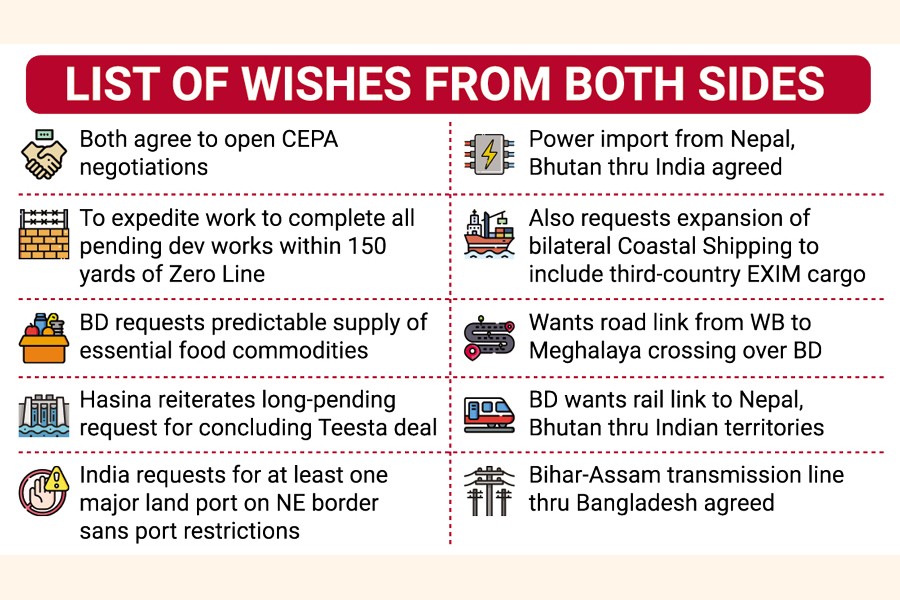
In response to Bangladesh's request for predictable supply of essential food commodities from India, such as rice, wheat, sugar, onions, ginger and garlic, the Indian side said the request "will be favourably considered based on prevalent supply conditions in India, and all efforts will be made in this regard".
Recognizing that peaceful management of the Bangladesh-India border is a shared priority, the two leaders directed the officials to expedite work to complete all pending developmental works within 150 yards of the Zero Line, including fencing starting with the Tripura sector, with the objective of maintaining a tranquil and crime-free frontier.
Noting with satisfaction that the number of deaths due to incidents along the border has been significantly reduced, the two sides agreed to work towards "bringing the number down to zero", the statement stated.
Both leaders reaffirmed their strong commitment to eliminating terrorism in all its forms and manifestations and decided to further "strengthen their cooperation to counter and prevent the spread of terrorism, violent extremism and radicalisation in the region and beyond".
India requested early signing of an interim water-sharing agreement on Feni River, taking into account the urgent irrigation requirements of the State of Tripura. The Bangladesh side took note of the Indian request.
Both the leaders welcomed the formation of Joint Technical Committee to conduct a study for optimum utilization of water received by Bangladesh under provisions of the Ganges Water Sharing Treaty 1996.
Recalling earlier discussions, Prime Minister Sheikh Hasina reiterated Bangladesh's long-pending request for concluding the interim agreement on the sharing of the waters of the Teesta River, the draft of which was finalized in 2011.
In the spirit of enhancing sub-regional cooperation, the two leaders agreed to expeditiously implement projects to connect the two countries' power grids synchronously, including through the proposed high- capacity 765KV transmission line from Katihar (Bihar) to Bornagar (Assam) through Parbatipur in Bangladesh, to be made through a suitably-structured India-Bangladesh Joint Venture for a Special Purpose Vehicle.
Bangladesh requested for import of power from Nepal and Bhutan through India and the Indian side informed that the guidelines for the same are already in place in India.
The two leaders welcomed the successful completion of trial runs under the Agreement on the use of Chattogram and Mongla Ports (ACMP) and looked forward to its full operationalisation at the earliest.
Indian reiterated its request for working towards the expansion of the bilateral Coastal Shipping Agreement 2015 to include third-country EXIM cargo.
Also, an agreement was reached to expeditiously explore direct shipping links between the two countries.
They also agreed to implement the decision to start riverine services under the Protocol on Inland Water Transit and Trade (PIWTT) routes 5 & 6 (Dhulian to Rajshahi -extension to Aricha) and 9 & 10 (Daudkandi to Sonamura).
The Indian side requested the Bangladesh side for cooperation in initiating new sub-regional connectivity projects including a highway from Hili in West Bengal to Mahendraganj in Meghalaya through Bangladesh, and in this regard, proposed preparation of a Detailed Project Report.
In the same spirit, Bangladesh reiterated its eagerness to partner in the ongoing initiative on India-Myanmar-Thailand trilateral highway project.
The Indian side informed that it had offered free transit via its territory to Bangladesh for exporting its products to third countries through specified Land Customs Stations/Airports/Seaports.
In this regard, the Indian side invited Bangladesh business community for using its port infrastructure for transshipment to third countries.
India has also been providing free transit to Bangladesh for exporting its products to Nepal and Bhutan, it is mentioned.
The Bangladesh side also requested rail connectivity with Bhutan through the newly inaugurated Chilahati-Haldibari route. The Indian side agreed to consider, based on its viability and feasibility.
To make this and other cross-border rail links viable, the Indian side requested removing port restrictions, inter alia at the Chilahati - Haldibari crossing.
They directed trade officials on both sides to start negotiations on the proposed Economic Partnership Agreement (CEPA) within the calendar year 2022 and to complete these at the earliest, in time for Bangladesh's final graduation from LDC status.
The Indian side reiterated its request for at least one major land port without port restrictions or negative list of restrictions, on the border with North Eastern States of India, for easier market access, starting with ICP Agartala-Akhaura.
Both agreed to enhance defence ties and the Indian side reiterated its request for implementing the 2019 MoU for providing a coastal radar system for greater maritime security at an early date.
On the nagging Rohingya issue, India underlined its continuing commitment to supporting both Bangladesh and Myanmar, as the only country that is neighbour of both, in the effort to ensure "safe, sustainable, and expeditious return" of these forcibly displaced people to their homeland.
mirmostafiz@yahoo.com
© 2026 - All Rights with The Financial Express

