MIR MOSTAFIZUR RAHAMAN, FROM SOUTH BLOCK, DELHI | October 07, 2025 00:00:00
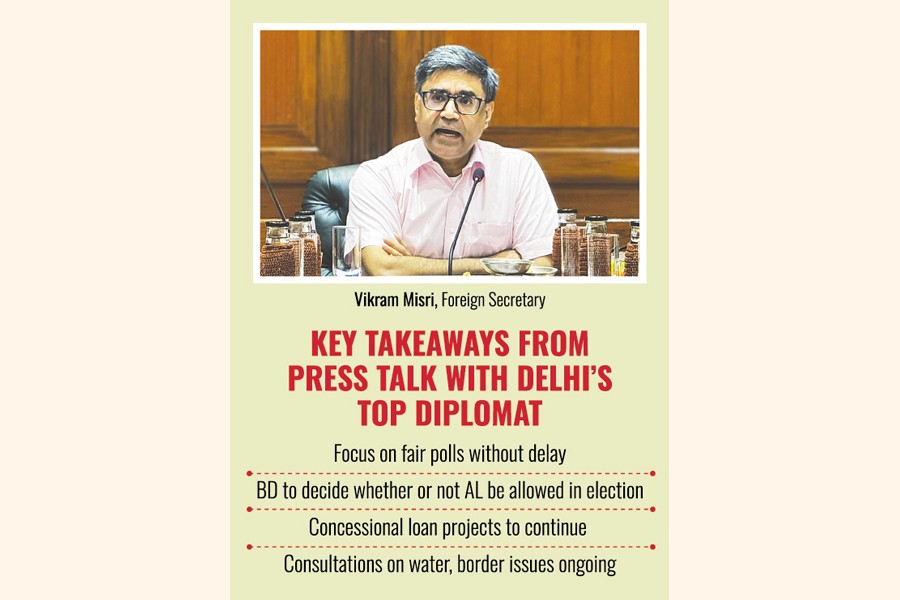
India is ready to engage with any government that emerges from Bangladesh's forthcoming elections as their policy remains "people-centric, pragmatic and non-partisan", says a spokesperson in an update on Delhi's stance on bilateral ties in post-uprising period.
The remarks come from India's Foreign Secretary, Vikram Misri, while speaking to a visiting delegation of the Diplomatic Correspondents Association of Bangladesh (DCAB) at the South Block in New Delhi on Monday.
Misri says India wants to see a "free, fair, inclusive and participatory election" in Bangladesh, held "without delay".
"We will engage with whichever government the people of Bangladesh choose to represent them," Misri makes clear India's position on the cusp of transition taking place after last year's uprising in Bangladesh that toppled the Sheikh Hasina government of Awami League.
"India is firmly in favour of elections being held at the earliest possible time and conducted in a credible and transparent manner."
Asked about Dhaka's statement that relations could suffer if India continues to host former prime minister Sheikh Hasina, Misri said the matter was being handled through legal and diplomatic channels.
"This is a judicial and legal process that requires engagement and consultations between the two governments," he told the diplomatic correspondents from Dhaka on Delhi trip.
"We are examining the issue carefully and will work with Bangladesh authorities on it. Beyond that, it would not be constructive to comment further."
He declines to be drawn into political interpretations, maintaining that India does not play favourites in Bangladesh's domestic politics.
"We have engaged with every government in Bangladesh, including the current interim one," he says on this score. "We should set aside the perception that India prefers one side over another."
Asked about the perception of a quarter that inclusion of the Awami League is needed in Bangladesh's upcoming elections for fairness, Misri makes a point: legitimacy -- both internal and external -- depends on their fairness. "It's for the people of Bangladesh to decide how these elections are structured and conducted."
The top diplomat, again, underscores: "Free, fair, inclusive and participatory elections lend legitimacy to democratic processes."
Responding to questions on recurring incidents along the border, Misri describes the issue as "emotive but complex," stressing the need for pragmatic solutions rather than blaming.
"These incidents take place after illegal crossings into Indian territory by smugglers, human traffickers and other criminals," he reiterates India's view of the border incidents that include shootings. "When they engage in armed attacks on our border guards, the BSF responds in self-defence. The key is to prevent illegal crossings in the first place."
He says India is ready to cooperate on fencing the remaining 700-800 kilometres of unfenced border and calls for improved communications channels to handle cases of detained nationals and missing persons.
On cross-border "push-ins" and "push-backs," the Indian foreign secretary acknowledges that such incidents occur on both sides, but says bureaucratic inefficiencies have also contributed. "We have around 2,400 pending cases of nationality re-verification. It's important that these processes move faster," he notes.
The foreign secretary reiterates that all water-sharing issues are being addressed through the Joint Rivers Commission, which met recently. "The Ganges Water Treaty remains valid, and we will continue discussions under the treaty's framework," he told the reporters, adding that India remained ready to revisit proposals on the Teesta issue with the next government in Dhaka.
Misri has called for a forward-looking economic agenda between the two next-door neighbours. "Our commercial partnership is mutually beneficial. Bangladesh is one of our largest partners in concessional finance, and we are the largest importer of Bangladeshi goods in Asia."
He notes that Bangladesh's graduation from the least- developed country (LDC) status in 2026 presents "an opportunity to build a fair, modern and equal trade relationship."
"We should not allow transient issues to undermine the significant economic progress achieved over the years," he says. "We should look beyond leadership and focus on a future-oriented, people-first partnership."
He highlights sectors like technology, startups, energy, and healthcare as new areas for collaboration, alongside continued cooperation in large-scale infrastructure and development projects.
Misri admits that India's visa services in Bangladesh had been temporarily affected during the unrest in July and August 2024, when several security incidents targeted Indian facilities. "We had to readjust our footprint due to the security situation," he explains, adding that visa operations are now recovering as stability returned.
"As conditions improve on the ground, we are scaling up our services again," he says. "Our intention is to continue people-centered engagement."
He adds: India would continue working with the interim government in Dhaka and any future administration formed through the people's mandate.
"Even though this interim setup is unprecedented in Bangladesh's constitutional framework, we have not stopped engaging," Misri mentions. "We have continued dialogue at all levels because our relationship is larger than politics."
The top Delhi diplomat underscores that India's ties with Bangladesh are rooted in shared "cultural, linguistic, religious, and historical bonds" that transcend political changes.
"This relationship is over five decades old and time-tested... "It will continue to prevail independent of what political or geostrategic texture may come about in the region."
The foreign secretary has stressed that India's approach towards Bangladesh remained pragmatic throughout the recent political transition in Dhaka. He cites Prime Minister Narendra Modi's early congratulatory message to Chief Adviser Professor Muhammad Yunus after he assumed leadership of Bangladesh's interim government.
Misri recalls his own visit to Dhaka earlier this year, calling it a "useful opportunity to clarify many issues and strengthen communication."
He says working-level meetings between the two sides have continued uninterrupted, covering issues from trade and border management to river sharing and development cooperation.
Concluding his remarks, the foreign secretary urges both sides to "shed old templates" and seek "practical, forward-looking solutions."
"We in India have a vital stake in peace, stability and development in Bangladesh," he says. "It is in our mutual interest to build a relationship that is modern, equal, and driven by the aspirations of our peoples rather than the politics of the moment."
mirmostafiz@yahoo.com
© 2026 - All Rights with The Financial Express

