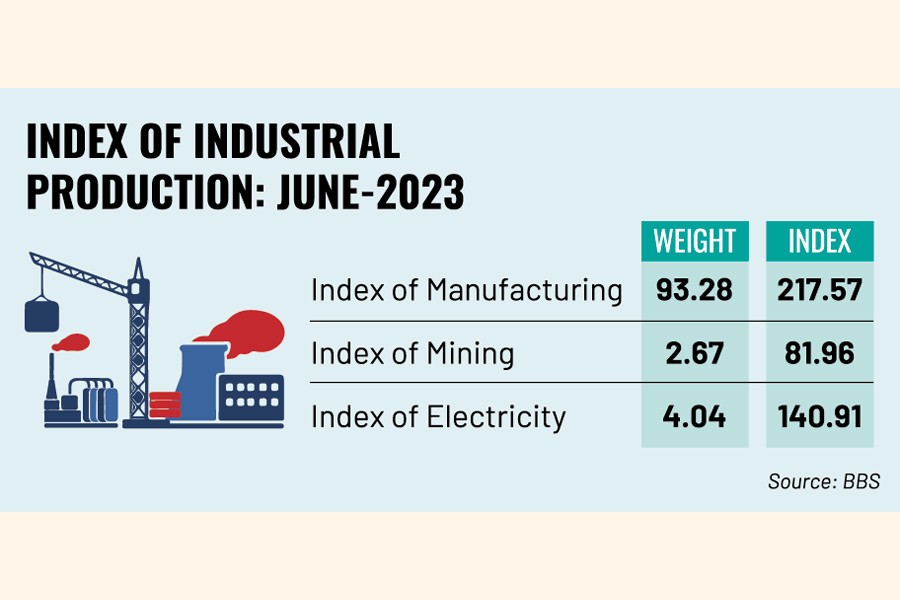
Major production sector in Bangladesh slips in rebound from a global upset as the country's industrial-output index showed the deepest drop at the end of past fiscal year, with food, clothing, paper, and printing shrinking.
Half of the large-scale manufacturing (LSM) industrial sectors in Bangladesh marked decline in June on a year-on-year (y-o-y) basis, according to data prepared by the Bangladesh Bureau of Statistics (BBS) in IMF-prescribed new methodology.
The government agency prepares the data under the IMF's system of national accounting (SNA) meant for use in the measurement of the GDP. It prepares the data for 22 large-scale industries of Bangladesh which have around 11-percent contribution to the gross domestic product or GDP.
In June, 11 large-scale industry- output indexes dropped deeply over the same month a year earlier, the BBS data showed.
Even the LSM had better in May as the 13-sector group swung to growth that period over its corresponding period.
Economists have raised concerns about an economic slowdown caused by record inflation and import restrictions which they believe are key reasons behind such performance in production.
Commenting on the latest figures, former lead economist at the World Bank Dhaka office Dr Zahid Hussain says, "The inflation and import restriction on raw materials are two major reasons behind it."
He also includes the tightening of monetary policy as well as administrative measures to curtail imports among the drags. These measures coupled with challenges of inflation, and energy shortfalls have resulted in the contraction of the LSM output.
"It is important to ease the severe dollar liquidity crunch by increasing inflows and maintain a realistic exchange rate so that manufacturing is not disincentivised," the economist says about what deems as a way of breakthrough.
The main contributors to the YoY decline were the manufacturing of food products which had a 16.6-percent index drop, RMG (5.0 per cent), paper and paper products printing and reproduction of recorded media (dropped by nearly 16 per cent), manufacture of chemicals and chemical products (13.3 per cent), pharmaceutical products and pharmaceutical preparations (5.3 per cent), computer, electronic, and optical products that dropped 16.3 per cent and electrical equipment, having 6.2-percent contraction.
On the other hand, the beverages sector showed a steep climb by 150 per cent, textiles rose 18 per cent, the manufacture of other non-metallic mineral products rose nearly 35 per cent and the manufacture of basic metals by 19.7 per cent, according to the BBS data.
On the hefty growth of the beverage sector, Dr M. Masrur Reaz, chairman of the Policy Exchange of Bangladesh, says this is due to choking climate-change effects.
"We have now the longer period of hot weather, leading to large sales of the soft drinks in the local market," he told the FE.
Import restrictions have contributed to the poor output-index performances. Inflation has eroded the purchasing power of many which trimmed the demand for goods, Dr. Masrur said.
Syed Nazrul Islam, first vice- president of BGMEA and managing director of Well Designers, told this correspondent that the overall orders from garment buyers remained poor since May last.
This poor demand is because of the long persisting of inflation in the Western economies, he says about the country's main export-earning industry.
Anwar-Ul Alam Chowdhury Pervez, a former president of the BGMEA or Bangladesh Garment Manufactures and Exporters Association, says: "Actually there were inflated figures of exports-now the central bank asks us about the lower inflow of export proceeds."
He said the Bangladesh Bank asked them why US$3.0 billion worth of export proceeds did not come in the country. "Actually there were inflated figures of exports, and simply for this reason, this mismatch of export receipts," he clarifies their position on the claimed non-repatriation of full export earnings.
He says buy orders on an average are 30-percent less than the expectation.
jasimharoon@yahoo.com
© 2026 - All Rights with The Financial Express

