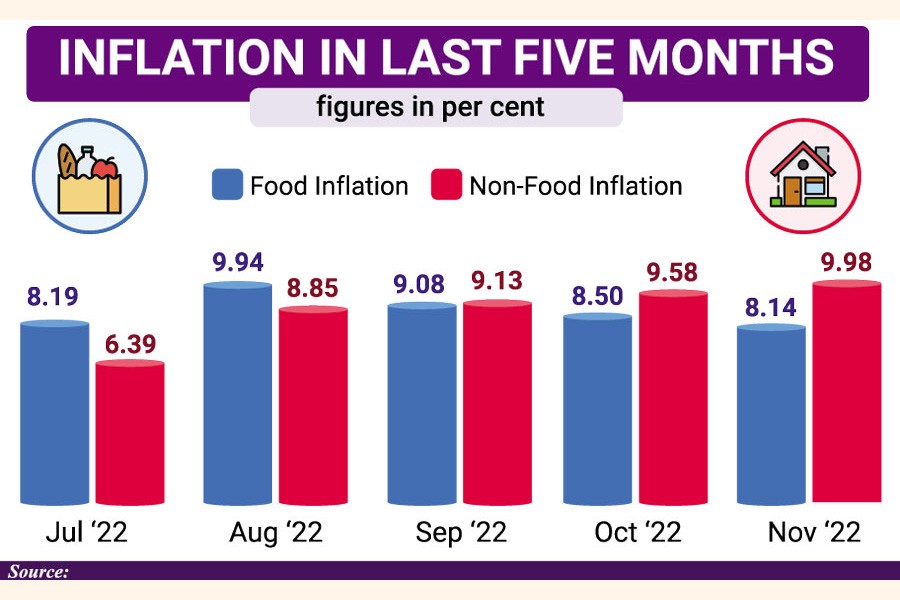
Bangladesh sees inflation ease somewhat with food harvests, alongside a global respite for fall in prices of consumer goods, although non-food essential commodities here stay steeply high-priced.
Bangladesh Bureau of Statistics (BBS) revealed the inflation Monday for the past month of November -- when new food and vegetable harvests began arriving on the market and global consumer indices showing signs of easing.
However, the segment of non-food inflation remained unrelenting in the month, touching almost double-digit mark, as prices of particularly industrial commodities stayed jacked-up.
On point-to-point basis, the inflation rate in November decreased by 0.06 percentage points to 8.85 per cent from 8.91 per cent in October.
In November last year (2021), the rate of inflation was recorded at 5.98 per cent, 2.87-percentage-point lower than this November.
The latest BBS data show that the inflation rate on the point-to-point basis surged by 0.40 percentage points to 9.98 per cent in the last month compared to the rate of the previous month of October. Inflation on account of food fell by 0.36 percentage points to 8.14 per cent in November compared to 8.50 per cent in October.
Planning Minister MA Mannan in a briefing Monday at his office said it is good news that the inflationary trend is showing decreasing trend month on month, which is expected fall further in the coming months.
"Since prices of vegetables, rice and some other items have decreased on the retail market, the inflation rate in November got reduced to some extent," he said in reply to a question.
"Government's prudent macroeconomic policy and sale of some essential products at subsidised prices to the vulnerable group have brought a good result in reducing the consumer-price index (CPI)," the minister added.
The BBS showed that the inflation rate on food items had dropped as the prices of broiler chickens, eggs, palm oil, vegetables, spices and fruits fell in November compared to that in the October.
On the other hand, the prices of dresses and gold had increased in November, resulting in a higher inflationary trend in non-food items, the BBS says in its evaluation report.
Asked about government measures to tame the inflation on account of non-foods, the planning minister said the government is not only taking steps to reduce the inflation in food items, it is also working to cool the non-food inflation.
World Bank's former lead economist Dr Zahid Hussain told the FE that the overall inflation rate should be much lower than recorded in November this year as this is the full season of vegetables and Aman rice.
"The food-inflation growth should have been a much negative one in November compared to the previous month's (October) amid the full vegetable and Aman rice season. But we are not noticing that in the BBS data. It means the food inflation has not fallen to the expected level," he says.
"On the other hand, the government's fiscal measures have failed to contain the non-food inflation. It means the present fiscal policy is not working well. In addition, if the price of power is increased further, it will fuel the non-food inflation rate onto double digit," Dr Hussain observes.
According to the BBS, the consumer-price index (CPI) was maintaining higher trend in the rural areas compared to the urban areas in November, too.
The rate of inflation on point-to-point basis in the villages was recorded at 8.94 per cent in November compared to 8.92 per cent in the previous month of October.
In the rural areas, the non-food inflation had crossed double-digit level to 10.31 per cent in the last month compared to 9.98 per cent in the previous month.
The food inflation in the rural areas dropped to 8.23 per cent in November from 8.38 per cent in October last, the BBS data show.
The statistical bureau shows that the overall inflation rate in the urban areas declined by 0.20 per cent to 8.70 per cent last month from 8.90 per cent in the previous month of October.
In the towns the food inflation dropped significantly by 0.80 percentage points to 7.95 per cent in November from 8.75 per cent in the previous month.
The non-food inflation rose to 9.54 per cent in the last month from 9.07 per cent in October, according to the BBS data.
Meanwhile, the BBS has shown that the wages in November increased a bit as the Wage Rate Index (WRI) got a lift.
The WRI in November was recorded at 6.98 per cent compared to 6.91 per cent in the previous month.
Meanwhile, latest reports say inflation is western countries are easing with a downturn in prices of consumer goods on the back of less volatility on the international market of food and fuel. Economic activity also takes in some momentum with China easing its 'Zero-Covid' stance and lifting restrictions in the wake of reported protests.
kabirhumayan10@gmail.com
© 2026 - All Rights with The Financial Express

