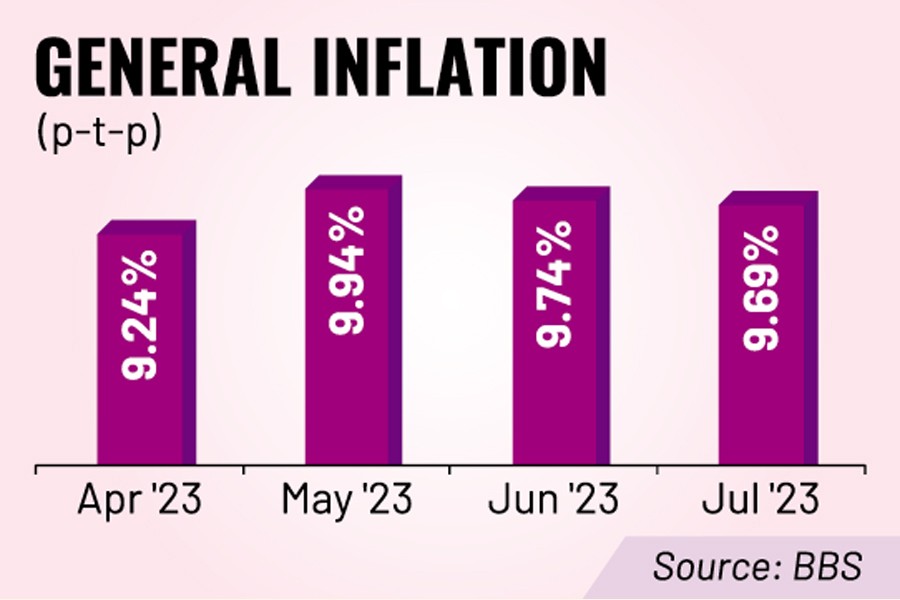
Headline inflation stays steep in Bangladesh for high consumer prices as July CPI remained almost unchanged at 9.69 per cent by official count, eluding a feel-good situation yet.
Economists feel that the nagging consumer-price inflation gives no letup in the country, despite global market's mild turnaround, because of some mismatches in domestic monetary and fiscal policies.
The latest rate of inflation surpassed the annual target by nearly 4.0 percentage points.
Analysts think the inflation remained high amidst tight monetary policy pursued since July by the central bank.
In June last, inflation was also the same at 9.7 per cent, Bangladesh Bureau of Statistics (BBS) data show.
As per its measure the monthly moving average (12-month average) also remained high at 9.2 per cent.
Food-account component of the inflation at national level stood at 9.8 per cent in July while non-food or core inflation was 9.5 per cent.
And rural inflation remained slightly higher than the urban rate. The rural general inflation was recorded at 9.8 per cent while the urban unchanged at 9.4 per cent.
The economists note that anxiety over high inflationary pressure on the economy -- and related fears -- heralds the new fiscal year with a signal of on immediate respite.
"The anxiety will remain as there is no policy to contain it," says Dr Ahsan H. Mansur, executive director of the Policy Research Institute of Bangladesh or PRI.
He mentions that the interest on lending has increased by 1.0 percentage point while the global scenario is much higher, even a 4-5percent spike in the interest. "The global inflation has been cooling."
The Bangladesh Bank has been pursuing a new rate called SMART based on the short-term treasury bills which actually helped raise the interest by a 1.0-percentage point on the financial market.
They spot higher indirect taxation as one of the key reasons behind the high inflation in Bangladesh.
"To my mind, the main reason is higher indirect tax which contributes to the higher inflation," says Dr Zahid Hussain, a former lead economist of the World Bank.
He points out that the budget deficit and other fiscal measures also contributed to the higher inflation as they are just inverse measures or "pro-measure" to counter the inflation.
On government borrowing from the central bank, Dr Hussain said: "There is a huge impact of issuing high-powered money on the economy as it fuels inflation up."
The government borrowed from the central bank instead of commercial banks. "The Bangladesh Bank actually provided high-powered money to the government and it will have gradual and short-to medium-term impact on the economy."
However, the BBS has modernised the CPI compilation from April 2023 to a greater extent by changing the base index from 2005-06 to 2021-22, introducing a new basket of goods and services with weights.
This is basically a paradigm shift in CPI compilation in Bangladesh following the latest 2020 CPI manual of the IMF.
National, urban, and rural CPIs have been constructed as per the 2021-22=100 base index instead of 2005-06=100. It has been constructed twelve groups according to the Classification of Individual Consumption by Purpose (COICOP) instead of the ILOs eight groups.
The new basket contains a total of 383 items (goods and services) with 749 varieties. There are 127 food items with 242 varieties and 256 non-food items with 507 varieties.
Currently, the CPI data are collected from 154 markets (Urban, Rural, and City Corporation areas) instead of 140 markets from 64 districts.
The statistical bureau followed Laspeyer's formula for CPI compilation.
jasimharoon@yahoo.com
© 2026 - All Rights with The Financial Express

