A prognosis comes from the regulator that the prevailing high inflation may intensify further following fuel-price rises, which indicates pricey commodities could be pricier.
"….near-term inflationary pressures are expected to intensify due to higher global oil prices, domestic fuel-price adjustments, and ongoing energy-supply constraints," the Bangladesh Bank (BB) says in its latest report on Inflation Dynamics in Bangladesh January-March 2026.
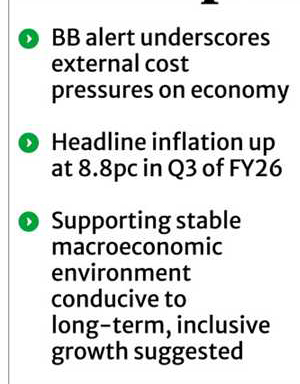
The central bank's latest observation comes just nine days after the government raised domestic fuel prices in response to continued increases in global petroleum- product prices, underscoring mounting external cost pressures on the economy.
Officials and economists, however, says these cost-push factors are likely to transmit through higher transportation and production costs, potentially broadening price pressures across the supply chain and complicating efforts to anchor inflation expectations.
Bangladesh's headline consumer price index (CPI) inflation (y-o-y) continued to rise, averaging approximately at 8.8 per cent in the third quarter (Q3) of the current fiscal year (FY) 2025-26, up from 8.3 per cent observed in the previous quarter, according to the quarterly report released Tuesday.
"Fuel-price adjustments may trigger a one-off spike in inflation, which would then ease gradually over time," Md. Ezazul Islam, Director-General of Bangladesh Institute of Bank Management (BIBM), says while explaining to The Financial Express (FE) the potential economic impact of the latest fuel-price hike.
"Fuel-price adjustments have a multiplier effect on the economy, as fuel is a key input across all sectors," explains Dr. Islam, also a former executive director of the central bank.
Talking to the FE, a BB senior official has said transport costs have already risen following the latest fuel-price adjustments, which may further add fuel to inflationary pressures on the economy. Energy inflation rose to 14.9 per cent in the third quarter of FY'26 from 14.4 per cent in the previous quarter.
On the other hand, food inflation edged up during the period under review, primarily driven by an increased contribution from vegetables and spices. However, protein-based foods remained the top contributor.
The central bank in its report says the increased contribution of protein-based food items, along with 'clothing and footwear', can be partly attributed to seasonal demand associated with Eid-ul-Fitr, which typically leads to higher consumer spending on food and apparel.
The average contributions of import-concentrated food items and domestic food items to headline inflation increased in the Q3 of FY'26 from the previous quarter.
On the other hand, the contribution of import-concentrated non-food items to inflation declined, according to the report.
Meanwhile, the wage-price gap narrowed slightly by the end of Q3 of FY'26 compared to the previous quarter, driven by a fall in headline inflation (y-o-y) to 8.7 per cent in March 2026, while wage growth remained stable at 8.1 per cent. This led to a modest deterioration in household purchasing power, reflecting sluggish real wage growth.
"Given these developments, sustained policy vigilance is essential to anchor inflation expectations, contain elevated food and core prices, and safeguard household purchasing power, thereby supporting a stable macroeconomic environment conducive to long-term, inclusive growth," the central bank notes in its report.
siddique.islam@gmail.com
© 2026 - All Rights with The Financial Express

