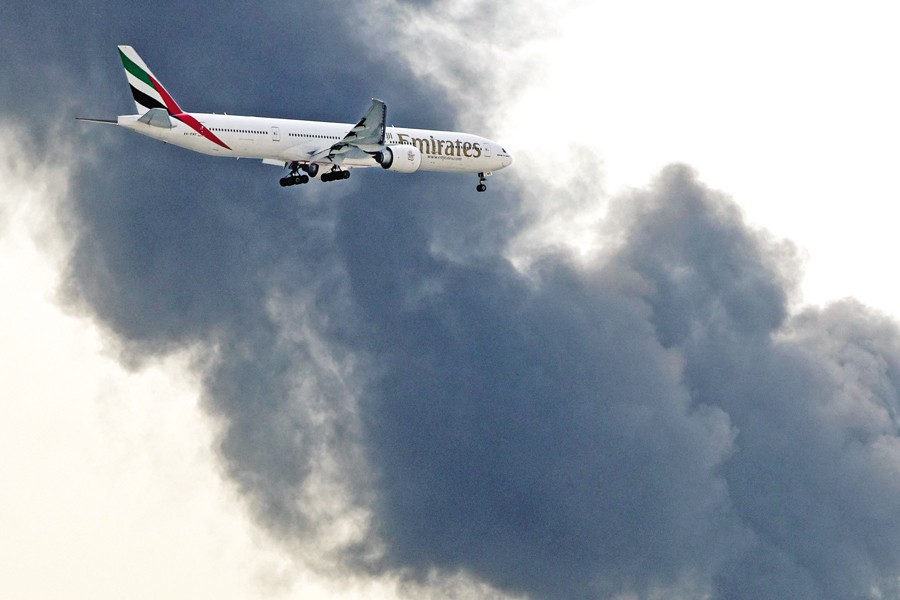
 An Emirates Airbus A350 aircraft prepares for landing as a smoke plume rises from an ongoing fire at Dubai International Airport in Dubai on Monday. — AFP
 Iran said it was ready to take the Middle East war "as far as necessary" as it launched strikes across the region on Monday, while US allies pushed back against Donald Trump's call for help to reopen a vital shipping lane.
 The US-Israeli war on Iran is now entering its third week with no clear end in sight, largely shutting the Strait of Hormuz, through which 20% of the world's oil and liquefied natural gas flow, pushing up energy prices and raising fears of a spike in global inflation, report agencies.
Israel said on Monday it had detailed plans for at least three more weeks of war as it pounded sites across Iran overnight, while Iranian drone attacks temporarily shut Dubai airport and hit a key oil facility in the United Arab Emirates.
US President Donald Trump on Sunday called for a coalition of nations to help reopen the strait and said the US-led NATO defence alliance faced a "very bad" future if its members failed to help.
But while allies voiced support for diplomatic efforts to reopen the route, they were cautious about joining any military action.
"By now they have... understood what kind of nation they are dealing with, one that does not hesitate to defend itself and is ready to continue the war wherever it may lead, and take it as far as necessary," Iranian Foreign Minister Abbas Araghchi told reporters in Tehran.
Israeli military spokesperson Lieutenant Colonel Nadav Shoshani told reporters there were detailed operational plans for the war with Iran for the next three weeks, and other plans extending further ahead.
Israel has said it wants to weaken Iran's capacity to threaten it, striking ballistic missile infrastructure, nuclear facilities and the security apparatus, and that it still has thousands of targets to hit.
Iranian Foreign Minister Abbas Araqchi for his part said Tehran had not asked for a ceasefire or exchanged messages with the U.S., according to Iran's semi-official Student News Network.
Meanwhile, fears of a global energy crisis persisted, even as a small number of ships passed through the Strait of Hormuz, a vital waterway through which a fifth of the world's oil is usually transported.
Iranian strikes on commercial ships in and around the strait, and even just the threat of those attacks, have slowed shipping there to a trickle. That has dramatically increased the price of oil and put pressure on Washington to do something to ease the pain for consumers and the global economy.
Brent crude, the international standard, remained over $100 a barrel on Monday. US President Donald Trump said he has demanded that about seven countries send warships to keep the Strait of Hormuz open, but his appeals have brought no commitments.
The Israeli military said on Monday it was carrying out air strikes on Tehran, Shiraz and Tabriz.
It said its Air Force had also struck sites linked to Iran's space program, including destroying a research facility in Tehran involved in developing a satellite launched in 2024.
In Israel, air raid sirens warned of Iranian missiles. Iran's Revolutionary Guards said Tehran had launched attacks on areas In Tel Aviv, the U.S. al-Dhafra air base in Abu Dhabi, the U.S. naval base in Bahrain, and Bahrain's Sheikh Issa air base.
Trump threatens to 'remember' which allies do not help
The virtual shutdown of the Strait of Hormuz is battering the world economy, driving up energy and fertilizer prices; threatening food shortages in poor countries; destabilizing fragile states; and complicating efforts by central banks to drive down prices for consumers.
Trump said Sunday he wants to police the strait to make it safe for shipping. Republicans are increasingly concerned that rising prices for American consumers will hurt them in elections this fall.
Trump did not identify the countries he said he asked to help with those efforts, but he said he won't forget the countries that decline. He has previously appealed to China, France, Japan, South Korea and Britain.
"Whether we get support or not, but I can say this, and I said to them: We will remember," Trump said.
Europeans have been critical of the US and Israel for failing to provide clarity on their objectives in the war. German Foreign Minister Johann Wadephul on Sunday questioned EU involvement, saying security for the strait can only come "if there is a negotiated solution."
Prime Minister Keir Starmer of Britain, which is not an EU member, told reporters that Britain and allies were working on a plan to reopen the strait. Starmer said Britain might deploy mine-hunting UK drones already in the region, but insisted it "will not be drawn into the wider war."
He signalled that the UK is unlikely to dispatch a warship.
Japan and Australia both said Monday that they had not been asked to help protect the strait and had no current plans to do so.
Iran hits Dubai airport
As morning broke Monday, a drone hit a fuel tank near Dubai International Airport, the world's busiest for international passenger traffic, causing a large fire.
Firefighters contained the blaze and there were no injuries reported, but the airport suspended all flights before resuming them a few hours later.
Later, a person was killed in the capital of the United Arab Emirates when an Iranian missile hit a vehicle, the Abu Dhabi media office said. Fire also broke out at an oil facility in Fujairah, one of the UAE's seven emirates, following a drone attack.
© 2026 - All Rights with The Financial Express

