Financial health of Shariah-based banks in Bangladesh deteriorated sharply in 2025, owing to their failure to maintain regulatory requirements in many operational areas.
The performance of Islamic banks deteriorated across their capital adequacy, asset quality, efficiency and liquidity while their growth indicators declined slightly and market share remained unchanged compared to 2024.
A sharp decline in the CRAR and leverage ratio led to a deterioration in capital adequacy in 2025. At the same time, asset quality and efficiency declined sharply due to increases in non-performing investments and negative assets returns among Islamic banks.
Such a sorry state of the Islamic banks came up in the Financial Stability Report 2025 of the Bangladesh 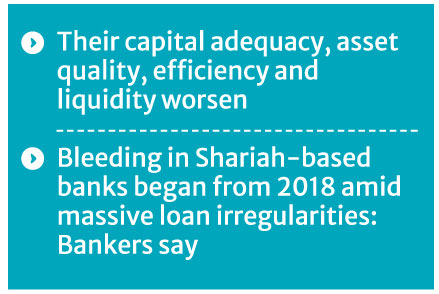 Bank (BB), the country's central bank,
The report stated that the asset quality of the Islamic banks operating in the country deteriorated at the end of December 2025.
Moreover, the Islamic banks could not meet the minimum capital requirements, the report said, adding the banks exhibited a lower investment income (profit)-to-total assets ratio and a negative return on assets (ROA) during the review period, driven by higher profit expenses. Additionally, this segment posted lower growth in total investments, deposits, assets, and shareholders' equity.
Among liquidity-related indicators, the investment-deposit ratio (IDR) and the liquidity coverage ratio (LCR) of the Islamic banks worsened further and remained non-compliant at end-December 2025.
Moreover, the Islamic banking sector did not meet the net stable funding ratio (NSFR) requirement at the period under review, according to the report.
The Islamic banks cluster in Bangladesh, along with conventional banks, continues to play a vital role in mobilising deposits and financing important sectors of the economy.
This Shariah-based banking system has attracted growing attention for its equity-based and (fixed) interest-free banking philosophy since its inception in 1983.
At the end of December last, a total of 10 full-fledged Islamic banks (including 5 banks under merger process) were operating in Bangladesh with their total 1,700 branches.
In addition, 41 Islamic banking branches of 17 conventional banks and 919 Islamic banking windows of 21 conventional banks provided Islamic banking services during the review period.
The share of Islamic banks in the overall banking system in terms of total investments, deposits, and assets stood at 26.01 percent, 19.17 per cent, and 20.83 per cent, respectively.
In terms of capital position, Islamic banks, as a whole, could not meet the minimum regulatory requirements for the capital-to-risk-weighted-assets ratio (CRAR), the capital conservation buffer (CCB), and the leverage ratio as of December 2025.
The CRAR and the leverage ratio fell significantly below zero at the end of December 2025 compared with 2024.
At the end of December last, the aggregate maintained CRAR of the Islamic banks dropped significantly to Tk 1,389.10 billion negative, whereas the regulatory total minimum capital requirement (MCR) was Tk 326.81 billion.
Only three out of 10 Islamic banks were able to maintain the minimum required common equity tier-1 (CET-1) capital, while only two banks managed to maintain minimum CCB requirements, said the report.
Compared with the conventional banking sector, Islamic banks' performance deteriorated in terms of the gross non-performing loans (investments) (GNPLs) and net non-performing loans (investments) (NNPLs) ratios.
At end-December 2025, the GNPLs and NNPLs ratios of Islamic banks deteriorated radically and reached 56.15 per cent and 29.18 per cent, respectively. Excluding five Islamic banks under resolution, the GNPLs and NNPLs ratio stood at 36.94 per cent and 29.61 per cent.
In 2025, the aggregate return on assets (ROA) of the Islamic banks turned negative, as a result of investment income falling short of expenses.
The aggregate ROA of Islamic banks decreased significantly to -23.90 percent in 2025, down from 0.12 per cent in 2024. At end-December 2025, 6 out of 10 Islamic banks earned a higher ROA than the average ROA of the Islamic banking industry. However, the ROA of 6 Islamic banks was negative during 2025.
Seeking anonymity, an experienced Islamic banker said the bleeding in the Shariah-based banks had started from 2018 due to massive scale of loan-related irregularities.
Until 2024, the managements of the banks like other conventional lenders were able to hide such bleeding through window dressing.
After the July-August mass-uprising in 2024, the central bank took various initiatives to squeeze the scopes of window dressing, which exposed the actual scenario of how deep the bleeding was.
And the merger process of five Islamic banks sent a wave of panic among the shariah clients, which worsened the situation further, he said.
Despite the fact, the experienced Islamic banker said, there are banks like Shahjalal Islamic Bank which keeps growing in all indicators.
Former managing director of Islami Bank Bangladesh Mohammad Abdul Mannan said Islamic banks have a glorious past, making vibrant contributions to the country's socioeconomic advancement.
But unfortunately, he said, this emerging segment of the banking operations was deliberately destroyed by a vested group under the state-sponsorship in the Awami League governing regime.
"Islami Banks do not weaken, they have been weakened," he said.
Mr. Mannan, who was also chairman of Fist Security Islami Bank, said the central bank who prepared the stability report cannot avoid its failure to protect the promising banks from manmade disaster.
jubairfe1980@gmail.com
© 2026 - All Rights with The Financial Express

