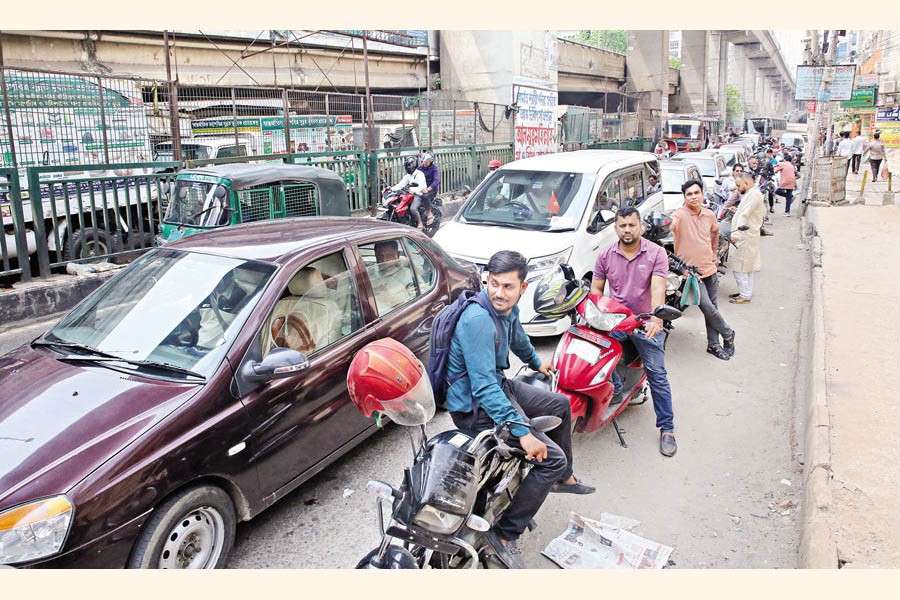
 Amid concern over fuel shortages, long queues of vehicles are still seen at filling stations across the capital. The photo was taken in the Malibagh area on Tuesday. — FE Photo
 Bangladesh's energy regulator ramped up prices of jet fuel for both domestic and international plane flights amid volatile global oil prices due to the Middle-East crisis.
Bangladesh Energy Regulatory Commission (BERC) raised the prices of jet fuel, also known as aviation fuel, for international flights by around 79 per cent to US$1.3216 per litre from US$ 0.7384, according to a press release issued Tuesday.
 For domestic flights, the price has been hiked by around 80 per cent to Tk 202.29 from the previous rate of Tk 112.41 per litre.
The commission stated that the adjustment was made in line with the global market prices and average Platts rates for the period between March 5 and March 22.
"The new rates will remain in effect until further notice," the commission notes.
Meanwhile, Minister for Power, Energy and Mineral Resources Iqbal Hassan Mahmood said on the day that there was sufficient stock of fuel oil in the country and ruled out any crisis of fuels.
Talking to reporters at his office at the secretariat he also said there was no decision to increase the price of other petroleum products right now.
Industry insiders, however, warn that such steep rise in the jet-fuel prices will directly impact airfares, especially on domestic routes, putting extra pressure on passengers.
Operating costs for airlines running international flights will also increase, according to them.
The Aviation Operators Association of Bangladesh (AOAB) has termed the hike 'unjustified' and also called for an urgent reconsideration.
The AOAB in a press release Tuesday argued that the rate hike did not match the current realities.
There is no fuel shortage, 25 oil tankers have recently arrived with oils at previously fixed prices, and global oil prices have been declining, the association claims.
AOAB Secretary-General Mofizur Rahman claimed that Bangladesh's increase in jet-fuel price is abnormally high compared to that of neighboring countries.
India and Nepal kept the prices unchanged, while Pakistan raised the rate by 24.49 per cent, and the Maldives by 18.54 per cent, the association maintains.
They warn that airlines could face severe financial strain, with domestic passengers bearing the brunt through higher fares.
"Rising taxes on jet fuel will further escalate costs, potentially forcing suspension of domestic routes and threatening the sustainability of the aviation sector," the association points out the domino effect of price rises.
The AOAB has urged the government to swiftly review the decision and adopt a more realistic pricing policy for the sake of stability and growth in Bangladesh's aviation industry.
Meanwhile, the ongoing tensions in the Middle East and logistical irregularities at key depots have disrupted Bangladesh's fuel-distribution network, leaving filling stations in the capital struggling to meet basic demand, says a firsthand report by SAJIBUR RAHMAN.
Pump owners report receiving less than 50 per cent to 60 per cent of their required stock from major hubs like Narayanganj, forcing many stations to adopt a "stop-and-go" operational model -- opening only when a tanker arrives and closing immediately once stocks are depleted.
Around 300 petrol pumps across the country are currently operating on a temporary-closure basis, according to industry insiders.
They said supply disruptions from depots, amid global market volatility stemming from the Middle-East conflict, may have slowed distribution temporarily.
However, no official announcement regarding a nationwide shortage was issued as of Tuesday afternoon.
Nazmul Haque, President of the Petrol Pump Owners and Dealers Association, says around 300 petrol pumps across the country are currently operating on a temporary-closure basis. "When they receive fuel, they operate. Once the stock runs out, they shut down temporarily," he explains.
Haque adds that fuel supply needs to be increased by 30 to 32 per cent to ease the ongoing crisis.
"At present, pumps are receiving only about 60 per cent of the fuel they require," he told the FE writer.
He urges that all filling stations, without exception, should be supplied continuously, warning that temporary closures create unnecessary panic among motorists.
Mizanur Rahman, Joint Convenor of a faction of Bangladesh Petrol Pump Owners Association, says petrol pumps across the country are receiving less than 50 per cent of the fuel they require, leading to a severe supply crisis.
Mizanur, who owns six filling stations in Bogura and Dhaka, mentions that majority of petrol pumps in Rajshahi Division are maintaining such on-again, off-again to make do with shortage supplies.
"Whenever we receive fuel, we start selling it. But once the stock runs out, we are forced to shut down again," he says.
The situation has triggered long queues across key points in Dhaka, leaving motorists waiting for hours amid growing uncertainty over fresh supplies.
A visit to several stations on Tuesday showed irregular deliveries from depots -- particularly in Narayanganj -- significantly reduced fuel availability, with pump owners receiving less than half of their required supply in many cases.
Industry representatives warn that unless distribution normalises soon, the crisis could deepen further across the country.
At the Trust Fuel Station on Bijoy Sarani, operations reportedly continued until around 9:00am before authorities announced that fuel stocks had run out.
Although customers were later informed that fresh supplies might arrive around 3:00pm, many remained uncertain whether they would receive fuel even after hours of waiting.
Ripon, a motorcyclist who arrived at the station at 6:00am after failing to get fuel in Mirpur, said he had already spent three hours in line before sales were halted.
"If we cannot get fuel after standing this long, how are we supposed to manage? We have work to do. If we leave, we'll have to start again from the back of the queue," he said.
Another rider, Rajib, questioned official claims that there was no shortage.
Monir Hossain, who came from the Gulshan-Badda area after failing to get fuel there on Monday, said he had waited since 7:00am.
"Yesterday morning fuel was available at one pump in Badda, but the line was too long. In the afternoon, it was closed. Today again, after pushing forward in the queue for hours, we are told fuel is finished. They say supply may come after 3:00pm. But there is no certainty," he said.
At Sikder Filling Station in Tejgaon, Rizvi, a motorcyclist, said he had been standing in line for over one and a half hours as of 3:51pm on Tuesday and expected to wait longer before getting his tank filled.
Asish, a Jeep driver working for an embassy, said he had waited nearly an hour at 3:48pm at the same filling station there.
Pump employees cited irregular supplies from depots as the primary reason for the disruption.
Mahfuz, an employee at Statta and Company Filling Station in Tejgaon, said no octane was sold Tuesday because the station did not receive supplies from the depot concerned.
"However, diesel is available as most trucks are yet to operate in the city," he said, adding that sales resumed only after receiving fuel from the Narayanganj depot.
Meanwhile, Shanto, an employee at Ideal Filling Station, said the station remained closed Tuesday for a lack of supply from the Narayanganj depot.
On the ground, long queues of motorcycles and private vehicles stretched from the Bijoy Sarani pump toward the Mohakhali-bound road. All entry gates to the station were closed, and no workers were visible inside at one point during the visit.
Similar scenes were observed at filling stations in Banglamotor and other parts of the capital.
Motorists said the uncertainty -- rather than just the shortage -- was compounding their suffering.
Many remained in line for hours without assurance that fuel would be available when their turn came.
Azizjst@yahoo.com
sajibur@gmail.com
© 2026 - All Rights with The Financial Express

