The judiciary of Bangladesh is set to enter a new phase of efficiency and institutional independence with the promulgation of the Supreme Court Secretariat Ordinance 2025, a long-awaited reform that grants full financial and administrative autonomy to the apex court.
The landmark Ordinance reshapes how the country's judicial system is managed and funded by empowering the Supreme Court Secretariat to prepare its own budget and authorising the chief justice to approve expenditures within the allocations passed by parliament.
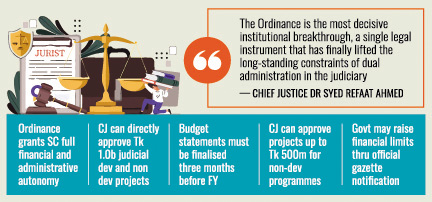
It also authorises the chief justice to directly approve up to Tk 1.0 billion for development and non-development projects for the judiciary, without prior permission from the executive committee of the national economic council (ECNEC) or the finance division.
According to Section 11(1), "The supreme court secretariat shall, for each financial year, prepare a statement of estimated income and expenditure for the courts, institutions, and departments under its jurisdiction, as well as a separate statement of estimated income and expenditure for the Supreme Court."
The statements must be prepared at least three months before the start of the fiscal year.
Under Section 11(3), the chief justice shall forward these statements to the Minister of Finance for presentation to parliament along with the government's annual financial statement.
Section 11(7) states that no prior government approval shall be required for expenditures made from funds allocated to the Supreme Court and the Supreme Court Secretariat under the national budget.
Before this Ordinance, the law ministry prepared the judiciary's budget, and the Supreme Court registry received only a consolidated amount for routine expenses -- often facing delays and bureaucratic hurdles that hindered the utilisation of allocated funds.
In FY 25, the Supreme Court registry received Tk 2.52 billion, and Tk 2.50 billion in FY 26, but could not fully utilise the allocations due to slow approval processes.
Mohammad Habibur Rahman Siddiquee, the first acting secretary of the newly established Supreme Court secretariat, welcomed the enhanced financial authority.
"Previously, approval had to be obtained step by step for every expenditure. In many cases, the allocated budget could not be utilised because approvals were delayed and funds had to be returned. Now that financial autonomy has been introduced, administrative work will accelerate significantly," he said.
Section 12(1) reiterates that "The chief justice shall be the final authority for approving expenditures from the funds allocated to the Supreme Court Secretariat in the budget."
Section 8(3) authorises the chief justice to approve any project recommended by the planning and development committee if its estimated cost is within Tk 500 million. Projects exceeding this limit must be sent directly to the planning minister for submission to ECNEC.
Similarly, under Section 8(7), for non-development programmes, the chief justice may approve schemes up to Tk 500 million, with higher-cost proposals requiring approval from the finance division.
Section 8(8) allows the government, in consultation with the Supreme Court, to increase these financial limits through gazette notification to adjust for inflation or other considerations.
Masdar Hossain, member of the Judiciary Reform Commission and former Senior District and Sessions Judge, told The Financial Express that true judicial independence is inseparable from financial autonomy.
However, he noted that imposing an expenditure ceiling on the chief justice is "not ideal", as caps may continue to create bureaucratic hurdles for large-scale projects.
In a recent programme, Chief Justice Dr Syed Refaat Ahmed described the Ordinance as "the most decisive institutional breakthrough", calling it "a single legal instrument that has finally lifted the long-standing constraints of dual administration in the judiciary".
"For the first time in our constitutional history, the supreme court now possesses full administrative and financial autonomy," he said at a seminar in Chattogram organised jointly by the Supreme Court of Bangladesh and the United Nations Development Programme (UNDP).
The Ministry of Law, Justice and Parliamentary Affairs issued the Supreme Court Secretariat Ordinance 2025 on November 30 pursuant to an order from the President.
Earlier, on November 20, the Advisory Council of the interim government gave final approval to the draft ordinance to establish a separate secretariat to ensure proper discharge of supervisory, controlling and disciplinary functions over subordinate courts, and to further strengthen judicial independence.
bikashju@gmail.com
© 2026 - All Rights with The Financial Express

