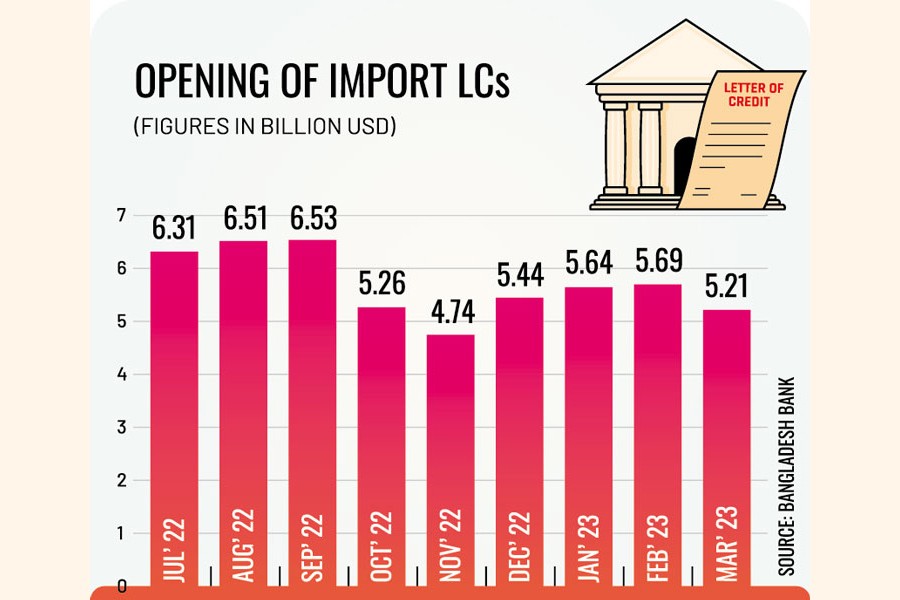
Opening of letter of credit (LC) for imports plummeted over 25 per cent during the last nine months to March as Bangladesh opted for tightening to ease pressures on its foreign-exchange reserves.
The drastic fall in import orders is apparently impacting many local manufacturers as the supply of raw materials, capital machinery and intermediate goods also dropped significantly during the period under review, official data show.
During the July-March period of the fiscal year 2022-2023, the total opening of LCs was recorded at US$51.37 billion, down by 25.38 per cent from the same period a year earlier when the LCs amounting to US$ 68.84 billion were opened.
The opening of LCs against intermediate goods dropped by 30.91 per cent during the nine months, capital machinery by 55.88 per cent, industrial raw materials by 31.16 per cent, consumer goods by 15.99 per cent, machinery for miscellaneous industry by 44.99 per cent and others by 18.74 per cent.
Only petroleum imports, whose market remained volatile since the beginning of war in Europe, rose 11.32 per cent, according to official statistics prepared by Bangladesh Bank (BB), the central bank of Bangladesh.
People familiar with such developments told The FE that the tight-fisting has been impacting many local manufacturing sectors, especially who depend on the imported raw materials.
President of Bangladesh Chamber of Industries (BCI) Anwar-Ul Alam Chowdhury Pervez said growing inflationary pressure normally impacts people’s purchasing capacity and it forced people to consume less.
If the consumption falls, the production also drops and industrialists do not feel comfort to expand their businesses or import raw materials for enhancing their productivity, he says about the chain of effects.
“This is what is happening now. Look at the trend of private-sector credit growth. It continues falling gradually. It means private-sector entrepreneurs are reluctant to take credits,” he said.
According to the BB, the private-sector-credit growth dropped to 12.14 per cent in February 2023. The credit growth was 14.07 per cent in August 2022. Since then, it has kept falling.
The BCI president suggested that the policymakers should allow struggling local industries to import raw materials so that they do not turn into sick industries.
Managing Director and Chief Executive Officer of Pubali Bank Limited Mohammad Ali said export is declining. So, the investment in capital machinery is also going down.
He says many industries used to stock huge volume of products in the past. But prevailing uncertainty in the global business order coupled with the ongoing tightness in the foreign currencies and lower demand prompted the entrepreneurs not to go for stocking more products.
“That’s probably the reason behind the falling capital-machinery import,” he adds.
When contacted, Chairman of Policy Exchange of Bangladesh Dr M. Masrur Reaz said it is very surprising that the fall in consumer goods is quite small despite various measures taken by the central bank to control import of various consumer goods.
“It is concerning. I think the BB should give special attention to this area in the coming days if it continues with its belt-tightening move,” he said.
The economist thinks the fall is a good sign for short term but if it continues further in the coming few months, it will have an adverse impact on the country’s economic output.
jubairfe1980@gmail.com
© 2026 - All Rights with The Financial Express

