A much-debated project distributing development works for Members of Parliament (MPs) during the deposed Awami League regime makes a comeback with cost and time escalations despite being earlier forsaken by the current interim government, sources say.
The Local Government Division (LGD) has proposed extending the tenure of the Universal Social Infrastructure Development (Phase-II) project by one year and increasing its cost by Tk 4.18 billion, instead of discarding it as decided earlier, they said Wednesday.
Originally launched to fulfill the demands of lawmakers from the Awami League government, the project earned widespread criticism for being "politically motivated".
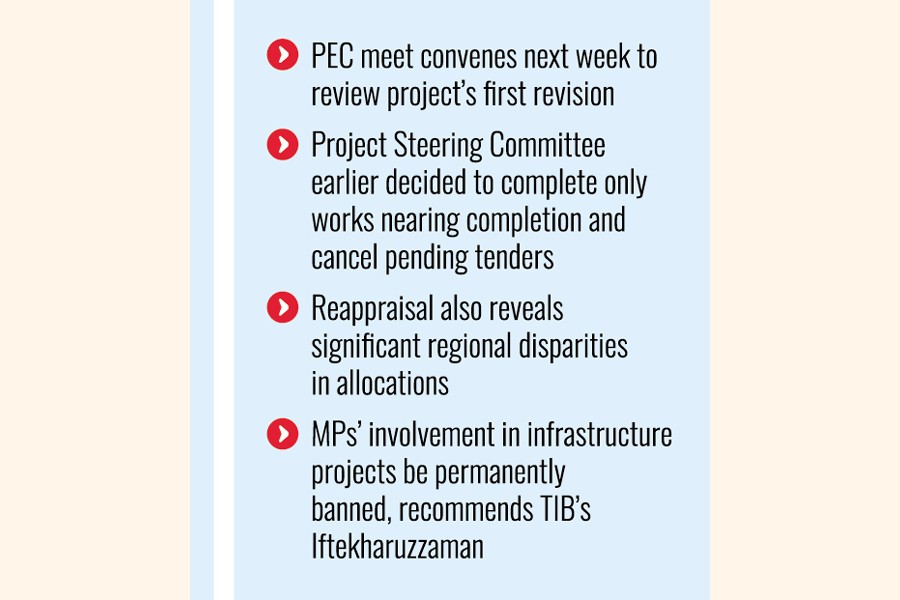
Planning Commission officials have confirmed that a Project Evaluation Committee (PEC) meeting has been scheduled for next week to review the first revision of the project, which now carries an estimated cost of Tk 15 billion, 38.64-percent higher than the initial estimate of Tk 10.82 billion.
The reappraisal of the project, proposed during the tenure of the government formed following the anti-inequality movement, reveals significant regional disparities in allocations.
Under the scheme, Chattogram district has been proposed to receive a total of Tk 515 million-around 4.0 per cent of the project's total infrastructure budget-while Meherpur district has been allocated only Tk 50 million.
The Planning Commission has urged equitable distribution to ensure balanced development across districts.
The project, approved in 2022, aimed to implement small-scale local development schemes-such as improvements to mosques, temples, graveyards, community centres, and other facilities- by the Local Government Engineering Department (LGED), based on MPs' recommendations, the proposal shows.
However, the approval was given without any feasibility study, overriding government rules that require such an assessment for projects exceeding Tk 500 million.
The Implementation Monitoring and Evaluation Division (IMED) earlier had flagged the lack of a feasibility study as a major weakness, noting that the project was "driven more by political influence than by verified development needs".
Following the establishment of the interim government, a Project Steering Committee (PSC) in the LGD decided to complete only works nearing completion and cancel pending tenders.
However, LGED has now proposed expansion of the project in terms of tenure and budget both. The project's tenure will be extended by one year, from June 2026 to June 2027.
The LGD cites inadequate allocations under the Annual Development Programme (ADP) and the introduction of new government allowances as reasons for the extension and budget revision.
Officials have said the revision aims to adjust expenditures across components, cancel or add certain work packages, and update cost structures in line with policy changes.
The IMED also observes that while the project received sufficient funding in its first year, allocations in FY2023-24 and FY2024-25 were inadequate, slowing both financial and physical progress.
The report highlights risks like political interference, social disputes, and natural disasters such as floods, cyclones, and earthquakes. It recommends that similar projects in the future be preceded by proper feasibility studies and adequate ADP funding.
To improve accountability and implementation, IMED suggests appointing an experienced project director for oversights and recommends redirecting any unspent funds toward additional community infrastructure that could enhance public safety and welfare.
Experts and economists have criticised the scheme, noting that MPs were responsible for selecting development projects, often favouring areas near their residences or awarding contracts to preferred contractors. Many projects were left incomplete or poorly executed, resulting in minimal public benefit.
Dr Iftekharuzzaman, Executive Director of Transparency International Bangladesh (TIB), says the government has long misused public funds by approving projects aimed primarily at benefitting Members of Parliament.
"These projects often serve MPs' personal or political interests, enabling their associates to profit, while providing little or no public benefit," he told The Financial Express.
He urges a thorough, independent audit before releasing additional funds and recommends that MPs' involvement in infrastructure projects be permanently banned. He makes it clear that lawmakers' primary responsibility is legislation, not project implementation.
"Although the project was scheduled for completion, additional funds been asked to meet local needs, prompting the proposal to increase the budget by 39 per cent," former project-director Nazmul Karim said to a question.
jahid.rn@gmail.com
© 2026 - All Rights with The Financial Express

