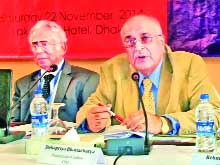
 CPD Distinguished Fellow Dr Debapriya Bhattacharya speaking at a dialogue at a city hotel Saturday. Prof Anwarul Hoda is also seen. — FE Photo
Little progress has been made in implementing the measures taken in WTO conferences, especially in Doha and Bali ministerial meets, for the benefit of Least Developed Countries (LDCs) and developing nations.
Speakers at a dialogue here Saturday on 'Recapturing the Momentum in the Post-Bali Process of the WTO' vented such frustration, as the stakeholders, including Bangladesh, have long been left in the lurch.
They deplored that none of the decisions, including preferential treatment and market access for LDCs, was yet fulfilled.
The LDCs, they said, are still unsure whether the recommendations of WTO's Bali round of conference on global trade regime will be adopted or not.
Such scepticism stems from the fact that the developed and developing countries have failed to reach a consensus on many of the issues.
Organised by private think-tank Centre for Policy Dialogue (CPD), the meet highlighted the urgency of immediate conclusion of the Doha Round and preparing for the post-Bali agenda focusing more on setting new rules to reap benefit from upcoming negotiations.
"Doha Development Round initiated much promise, but not much progress as yet," said CPD Executive Director Dr Mustafizur Rahman while presenting his paper on 'Whilst the LDC package in Bali was a progress, developments in the past one year in Geneva show that not much has happened that can be turned encouraging.
LDCs, speakers said, will need to take initiative to narrow down the differences within the poor-country club, especially regarding duty-free and quota-free (DFQF) market access.
They also have to undertake vigorous homework to identify their needs and build partnership with other LDCs to face post-Bali negotiations.
The CPD organized the dialogue in partnership with the Friedrich-Ebert-Stiftung (FES), Bangladesh Office. Held at a local hotel, the dialogue was addressed, among others, by
Professor Anwarul Hoda, Chair Professor, Trade Policy and WTO Research Programme, Indian Council for Research on International Economic Relations (ICRIER), Mr Richard O. Cunningham, Chairman, Cordell Hull Institute, Washington, D.C., and Professor Longyue Zhao, Director, China Center for International Development, Nankai University, China.
CPD Chairman Professor Rehman Sobhan presided while its Distinguished Fellow Dr Debapriya Bhattacharya moderated the dialogue participated by academics, researchers, and representatives from various government and development organisations.
At the ninth ministerial meet of the WTO in Bali in December last year, a consensus was reached on three important issues: trade facilitation, food security and LDC package.
The developed countries were supposed to adopt them in July this year, but they were yet to give final approval for differences of opinions, especially because of India's concern for its national food security.
Professor Anwarul Hoda, however, hinted that some progress had already been made between the USA and India very recently regarding WTO's Trade Facilitation Agreement TFA.
In this context, he expressed his optimism about the signing of the tangled agreement.
"I hope that the blockade created over signing TFA will disappear soon," he said.
For Bangladesh and Asian LDCs, the issue of DFQF market access is very important as their major export-apparels - are not covered under the US GSP scheme, opined some of the speakers.
mzrbd@yahoo.com
© 2026 - All Rights with The Financial Express

