Local wheat suppliers expressed concern about smooth supply of wheat flour following Russia's decision to axe the Black Sea Grain Initiative (BSGI) on Monday.
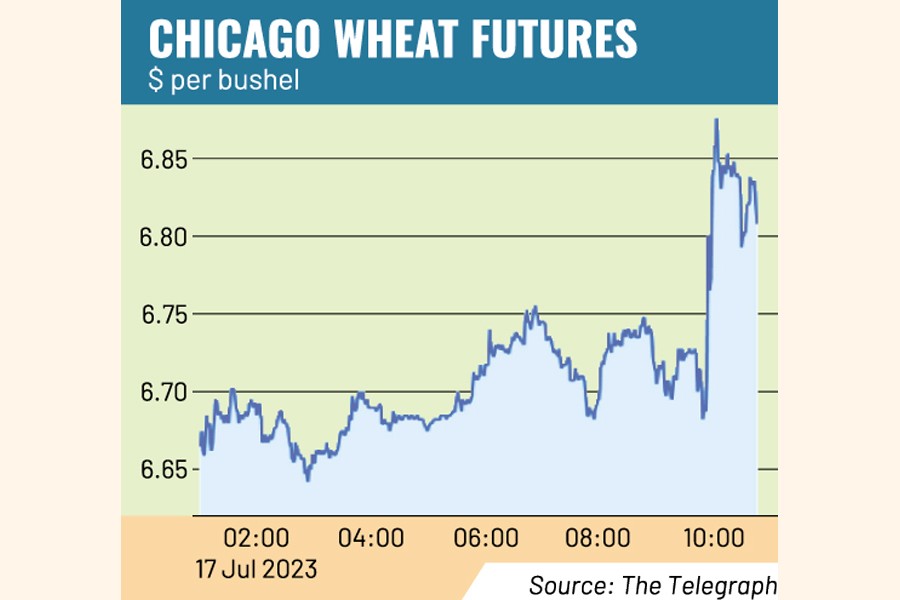
Minutes after the Kremlin announced that the deal had "de facto ended", wheat prices experienced a hike in the international market, as reported by the Telegraph.
Value-chain experts warn that Russia's discontinuation of the Black Sea Grain Initiative may further fuel local prices and result in a low supply of the food grain, exacerbating the declining trend of wheat imports in Bangladesh.
The Black Sea grain deal, brokered by the United Nations and Turkey in July of last year, aimed to address a global food crisis by facilitating the safe export of Ukrainian grain during the war between Ukraine and Russia.
While the deal had been extended multiple times, it was set to expire on July 17. Russia had previously said that the conditions for its extension had not been met.
The recent escalation in tensions between Russia and Ukraine resulted in Russia accusing Ukraine of attacking the Crimean bridge with maritime drones, resulting in casualties.
The Telegraph reported that the termination of the deal has caused wheat prices to surge, with the most active contract on the Chicago Board of Trade increasing by 6.7 per cent to $6.89 per bushel.
The Black Sea Grain Initiative played a crucial role in ensuring the smooth supply of over 32 million tonnes of wheat from Ukraine, even during the ongoing war between the two neighbouring nations.
Since the start of the conflict between Russia and Ukraine in February 2022, wheat prices have been on the rise, reaching a decade high in May of this year at over $400 per tonne (excluding shipping charges), as reported by global commodity web portals.
However, after the initiation of the BSGI, wheat prices started to decline, showing a 22 per cent plunge since March 2022, according to the Food and Agriculture Organization (FAO) of the United Nations.
Anup Kumar Saha, executive director of local baker Akij Insaf Group, said wheat imports in the country witnessed a slight decline in the last fiscal year, while the private sector managed to bring in 3.2 million tonnes, mostly from Black Sea nations.
He mentioned that wheat prices started to decline after the BSGI deal, allowing for wheat sourcing at $270 per tonne (including shipping charges) in July of this year. Prior to the initiative, the price had surpassed $400 per tonne.
Professor Dr Rashidul Hasan, a value chain expert, highlighted the wheat supply disruption in 2022 from Ukraine, the second-largest exporter of the food grain.
He said the Black Sea deal helped to some extent in reducing prices in the local market.
Professor Hasan expressed concerns about the potential decline in imports due to higher global costs, which could result in a volatile local market.
He said both the government and the private sector should explore alternative markets to ensure a smooth supply of the food grain.
Besides, he pointed out that a low supply of wheat could also impact the rice market, which should be taken into consideration.
Last week, major trade bodies in the country, including the Federation of Bangladesh Chambers of Commerce and Industries, International Chamber of Commerce Bangladesh, Dhaka Chamber of Commerce and Industry, Metropolitan Chamber of Commerce and Industry, Chittagong Chamber of Commerce and Industry, and Foreign Investors' Chamber of Commerce and Industry, expressed their deep concerns regarding the impasse of the BSGI deal.
On July 11, they urged the government to request an extension of the deal from Russia to ensure a smooth grain supply to least developed countries (LDCs).
According to the Trading Corporation of Bangladesh, the price of wheat flour in Bangladesh reached an all-time high of Tk 75-85 per kg in the July-August period last year.
Although the price has declined since then, it is still 25-35 per cent higher compared to a year ago.
tonmoy.wardad@gmail.com
© 2026 - All Rights with The Financial Express

