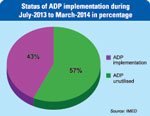
The government is currently burdened with idle funds worth more than Tk 55 billion due mainly to poor implementation of its annual development programme (ADP).
Sources familiar with the matter said political unrest during last October-December had slowed the ADP implementation leading to the accumulation of surplus funds.
They said a tussle between the Ministry of Finance (MoF) and the Ministry of Planning (MoP) over revised ADP also had slowed the development work resulting in slow fund release.
Sources said an increase in net sales of savings instruments also helped creation of idle funds.
Official sources hinted that the government borrowing from the banking system might be lowered significantly this year in the context of less-than-expected expenditure until April 30.
The government planned to borrow an additional Tk 40 billion from the banking system reaching Tk 300 billion this fiscal year following revision of the ADP to Tk 600 billion.
The government expenditure on account of ADP implementation, subsidy disbursement and other costs usually goes up during the March-June period of any fiscal.
Official sources said the current year was very unusual in terms of a large amount of idle money stuck in the government treasury.
Dr Zaidi Sattar, chairman at the Policy Research Institute of Bangladesh (PRI), told the FE: "The excess cash with the government at this time is the likely result of slow ADP spending which has reduced the requirement for deficit spending."
Sattar said whereas private commercial banks (PCBs), which are Primary Dealers (PDs), faced devolvement for holding bonds, they are now finding it profitable to invest in Treasury Bonds as banks are burdened with excess liquidity due to falling lending.
He said: "All this could change in the coming days if we see the usual spurt in ADP spending in the last quarter."
However, as a result of substantial amount of idle money, the government is now planning to borrow from the banks later in May.
"We will not borrow during the initial auctions of the central banks as it will cost in terms of interest payment," said a senior official at the finance division.
The government borrows from the banking systems through auctions held at the central bank each week.
The government borrows mainly two instruments -treasury bond and treasury bills.
According to Bangladesh Bank (BB) statistics, the government borrowed only 19 per cent of its borrowing target from the banking system until April 15, due to low implementation of development programmes and low spending on subsidy. The figure is 36 per cent lower than in the same period of the previous fiscal year, sources said.
Dr Zahid Hussain, lead economist at the World Bank's Dhaka office, told the FE there was little chance for full ADP implementation this year.
"I expect the expenditure might reach at best Tk 500 billion against the Tk 600 billion target," Dr. Hussain said.
He, however, questioned the speed of ADP implementation. "The quality of works gets lost in a hurried implementation."
Furthermore, "Subsidy spending is low, which further curtailed the government's expenditure," Dr. Hussain said.
In the first nine months of the fiscal year 2013-14, the ministries spent only Tk 284.28 billion under ADP, which is 43 per cent of the total allocation, according to data from the Implementation Monitoring and Evaluation Division (IMED).
During the same period in 2012-2013, the rate of ADP implementation was 49 per cent.
The worst performing ministry in terms of ADP implementation is the Ministry of Foreign Affairs. It utilised 1.0 per cent against its allocation, followed by the Bridge Division at 6.0 per cent.
On the other hand, Ministry of Expatriates' Welfare and Overseas Employment topped the position in terms of expenditure at 76 per cent.
ADP implementation is normally low in the first half of a fiscal year, but this time it was much lower than usual due to political unrest and other reasons associated with it.
The expenditure on subsidy was also low. During the July-February period, the subsidy spending on exports and agriculture stood at Tk 65.71 billion down from Tk 82.63 billion last year, according to data from the finance division.
Spending on fuels and accompanying subsidy was relatively low during the nine months ending in March against the previous corresponding period, Bangladesh Petroleum Corporation sources said.
It is believed that fuel consumption dropped in the current fiscal year due to the countrywide political turbulence, especially during October-December period in 2013.
© 2026 - All Rights with The Financial Express

