The largely expanded public administration continues to delude the people: they are not deriving the intended or desired benefits from it.
A good number of departments are underperforming or just lying as 'lame duck', having lost their relevance, experts observed.
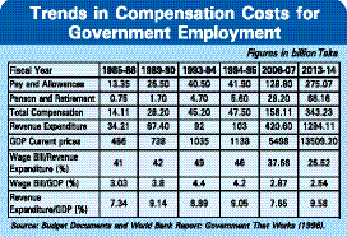
Expansion of Government -- in its size -- without making it effectively functional has come into question as ever-increasing amounts of taxpayers' money are being spent to foot the bill of salaries, allowances and other operational expenses for the upkeep of a growing number of public officials and their supporting staff.
The number of government departments has increased by nearly 100 over the last three decades to 275 at present.
But the employment distribution among the departments is largely mismatched with their requirements, leading to their poor service delivery.
There are some departments, according a number of former civil bureaucrats, which have now become obsolete and need to be reorganised or scrapped outright for their 'redundancy'.
On the other hand, there is also a need now for creating some new departments, in keeping with the changing economic and social needs.
The delay in making the units of Government properly functional after their inception through providing the required number of personnel as well as logistics support is one of the key reasons behind their poor services, a number of former bureaucrats said.
Lax or poor enforcement, they added, has eroded people's confidence in many of such public bodies.
The government created 21 departments over the last 13 years since 2001 only, but a good number of those are yet to be functional or to achieve any of their stated goals that prompted their establishment.
Hi-Tech Park Authority, Deep-sea Port Cell and Bangladesh Economic Zones Authority are cited among such 'Government' entities that could not yield any result yet as they should have done.
The senior civil bureaucrats are of the view that some time-worn authorities like the Department of Agricultural Marketing (DAM), Dhaka Mosquito Control and Film Archives, to cite some examples here, need to be either recast or merged with other organisations to serve some useful purposes.
The DAM compiles prices of agricultural products, collected by its field offices across the country.
The Trading Corporation of Bangladesh (TCB) also does a similar job, but it works only for the urban areas.
Dhaka Mosquito Control under the ministry of local government, rural development and cooperatives (LGRD) has virtually no function -- myriad mosquito bites eloquently prove the worth of the do-nothing.
The Film Archives has no adequate collection and no role in promoting film education and, according to many, it might be merged with other similar offices, like the National Institute of Mass Communication.
Among the new government offices, the Hi-Tech Park Authority, formed at least four years back, is yet to award a single bid to build such parks, befitting a modern economy.
The government formed Deep-sea Port Cell three years back to facilitate the construction of such a port and its operations. The cell remained almost non-functional since then; the government is yet to finalise funding for this project.
The government formed BEZA to promote economic zoning in the country. But it is yet to initiate moves for any of its five earmarked sites for development.
The government dissolved the Department of Insurance and made it into an autonomous body, named Insurance Development and Regulatory Authority (IDRA).
But the required manpower for the IDRA still awaits official approval by the line ministry, after four years of its operational activities.
The hamstrung watchdog can hardly keep an eye on the operations of 77 insurance companies.
Dr. Saadat Husain, a former cabinet secretary, told the FE that creation of departments should be need-based and Government needs to conduct adequate studies before setting them.
He, however, said the culture of employment creation for new department is not purely political motivated, but it is "semi-political".
The administration, he noted, is prone to taking an imbalanced approach to distribution of employees.
"There is adequate manpower in places where they do not require them to that extent, but there are some departments that do not have proper manpower," said Dr. Saadat, who had also served as chairman of the Public Service Commission (PSC).
And this, he observed, is one of the barriers to ensuring good governance.
Ali Imam Majumder, another former cabinet secretary to the government, said departments take much time to be functional.
"This, in my view, is due to the bureaucratic tangles," Mr. Majumder said.
"This reality is a problem of the existing system," he observed.
However, he is opposed to any fast expansion of departments of the overall public administration.
"Nowadays the non-government organisations (NGOs) are taking many responsibilities that can facilitate downscaling of the 'works' of the government," he noted.
"I don't find any reason for continuing an autonomous body, named BRDB (Bangladesh Rural Development Board) involving itself in micro-credit functions, as hundreds of NGOs are doing this job," he said.
Dr Akbar Ali Khan, a former adviser of a caretaker government, said there is a need for creation of some departments while some old and less-important ones should be unbundled.
jasimharoon@yahoo.com
© 2026 - All Rights with The Financial Express

