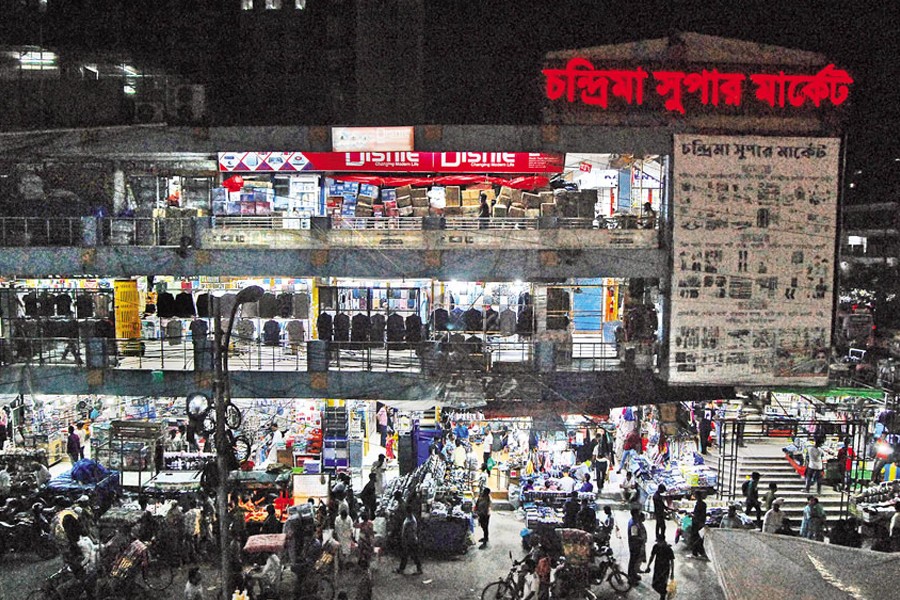
 Shops remain open at Chandrima Super Market in the capital on Thursday despite government's order to shut market by 6:00pm to save energy amid the fuel crisis. — Focus Bangla
 Many markets and shopping outlets remained open after 6:00pm Friday despite the cutoff time coming from the government, rather abruptly.
At the cabinet meeting on Thursday night, the government decided, among others, that shops and markets should shut by 6:0pm from Friday as part its austerity measures in the face of energy crisis amid the ongoing Mideast war.
A random visit to some city areas revealed that New Market was operating normally after 6:0 on the day as there were no instructions from the market owners' association. Most of the lights at the market were seen on because of the influx of buyers.
A security guard of Gazi Bhaban Shopping Centre at Naya Paltan, Md. Osman, told the FE that the market was shut around 7:00 pm.
Another security guard at Jonaki Super Market in the same area said the shopping mall was closed around 8:00pm.
The traders at Gazi Bhaban Shopping Centre, however, said they would comply with the government order accordingly from Saturday (today).
Meanwhile, medicine sops or pharmacies, restaurants, food shops and kitchen markets remained open as usual, as they are exempt from the taboo.
Traders said they "are obliged to accept any decision the government makes".
Some of traders claimed that they had not received any instruction regarding shutting down the market by 6:pm.
Many shops and markets in different parts of the capital were seen open one to two hours after 6:0pm deadline.
Meanwhile, Bangladesh Shop Owners' Association (BSWA) has urged the government to review its decision regarding closure of the shops and market by 6pm.
After a meeting on Friday, the group called upon the prime minister to allow stores to open at 11am instead of 9:am and remain operational until 8pm "in greater interest of 70 million shop-owners and businesspeople and 250 million employees".
Offices will run one hour short and shops shut at 6:00pm across Bangladesh as the government decides on fuel austerity amid one of worst global energy crisis stemming from turmoil in Mideast hubs.
As per a belt-tightening decision made by the cabinet on Thursday night, fuel allocations for the Prime Minister and ministers will face 30-percent cuts.
The government revised working hours of both public and private offices following the global energy crisis triggered by the ongoing war between the US-Israel duo and Iran in the Middle East that deeply disrupted supply of petroleum products and liquefied natural gas.
Under the new decision, office hours will be from 9:00am to 4:00pm, with a one-hour cut from 9:00am-5:00pm workday.
Banking transactions will take place from 9:00am to 3:00pm, with banks closing by 4:00pm.
"All shops and shopping malls across the country must close by 6:00pm," says the government firman.
The curtailed shopping-timing decision came into effect from Friday, shutting out many evening-time shoppers, says a spot account of the abrupt change.
The cabinet meeting that made the contingency measures began at around 8:45pm in the Cabinet Room of the Jatiya Sangsad Secretariat-in the wake of growing queues to refilling stations across the country, in a crunch largely attributed to "panic buying" and hoarding of fuels.
With Prime Minister Tarique Rahman in the chair, the meeting continued nearly three hours until around 11:45pm.
After the meeting, Cabinet Secretary Nasimul Ghani briefed the media on the decisions. Prime Minister's Press Secretary Saleh Shibly and other officials were also present.
Earlier on Thursday morning, Bangladesh Shop Owners Association had announced that shops and shopping malls would close by 8:00pm.
However, the government set the closing time at 6:00pm under the fuel-saving measure.
Hotels, pharmacies, essential services shops, and kitchen markets will remain outside this restriction.
The cabinet also approved several steps to reduce government expenditure over the next three months.
During this period, no new vehicles (including cars, watercraft, or aircraft) or computer equipment will be purchased. Internal training programmes have been reduced by 50 per cent, and all foreign trainings funded by the government will remain suspended "until further notice".
Expenditure on hospitality for meetings and seminars has been cut by 50 per cent.
Government spending on fuel, electricity, and gas will be reduced by 30 per cent. Travel expenses have also been cut by 30 per cent.
No decorative lighting will be allowed for weddings or celebrations.
Cabinet Secretary Nasimul Ghani said the Ministry of Education will issue separate guidelines regarding educational institutions as further discussion is required on some aspects.
"Considering the situation, the ministry will begin issuing directives related to schools and educational institutions from Sunday, ensuring that academic activities are not disrupted."
Also is there a decision to introduce electric buses for educational institutions in Dhaka and other parts of the country (where applicable). Schools will be able to import these buses duty-free. However, a 20-percent duty will apply if imported for commercial purposes. The buses must be brand-new.
Earlier, the Ministry of Education had planned classes to be conducted six days a week, combining online and in-person learning. The proposal includes three days of online classes and three days of physical classes on an alternating basis. Even during online classes, teachers would remain physically present at institutions while conducting lessons. Practical classes would be held in person.
Educational institutions reopened last Sunday after nearly 40 days of closure due to Ramadan, Eid-ul-Fitr, and other occasions.
Meanwhile, many countries, besides Bangladesh, have been affected by the energy crisis caused by the Middle East conflict. To reduce pressure on energy consumption, partial online education has been proposed. A final decision is expected on Sunday.
The cabinet also approved a draft amendment to the Public Examinations (Offences) Act 1980, allowing for the prosecution of all forms of exam-related crimes.
According to the briefing, these government measures are expected to play an important role "in maintaining economic stability, ensuring energy conservation, and establishing discipline in public life".
Proper implementation of these steps is hoped to help the country tackle future challenges.
talhabinhabib@yahoo.com
© 2026 - All Rights with The Financial Express

