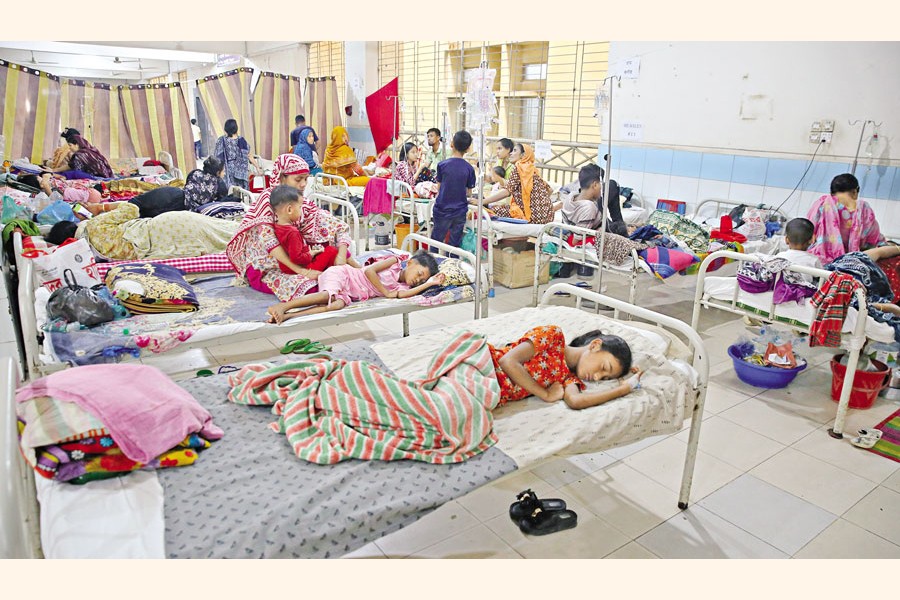
 Children with measles symptoms receive treatment at a dedicated ward at Mugda Medical College Hospital in the capital on Wednesday as infections rise across the country. — FE Photo by K Asad-Uz-Zaman
 The government has decided to launch an emergency vaccination programme against measles across the country from Sunday next, prioritising vulnerable areas amid an escalating outbreak.
Health and Family Welfare Minister Sardar Md Sakhawat Husain made the announcement at a press conference at the ministry in the capital on Wednesday.
 "The vaccines and syringes will be sent to rural areas, especially in the most affected measles-hit upazilas, within the next two days. Vaccination will start from Sunday morning," the minister said.
"We have cancelled all leave for field-level staff from Thursday. There will be no leave. Those administering vaccines will work under the supervision of local officers," he added.
The minister said actions are being taken on an urgent basis, admitting that there have been some casualties.
"But I must say it is a great success for us. We have managed the outbreak properly. We managed hospital wards in different places.
"We collected ventilators from the private sector at an accelerated pace, which was very necessary. After collecting ventilators, we ensured their availability so that children do not die due to a lack of oxygen," he added.
The minister said Gavi, an international initiative for vaccine collection and distribution, has 21.9 million measles vaccines in stock.
In addition, Tk 6.0 billion has been allocated for vaccine procurement.
Earlier, children aged nine to 15 months were vaccinated. However, under a special programme, children and adolescents aged six months to 10 years will now be eligible for vaccination, the health minister said.
He attributed the emerging situation to policy shortcomings, delayed decisions and weak implementation in recent years.
At least two more children have died with measles-like symptoms in Rajshahi and Bogura in the last 24 hours.
Our Rajshahi correspondent reports that a child died at Rajshahi Medical College Hospital (RMCH), bringing the total number of such deaths at the facility to four, hospital officials said on Wednesday.
Hospital spokesperson and emergency department in-charge Dr Shankar Kumar Biswas confirmed that the child died within a 24-hour period between Tuesday noon and Wednesday noon, showing symptoms consistent with the highly contagious disease.
Currently, 117 children are undergoing treatment at RMCH with symptoms resembling measles, indicating a sharp rise in infections in recent days.
During the same 24-hour period, 22 new patients were admitted, while 14 children were discharged after recovery, according to hospital data.
In a separate incident, a 10-month-old child named Humaira died at Shaheed Ziaur Rahman Medical College Hospital in Bogura in the early hours of Wednesday, also with symptoms consistent with measles.
Our Bogura correspondent reports that the child, daughter of Abdul Hannan from Sherpur in Bogura, had been admitted to the hospital's paediatric ward on Monday (March 30) with measles-like symptoms. She died around 3:40am on Wednesday while undergoing treatment, hospital authorities said.
Officials at the Bogura Civil Surgeon's Office confirmed the identity of the child and said a sample has been collected and sent to Dhaka for laboratory testing to confirm whether the illness was measles.
Measles infections are rising sharply across several northern districts under Rajshahi Division, with health authorities reporting confirmed cases, mounting hospital admissions and a high proportion of unvaccinated infants among those affected.
The outbreak has spread across Bogura, Naogaon and Joypurhat, with officials linking the surge to infections originating in neighbouring Pabna and gradually expanding to other districts.
According to civil surgeon offices, 12 measles cases have been confirmed in Bogura and eight in Naogaon through laboratory tests.
No confirmed cases had been recorded in Joypurhat as of March 31, although samples from five suspected child patients have been sent to Dhaka for testing.
Health officials said the vast majority of patients are children, with around 90-95 per cent aged below one year.
Many are between one-and-a-half months and nine months old -- an age group typically not fully covered by routine vaccination -- raising serious concern among doctors.
nsrafsanju@gmail.com, anaetru@gmail.com, editorsajedur@gmail.com, sajedurrahmanvp@gmail.com
© 2026 - All Rights with The Financial Express

