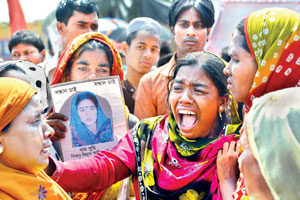
 Grief-stricken relatives of a garment worker, still missing since the Rana Plaza collapse, wailing at the accident site at Savar off the city Thursday on the occasion of the first anniversary of the tragedy. — FE Photo
The nation commemorated the tragic collapse of Rana Plaza Thursday on the first anniversary of the industrial disaster with deep shock and demand for immediate payment of compensation and ensuring workplace safety in apparel industry.
Thousands of people, including survivors and families of the dead victims, marched towards ruins of the nine-storey building at Savar off the city, carrying flowers and chanting slogans for justice.
In the morning, after paying tributes to the workers, who died in the deadliest-ever man-made industrial disaster, they also staged demonstration in front of the accident spot, demanding acceleration in the compensation payment process.
More than 30,000 members of several workers' organisations and victims' relatives also staged a sit-in in front of the Rana Plaza site at around 8:00am, demanding capital punishment to Sohel Rana, owner of the faulty building.
The demonstrators also blockaded the Dhaka-Aricha Highway for more than three hours in the morning in this connection.
Many of them wore funeral dress in protest of the building collapse, which raised the question of workplace safety in the country's US$ 22 billion apparel industry.
"We're yet to see any sign of compensation even after one year of the horrible incident. How long will we wait for it? We're getting tired," said Rekha Khatun, who worked at a factory housed at the building before collapse.
Expressing her deep concern over the delayed move to punish Sohel Rana, and managements of the factories, she said: "We want justice from the government. We lost everything we had a year ago."
Family members of the deceased and other people also thronged Jurain graveyard in the city, where bodies of 291 workers were buried, and prayed for salvation of the departed souls.
Of them, 85 bodies still remain unidentified, as DNA samples of their remains have not matched with anyone yet.
The workers' graves were covered up with black cloths and flags, showing silent protest against the worst-ever industrial disaster across the globe.
Apparel workers' leader Nazma Akhter expressed her dissatisfaction over the post-Rana Plaza collapse developments, saying that the country is yet to trace out the bodies of more than 100 workers over the last one year.
She said apparel manufacturers, global retailers and the government made many promises on compensation and rehabilitation of the survivors and families of the dead victims.
But in reality, no worker got adequate compensation. Nearly 73 per cent of the survivors are still jobless, and 66 per cent of them are facing a lot of hardships to meet their daily needs.
"Commitments should be executed for the sake of humanity," she added.
In protest of the tragic incident, a section of workers marched towards the headquarters of Bangladesh Garment Manufacturers and Exporters Association (BGMEA), but failed because of intervention of the law enforcement agencies.
The workers also demanded immediate punishment to the factory owners and the owner of the multi-storied commercial building.
However, the apparel manufacturers also commemorated the day with haunting memories and organised a rally around the BGMEA headquarters.
They also held a doa mahfil in the BGMEA office, seeking eternal peace for the workers, who died in the building collapse one year ago. Munajat was also offered to Almighty Allah for early recovery and rehabilitation of the injured, and welfare of the victims' families.
In the programme, the BGMEA office-bearers said they will provide financial assistance to the victims' families, who are yet to get the assistance.
They also said BGMEA will manage jobs for the survivors and families of the dead victims in the apparel industry.
Rana Plaza, housing five apparel units, collapsed on April 24, 2013, killing a total of 1,135 workers and severely injuring 2,438 others.
It is alleged that the factory managements and the owner of Rana Plaza forced the workers to continue working in the risky building.
The disaster created a shockwave throughout the world, resulting protests at home and abroad on the issue of workplace safety.
In the face of the protests, brands of the US and the UK sourcing cloths from Bangladesh, formed two separate bodies to inspect safety arrangements at the apparel factories.
© 2026 - All Rights with The Financial Express

