Multi-pronged global stakeholder pressures built up on Bangladesh authorities for a 'significant and reasonable' pay hike for the country's garment workers as wage negotiations peak with claim submissions today, industry sources said.
Both owners and workers' representatives on the minimum wage board for the export-oriented garment industry are scheduled to make their respective wage-hike proposals today (Sunday) at its fourth meeting, they added.
The trade unionists are backed up by some 4.0 million workers and foreign stakeholders like retailing brands and buyers and labour-rights groups.
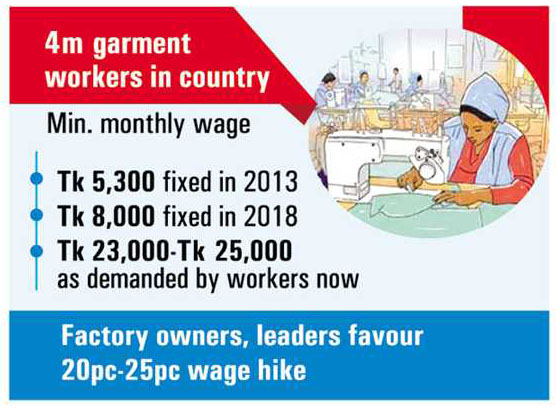
Talking to the FE over the apparent tug-of-war ambiance, a number of factory owners and sector leaders favoured a rise in garment workers' wages ranging from 20 per cent to 25 per cent against the workers' demand for Tk 23,000 to Tk 25,000 per month for an entry-level worker.
The current minimum monthly wage for an entry-level garment worker is Tk 8,000, which was fixed in 2018, up from Tk 5,300 set in 2013.
On April 9 this year, the government formed the wage board for the workers of the garment sector to review the minimum monthly wage--incidentally, in the wake of steep price rises.
Meantime, major and leading European Union brands, including H&M, Inditex and Primark, and US brands like Adidas, Puma, PVH and Hugo Boss in separate letters to Prime Minister Sheikh Hasina requested a successful conclusion of the ongoing negotiations under the minimum wage-review mechanism that "incorporates the views of all stakeholders and reflects the economic realities in Bangladesh".
The latest came when a total of 15 US brands and retailers, in a letter to the Prime Minister on October 13, urged a transparent minimum wage review that involves all stakeholders and that does not lead to any 'retaliation'.
The brands are Adidas, Gap Inc, Under Armour, Patagonia, Burton, Hugo Boss, Abercrombie & Fitch, Amer Sports, AEO Inc, Levi Strauss & Co, lululemon, SanMar, KMD Brands, PVH Corp and Puma.
On September 12, members of the Action, Collaboration, and Transformation (ACT) in a letter to the country's RMG Minimum Wage Board requested a substantial increase in the workers' wages.
The ACT, a coalition or joint initiative between 19 international garment brands, retailers and IndustriALL Global Union, mostly comprises members from the EU- based brands and retailers including H&M, Inditex and Primark.
The Clean Clothes Campaign (CCC) at a protest in Amsterdam on September 04 urged Bangladesh government, local apparel makers, and global buyers sourcing from the country to agree on and support workers' demand for Tk 23,000 as minimum monthly wage.
On July 27, the American Apparel and Footwear Association (AAFA), in the single-largest export destination for Bangladesh, also wrote to the PM for a raise in minimum wages for garment workers.
The group termed the minimum- wage review 'crucial opportunity' to address existing disparities and to establish fair remuneration for garment workers, and said that they are closely monitoring the current minimum-wage review in Bangladesh.
AAFA is the US trade association that represents more than 1000 apparel, footwear and other sewn products' companies and their suppliers with over $490 billion in annual US retail sales.
In July, five non-profit global organisations-- Ethical Trading Initiative with amfori, Fair Labor Association (FLA), Fair Wear, and Mondiaal FNV-- wrote a joint letter to the chairman of the Minimum Wage Board of Bangladesh in support of an increase in the minimum wage for the RMG sector, which is currently well below the rising cost of living in Bangladesh, in line with a living wage for workers and their families.
Bangladesh Garment Manufacturers and Exporters Association (BGMEA) president Faruque Hassan in response to the ACT letter, where he was copied, said before the end of this year a new minimum wage would be declared and there would be a "rational adjustment, like in the previous reviews, with the aggregate inflation in past five years".
Considering the standard and cost of living of the workers, and the inflation, he stressed fair price and ethical sourcing from buyers-- in a sort of tradeoff.
Talking to the FE, a BGMEA board member said a good number of its members agreed on a 20-percent rise in the minimum wage.
"The amount should be in-between Tk 10,500 and Tk 11,000 as the size of the factories are not same and work-order situation is not good," he added.
Another member says the industry "can't absorb more than 25-per- cent hike".
When asked, Sirajul Islam Rony, workers' representative on the wage board, said they were still working on their respective proposal, until the filing of the report at 7.45 pm.
The union leader, however, said he would propose a 'realistic' amount taking the overall scenario into account.
According to sources, the workers' representative might propose about Tk 20,000 as monthly minimum wage.
Munni_fe@yahoo.com
© 2026 - All Rights with The Financial Express

