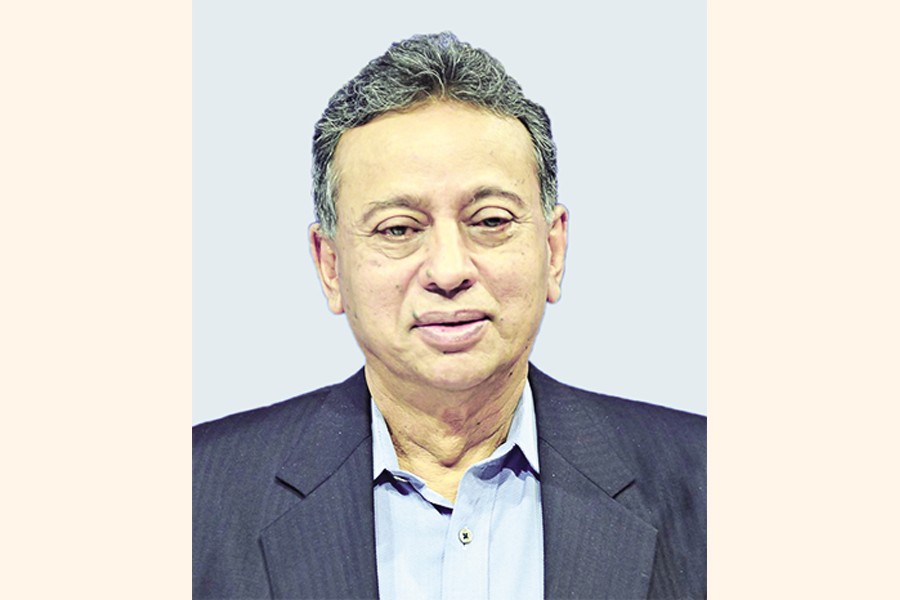
 Amir Khosru Mahmud Chowdhury
 Newly-appointed Finance and Planning Minister Amir Khosru Mahmud Chowdhury on Tuesday set out an agenda centred on deregulation and lowering the cost of doing business, saying the measures were essential to restore momentum in the country's fragile economy.
Talking to the Financial Express shortly after being sworn in as a full minister with the combined finance and planning portfolios, Khosru said his immediate priority was to streamline institutional and regulatory powers to improve efficiency.
"My first priority is deregulation," he said, adding that his next focus would be reducing the high cost of doing business, which, he mentioned, remained above that of many peer economies.
He said persistent barriers to business activities continued to hamper investment, fuel inflation, and weaken overall economic efficiency.
Bangladesh is currently grappling with sticky inflation of above 8.0 per cent, which has been hitting low- and fixed-income groups particularly hard for a while.
Khosru expressed confidence that inflationary pressures would ease following the implementation of the two key reforms.
"Once deregulation is in place and business activities become easier, economic indicators will begin to improve, and the economy will regain momentum," he said.
Bangladesh has long faced structural weaknesses in the business environment, particularly access to finance, environmental compliance, trade facilitation, tax payments, and technology adoption.
According to Khosru, high operating costs, including inefficiencies, time-consuming procedures, and corruption, remain the major drivers of inflation.
Bangladesh ranked 168th out of 190 economies on the World Bank's Doing Business index until 2019, before the publication was discontinued following data irregularity controversies.
Khosru, in his previous term as the commerce minister during the 2001 BNP-led government, introduced several deregulation measures aimed at improving trade efficiency.
One key reform involved transferring authority for issuing the Utilisation Declaration (UD) from the Export Promotion Bureau (EPB) to the Bangladesh Garment Manufacturers and Exporters Association (BGMEA), the apex body of apparel makers in Bangladesh.
The UD is a mandatory document required by garment exporters to import duty-free raw materials under the bonded warehouse system.
It certifies raw material requirements for specific export orders and is essential for customs clearance, export processing, and obtaining cash incentives.
Before the reform, exporters often faced lengthy delays and unethical practices, including bribery, which disrupted production schedules and caused lead-time failures.
"Delegating the function to the BGMEA significantly reduced processing time and improved transparency," he said.
Over the past 17 months, Khosru continued advocating deregulation while also emphasising the need to strengthen trade promotion institutions.
Earlier in his career, following the 1996 stock market crisis, he played a role in introducing the Central Depository Bangladesh Limited (CDBL), which was incorporated in 2000.
CDBL provides electronic settlement and transfer of securities through a computerised book-entry system, improving transparency and efficiency in capital market transactions.
Khosru hails from North Kattali in Chattogram and previously served as the president of the Chittagong Chamber of Commerce and Industry (CCCI) and the Chittagong Stock Exchange (CSE).
jasimharoon@yahoo.com
© 2026 - All Rights with The Financial Express

