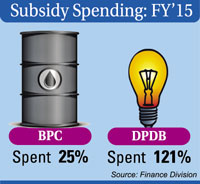
The government's total spending from subsidies by the end of this fiscal may not be much lower than the original allocation, although the state's lone fuel import wing used only one-fourth of the money set aside for it.
The spending might remain at par with the aggregate of subsidies originally allocated in the current budget or it might be slightly lower than that at the end of the fiscal year (FY) 2014-15, officials familiar with the development told the Financial Express (FE) on Thursday.
"We assure that the subsidy will not exceed the original size, but again it will not drop significantly," said an official at the Finance Division under the ministry of finance (MoF).
"The revised subsidy so far remained slightly lower than its original size of Tk 260.53 billion," said an official familiar with the development.
The projected spending from subsidies was revised slightly downward to Tk 260 billion from the original size.
The official at the Finance Division said the Bangladesh Petroleum Corporation (BPC) spent only Tk 6.0 billion (600 crore) out of its allocation of Tk 24 billion.
Spending from the BPC's subsidy amount fell drastically following a fall in prices of fuel oil in the international market. Prices of both crude and finished oil had been falling since June last year. World oil prices have collapsed by about 60 per cent since June.
It is believed the BPC's low spending from the subsidy is offset by that spent on the Bangladesh Power Development Board (BPDB) for feeding quick rental power plants.
The BPC is reportedly making profit on some fuel products.
The Bangladesh Jute Mills Corporation (BJMC) also took only Tk 2.0 billion to purchase jute. It so far did not approach the authority concerned for any further fund.
The BJMC had been allocated Tk 15 billion in the current fiscal year.
On the other hand, the volume of subsidy for the BPDB has so far surged by Tk 15 billion or over 21 per cent than projected.
The government in its budget documents allocated Tk 70 billion in the form of subsidy for the BPDB and it rose to Tk 85 billion.
Official sources said the BPDB's subsidy had been rising mainly because of feeding the expensive quick rental power plants.
It is believed the BPDB's subsidy is rising as the country's largest private independent power plant (IPP) situated at Meghnaghat has been laid shut for long.
To compensate the power generation shortfall the BPDB is purchasing electricity from quick-rental plants at much higher rates.
The Meghnaghat power plant is gas-fired and its electricity rate is much lower. But the big unit had been remaining shut since April, 2014 following a major fire incident.
The BPDB usually purchases power from gas-fired plants at rates between Tk 3.5 and Tk 5.5 per unit.
But the electricity price from the quick rentals goes up sharply--usually ranging between Tk 13 and Tk 20 per unit for diesel-fired plants while the rates vary between Tk 7.0 and Tk 13 for furnace oil-based plants.
They hinted that at the end of the fiscal year the demand for subsidy from the BPDB would rise further.
On the other hand, the demand for subsidy from the agriculture sector is expected to remain unchanged at Tk 90 billion.
The subsidy for the export sector may rise higher than the projection of Tk 28.5 billion.
The government earmarked a total of Tk 260.5 billion or 1.9 per cent of the GDP as subsidies for sectors concerned for the entire current fiscal year.
People concerned said subsides for the food sector and under the miscellaneous head also could rise to some extent compared to the projection of Tk 18.03 billion and Tk 15 billion respectively.
jasimharoon@yahoo.com
© 2026 - All Rights with The Financial Express

