After two decades of development work the Rajdhani Unnayan Kartripakkha (Rajuk) has now changed the concept of Purbachal New Town project to make it the country's first 'smart city' without any feasibility study.
The latest change in concept of the project has also caused concerns among plot allottees and urban planners, who think it has been done to benefit a vested quarter that would ultimately kill more time for execution of the scheme under a new pretext.
But officials concerned said adoption of such a concept would not create any problem with the existing infrastructure. Rather it would ensure state-of-the-art facility within the project area in this era of information technology.
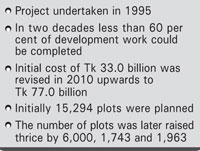
The city development authority undertook its largest urban development project in 1995 to lessen the growing pressure of housing on the capital through building a modern city on 6,150 acres of land between the rivers Balu and the Sitalakhya 16 kilometres off the zero point in Dhaka city.
About two decades have passed since the housing project was undertaken and less than 60 per cent of development work has so far been completed to the frustration of plot allotment holders.
Officials, development experts and urban planners have, however, attributed such an inordinate delay in the project implementation to wrong development plan, frequent changes in the design and other procedures and utility service providers' apathy.
The inordinate delay is not only causing waste of valuable time but also public funds, as the initial cost of the project amounting to Tk 33.0 billion (3300 crore) was revised in 2010 upwards to Tk 77.0 billion, marking 133.3 per cent increase with the inclusion of utility infrastructure, they said.
A section of senior Rajuk officials involved in the scheme said the change in the concept was made following an instruction of the Prime Minister's Office (PMO) that the project should follow a 'uni-duct' system. 'Uni-duct' is an underground single channel system of all utility lines including power, gas, water, sewerage and solid waste.
When contacted, Rajuk Chief Engineer Md. Hafizur Rahman Munshi said they would build a 'smart city' at the Purbachal New Town and talked with different interested foreign groups in this connection. "There will be no problem with executing the concept with the existing infrastructure," he said.
However, the city developer already signed non-binding MoU (Memorandum of Understanding) with three foreign companies including Chinese CGCOC and Gezhouba Groups a few months ago with respect to installation of the 'uni-duct' system.
Additional Project Director Engineer Ujjwal Mallick told the FE that they had already handed over 12,000 out of 25,000 plots to the allottees in sectors 01, 13, 11, 04, 05, 23, 17, part of 09 and 14 and planned to hand over more under sectors 02 and 08 in December next.
"Now, we'll follow the concept of 'smart city' in the project like Singapore. There will be no utility lines overhead and the city will use digital technologies to enhance quality and performance of urban services to reduce costs and resource consumption and to engage more effectively and actively with its citizens," he said.
Under the plan, they would start approving designs of the buildings to be developed there from July 01, 2015 and septic tanks and Sewage Treatment Plants (STP) would a must for the structures, he said.
Seeking anonymity, a senior Rajuk official said the concept of 'smart city' was adopted without conducting any feasibility study and many local firms were , now, in a race for bringing foreign companies to get a share of the job.
The official, who was engaged with the project at the initial stage, said the city development authority hurriedly went for the concept, although it failed to get utility service providers for the project over the years. "Then what will we do with the uni-duct system, if there are no service providers?" he posed a question.
A plot allottee of Purbachal New Town Project expressed his frustration to the FE, saying that the RAJUK was supposed to hand over his plot by 2012.
"But they (RAJUK) did not. I think they will not be able to hand it over even within the next five years, if the construction work goes on at their current pace," he said.
Another plot allottee said the RAJUK made a change in the affidavit that any of the family members of the applicant who has a plot or flat under the RAJUK area would not be eligible for getting a plot in the project.
"It has created a new form of problems, although I was declared eligible for the plot. I don't know what happens to me," he said frustratingly.
According to the affidavit before the change, an applicant having a plot or flat inside the RAJUK area would not be considered for a plot under the project.
Former Secretary at the Ministry of Housing and Public Works (MoHPW) Suhel H Choudhury said it would not be possible for the existing RAJUK structure to complete the project if they were given 10 years more.
He said the RAJUK officials spent most of their time a day dealing with lobbyists. So, they have no time to talk about the progress and the hassles faced by the project officials.
Mr. Choudhury, who was the MoHPW secretary, when the project was initiated, said the RAJUK took a number of measures like township and apartment projects to reduce growing pressure on the capital city, but they failed to execute most of the schemes over the years.
Talking about the issue, urban planner architect Mubasshar Hussain was very critical of the activities of the RAJUK, saying that frequent changes made in the design and other procedures by the development authority on a regular basis in favour of a vested quarter led to the delay.
He alleged that the RAJUK was now eyeing the 45-kilometre lake around the project to develop more plots for highly influential individuals, which would have a negative impact on the environment.
"The concept of developing plots to lessen growing accommodation demand should be stopped immediately as most of the allottees usually sell the plots at a much higher price to others. So, it has created a new form of housing business," he said. Initially, there were 15,294 plots for the Purbachal project, but the number had later been increased thrice (6,000, 1,743 and 1,963).
jubairfe1980@gmail.com
© 2026 - All Rights with The Financial Express

