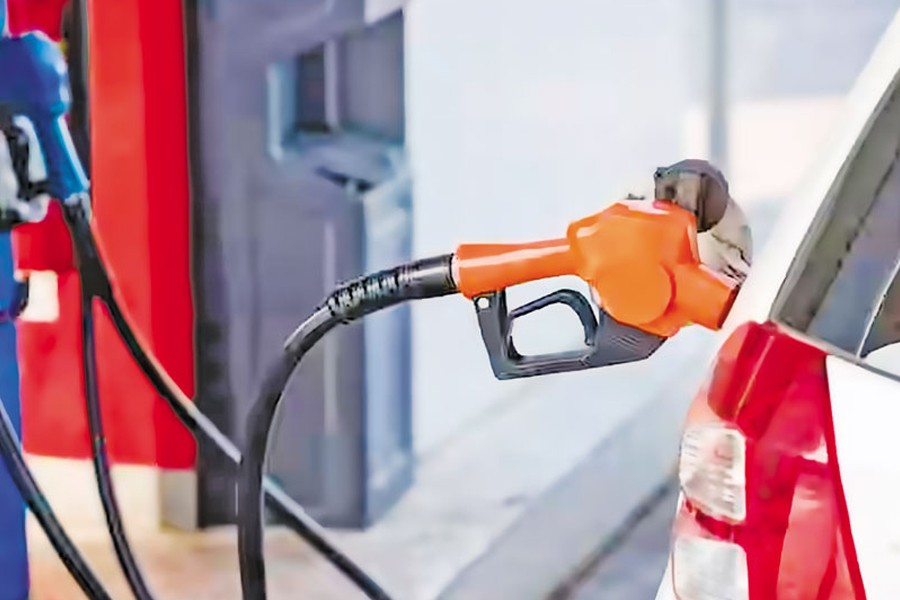
Prime Minister Tarique Rahman Wednesday held a special meeting on measures to address the country's fuel situation as queues to pumps lengthened amid panic buying triggered by war disruption to Arab oil hubs.
Meanwhile, the government reassured there was no major fuel crisis despite panic buying pressure, and there had been no decision made to raise fuel prices.
Information Minister Zahir Uddin Swapon expressed his confidence that Bangladesh would not face any major fuel crisis given the government interventions, as motorists resort to frenzied buying amid the Gulf conflict.
He acknowledges, however, that panic buying-driven by public anxiety-is putting authorities under pressure, and urges journalists to help build awareness to contain the trend.
Swapon presented an account of the first month of Tarique Rahman's government, a bdnews report said.
The minister notes that the ongoing Iran war has disrupted fuel supplies through the Strait of Hormuz, with impacts spilling into South Asia.
Bangladesh, he said, has already taken necessary steps to manage the situation.
"There has so far been no decision to raise fuel prices in the country. In fact, there remains a significant gap between our prices and those in neighbouring countries.
"A cabinet committee led by the finance minister has been formed, and they have managed the situation efficiently. As a result, we are not facing any crisis at this moment, and we hope we will not have to."
About public anxiety, Swapan said widespread reporting-particularly on social media-triggered panic buying.
"In our political and social context, some groups may try to exploit such situations. That is why we believe it is important to build public awareness against this panic-buying mentality through you."
He said media cooperation could help prevent unnecessary stockpiling.
"If you cooperate, we can avoid this unnecessary rush to buy out of fear. If everything proceeds as planned, we are hopeful no crisis will affect us."
At the briefing, Prime Minister's Information and Broadcasting Adviser Zahed Ur Rahman also urged restraint.
"The media has a responsibility to discourage excessive panic buying and storage. There are indications some are trying to stockpile at the pump level, and the government is looking into it.
"I would like to tell pump owners-if you are stockpiling in anticipation of a price hike, the prime minister has made it clear that fuel prices are not increasing. So such behaviour will not benefit you."
Ripple effects of the ongoing US-Israel war on Iran have reached the streets of Dhaka, triggering a severe fuel-supply disruption that has left filling stations dry and motorists stranded in long queues.
A spot visit through the capital on Wednesday revealed a city struggling with supply shortages, rationing, and a growing trust deficit between the public and energy authorities.
At the Ideal Filling Station in the Tejgaon Industrial Area, the desperation was palpable. By 4:00 pm, manager Salauddin stood before a line of private cars stretching nearly a kilometer. Despite a daily demand for nearly 60,000 litres, the station had received a mere 9,000 litres.
"Fuel was still being loaded at the Narayanganj depot at 4:01 pm. It may take another three to four hours to reach here," Salauddin said, adding that the station received no supply yesterday and feared a similar vacuum tomorrow.
The scarcity has forced many pumps to limit their operation.
At Purbachal Traders in Paribagh, fuel sales were suspended as staff waited for a supply slot sought from dawn.
Sujon, an employee, explains the grim math: they are receiving 9,000 litres every alternate day to cover a two-day requirement of 70,000 litres. For those stations still operating, rationing has become new norm.
Meghna Model Service Center near Shahbag was seen limiting motorcycles to just five litres each.
The human cost of the disruption is mounting. Commuters and professional drivers are losing both time and income. Kawser, a private car driver, laments the loss of trips and earnings.
"Every day I spend hours in queues instead of working. If I cannot get fuel on time, I lose my livelihood," he says.
Similar sentiments were echoed by Rakib, a buying-house employee, who had waited since noon sacrificing his office responsibilities.
"I have office tasks pending, but I can't leave because there's no guarantee I'll get fuel if I return later. It's mentally exhausting," Rakib remarked.
Amidst the logistical chaos, public frustration is being directed at the government's communications strategy.
Motorists questioned why official statements insist that stocks are sufficient while the reality on the ground suggests otherwise.
"The government should clearly announce whether there is enough oil or not," said Md Asif, a motorcyclist in Tejgaon. "We understand the war causes shortages, but why give false assurances? If there is a crisis, be honest so we can plan accordingly."
However, at other locations like Talukdar Filling Station at Asad Gate, the "Closed" signs remained up.
With the geopolitical situation in the Middle East remaining volatile, Dhaka's residents remain braced for continued uncertainty, urging the authorities to ensure a more predictable supply system so they can plan their lives without disruption.
sajibur@gmail.com
© 2026 - All Rights with The Financial Express

