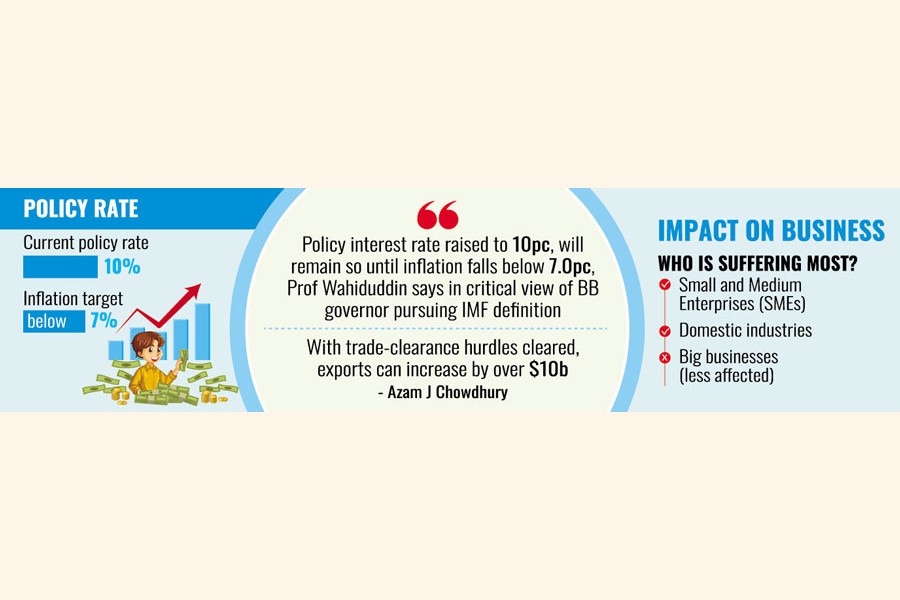
Planning Adviser Prof Wahiduddin Mahmud has said it is time to make a review of the tight monetary policy stance, for the same has not worked as desired.
"There is no longer much need to control inflation by reducing credit flow through monetary policy by simply increasing interest rates. Inflation will already come down somewhat," he told a seminar Wednesday.
"And the current high interest rate is mainly affecting working capital, because investment is not happening much," said the economics professor at the meet of economic reporters.
He sees not much of a problem for big businessmen in terms of working capital. "But outside that sector, interest rates have become a big expense in other domestic sectors."
The Economic Reporters Forum (ERF) organised the seminar on 'Economic stabilization and challenge for the next government' in Dhaka where Dr Mahmud was speaking as the chief guest. ERF President Doulat Akter Mala was in the chair.
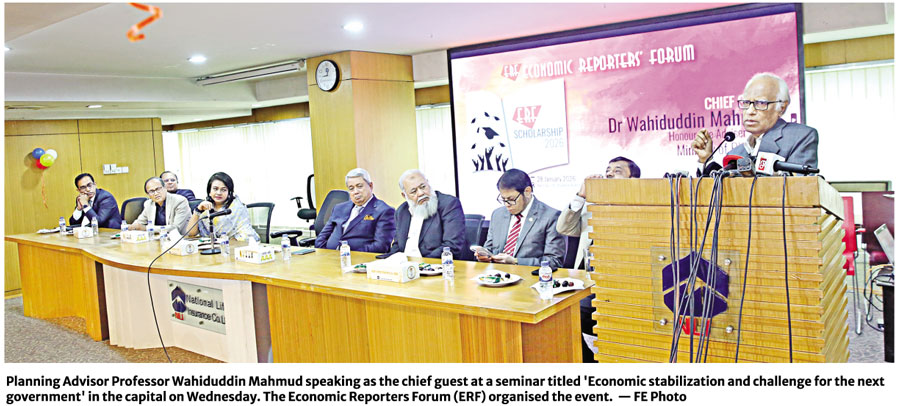
Planning Adviser Prof Mahmud said: "The Bangladesh Bank Governor may have expected this slow decrease to be faster. But I think it will decrease gradually. The reason is-as much as inflation has increased, the wages too. This means that the economy has now reached a new level."
The planning boss of the interim government asserts that it is not possible to return to the previous state. "If inflation remains at a certain level for a long time and decreases very slowly, then what we call price expectation is created," he explains.
If businessmen increase wages or set salaries, everyone thinks that inflation will increase a little more. Then everything tends to increase in price. It is a kind of self-generating process and that is why inflation will take time to come down.
He appeared highly critical of the IMF-prescribed policy measures on money supply on the financial market.
"In this context, our Governor is following the policy very strictly according to the IMF definition. He has increased the policy interest rate to 10 per cent compared to before and he is adamant in this position-he will remain at 10 per cent until inflation falls below 7.0 per cent."
But, he says, 7.0-percent inflation has no special economic significance. "Similarly, 10-percent policy interest rate is not a magic number. Although the World Bank and the IMF use some such benchmarks, there is no strong economic logic behind…..at least in my opinion."
Although Bangladesh Bank asked for low-rate working capital to the SMEs but the real experience is that as long as the interest rate of the banks on their own funds remains high, the banks not give loans at that comparatively low interest rate.
"So here, on the one hand, inflation, and on the other hand, interest rates-now it is time for coordination between these two."
On economic risks and challenges, Dr Mahmud said they had been able to make the economy stable from a destroyed one but had to pay a price for the stability. This is the "hidden cost of stabilization"-it is not visible in the economy.
"For example, to prevent the collapse of the banking sector, capital had to be replenished, and for that, BB had to print billions of taka. As a result, interest rates have to be kept high, credit flow has to be limited. These are direct losses to the economy," the senior economist says about the economics arithmetic.
He terms this loss mainly an indirect result of money laundering. For example, some industrial owners have left their factories, some industrial owners cannot be found.
Again, the same problem is faced by bank entrepreneurs. The government initially wanted to pay salaries to the industries where there are workers. In some industries, 30-40 thousand workers had to be paid salaries for three, four, five months, even though there was no production. This is also a huge loss. "This money also had to be provided through banks by printing money."
And this loss is not only short-term-its impact will last for several years. These are the invisible losses, which will not be repaid in a year, it will take more time.
A huge amount of arrears had to be paid for importing fuels which cost about US$4.0 to $5 billion.
Stressing the need for human-capital development, the adviser said, "If you build only physical infrastructure without developing human resources, it becomes like a skeleton what I witnessed this at Indonesia."
Replying to a criticism on the form of the government and its work, Dr Wahiduddin Mahmud said he himself does not understand whether they are working like a normal government or trying to work like a political government because this is a time of instability where it is very difficult to say specifically what kind of government this is.
"On the one hand, it has come to fulfil some expectations after the mass uprising-an inclusive government. On the other hand, it is partially a government with a constitutional structure. So, such a government has never come before in Bangladesh. It is a government after the uprising of the students and the masses."
Mr Mahmud criticized the last government's ignorance of human-capital development. The real solution is to build institutions where human resources can be created.
Noted businessman Azam J Chowdhury said at the seminar that although the government is trying to solve the economic problems by taking some loans from the IMF, the necessary reforms, especially at the macro level, had not happened.
"We talk about macroeconomic stability, but the external and internal debt service is being going up, the level of inflation is high, investment is not taking place and the exchange rate is still not being stabilized, which are our big challenges at the moment."
Expressing reservation on the real reforms by the interim government, Mr Chowdhury said: "If I talk about the micro level, then some examples from Bangladesh can be given. Suppose you import a product. After arriving at the port, you declare the goods and after paying the tax, you are supposed to clear the machinery or commodity within a day. But what happens in reality? Many times they don't even understand what goods have arrived."
Then they send them to BUET. After a month or a month and a half of going around from BUET, the clearance is done. This is the suffering of the micro level. This is not part of the macro-level reform," he told the audience.
"We need to pay bribe for getting land mutation or company certificate from the government offices." If simplification can be done here, Bangladesh's exports can increase by more than $10 billion.
Criticizing the interim government's ignorance to the private sector for making the economic policy, Azam J Chowdhury said, "You did not engage or talk to the pillars of Bangladesh's economy. So can Bangladesh be made successful with NGOs? Never. So whether it is macro level or micro level-if you want to reform any policy, you must engage with the people involved in this sector. You have to reform by talking, discussing."
Financial Express Editor Shamsul Huq Zahid noted that the interim government stabilized the economy but failed to make an economic return to a normal pace like earlier.
"We have observed that this government has sometimes taken economic policy with fear," he said, adding: "I think this economy will not return to a normal pace within 2-3 years."
After the seminar, the ERF handed over 137 stipends to children of the ERF family members for their outstanding results in academic career.
© 2026 - All Rights with The Financial Express

