Bangladesh's banking sector is bearing a burden of non-performing loans (NPLs) having ballooned to some Tk 5.45 trillion as of December 31, 2025, underlining deep-rooted weaknesses in credit discipline and financial oversight.
The figure was disclosed Monday in the Jatiya Sangsad by Finance Minister Amir Khasru Mahmud Chowdhury, along with a list of top defaulters placed in the House.
He came up with the disclosure in response to a written question from lawmaker Md. Abul Hasnat of Comilla-4. The session was presided over by Deputy Speaker Kaiser Kamal.
In a move that sheds light on the concentration of financial risks, the minister tabled a list of the country's top 20 loan defaulters-dominated by large industrial and trading groups, many of which have longstanding ties to the banking system.
Multiple entities linked to S Alam Group feature prominently, alongside firms associated with Beximco and other major business houses.
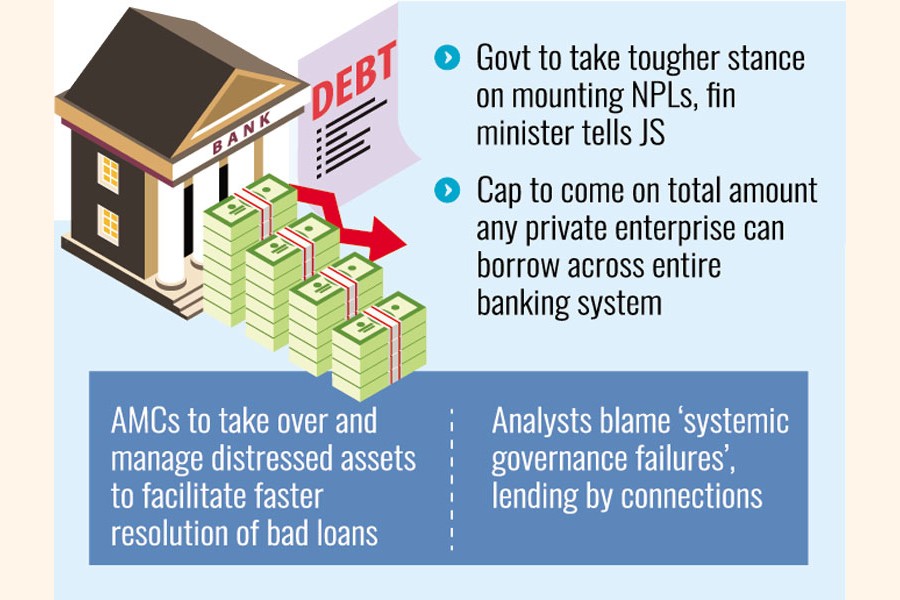
Analysts say the clustering of defaults within a handful of conglomerates reflects "systemic governance failures and persistent concerns over connected lending".
Following is the list of top 20 defaulters presented in the House:
(1) S Alam Super Edible Oil Limited (2) S Alam Vegetable Oil Limited (3)S Alam Refined Sugar Industries Limited (4) S Alam Cold Rolled Steels Limited (5) Sonali Traders (6) Bangladesh Export Import Company Limited (Beximco) (7) Global Trading Corporation Limited (8) Chattogram Ispat Limited (9) S Alam Trading Company Private Limited (10) Infinite CR Strips Industries Limited (11) Keya Cosmetics Limited (12) Deshbandhu Sugar Mills Limited (13) PowerPac Mutiyara Keraniganj Power Plant Limited (14) PowerPac Mutiyara Jamalpur Power Plant Limited (15) Pacific Bangladesh Telecom Limited (16) Karnaphuli Foods Private Limited (17) Murad Enterprise (18) CLC Power Company Limited (19) Beximco Communications Limited (20) Rongdhonu Builders Private Limited.
The finance minister told parliament that the government, in coordination with Bangladesh Bank, is pursuing a range of measures to recover default loans. The steps include legal action under existing frameworks.
"However, recovery efforts continue to be hampered by lengthy judicial processes and court-imposed stays, which in some cases allow defaulted loans to be temporarily reclassified as regular."
Also disclosed in parliament that loans taken from banks and financial institutions under the names of current Members of Parliament (MPs) and their affiliated businesses total over Tk 111.17 billion or Tk 11,117 crore 31 lakh and more than Tk 33.3 billion of it is classified as defaulted loans.
The Finance Minister disclosed this in parliament on a question about the loan portfolios of the lawmakers in the newly elected Jatiya Sangsad.
The minister came up with the information during the question-and-answer session on the ninth day of the first session of the 13th National Parliament.
In response to another written question from Md. Abul Hasnat, the Finance Minister stated that the current outstanding loans taken from banks and financial institutions by MPs and enterprises owned by them amount to such a figure.
"A significant portion of these loans has already been classified as defaulted," the minister informed the House.
However, he added on a special note that "due to court orders or stay directives, a portion of these default loans may have been reported as regular loans".
Ballooning default loans from banks and nonbanks happen to be a big problem in Bangladesh's financial sector.
On this score, the minister said the government was preparing to take a tougher stance on mounting non-performing loans, with plans to publish a list of "willful defaulters" and introduce sweeping legal and institutional reforms to bolster loan recovery.
He was responding to a written question from Md. Abul Hasnat.
The proposed measures signal a more assertive policy approach aimed at addressing structural weaknesses in Bangladesh's banking sector, where loan defaults have accumulated to record levels.
A key element of the plan is the publication of separate lists identifying both general defaulters and "willful defaulters"-borrowers deemed capable of repayment but unwilling to do so.
Authorities also intend to introduce a cap on the total amount any private enterprise can borrow across the entire banking system, in an effort to limit excessive credit concentration.
The government is simultaneously working on establishing a legal framework to enable private-sector Asset Management Companies (AMCs), which would take over and manage distressed assets, thereby facilitating faster resolution of bad loans.
The finance minister outlined a series of legal reforms currently under way, including amendments to the Bank Company Act, the Negotiable Instruments Act, the Artha Rin Adalat Act, and bankruptcy laws, with the aim of expediting loan-recovery processes and strengthening enforcement mechanisms.
Officials are also seeking to address a persistent impediment to recovery efforts-court injunctions.
"Many defaulters file writ petitions that delay or suspend recovery proceedings. The government plans to consult the Attorney-General to devise measures that would limit such legal bottlenecks."
To improve adjudication, the authorities are considering incorporating experienced bankers into panels or jury boards in Artha Rin Adalats (loan courts), allowing complex financial disputes to be resolved more efficiently.
At the same time, policymakers are looking to introduce incentives for compliant borrowers. Existing policies will be updated to reward "good borrowers" who regularly service their loans, potentially improving credit discipline across the system.
The minister also indicates that some of the tough punitive measures currently reserved for willful defaulters could be extended to general defaulters through legal reforms, further tightening accountability.
In addition, the government is revising rescheduling policies for short-term agricultural loans to better support farmers.
mirmostafiz@yahoo.com
© 2026 - All Rights with The Financial Express

