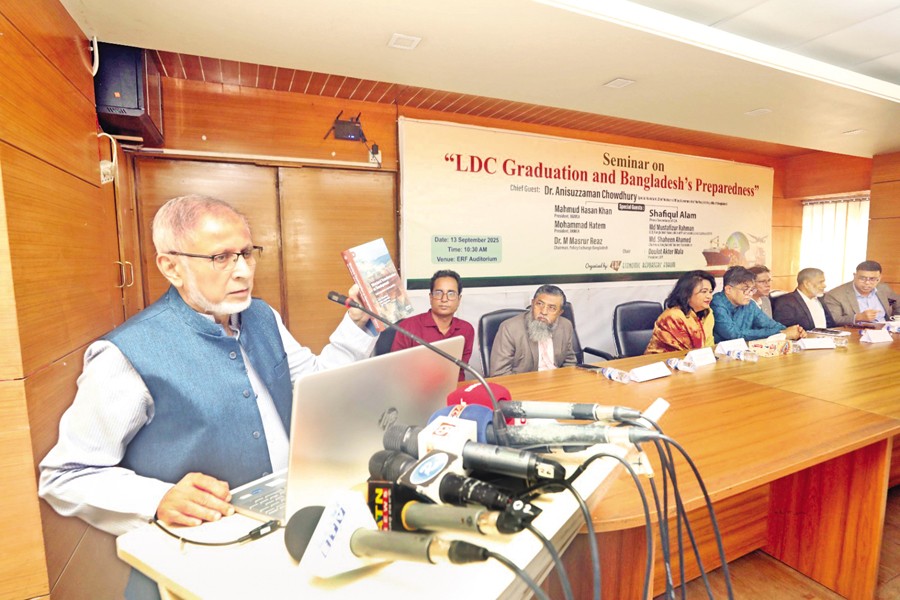
 Dr Anisuzzaman Chowdhury, Chief Adviser's Special Assistant, speaking as the chief guest at a seminar titled 'LDC Graduation and Bangladesh's Preparedness' at the Economic Reporters' Forum (ERF) auditorium in the capital on Saturday. — FE Photo Story on Page 1
 Private sector is asked to proactively lobby through their international trade partners for deferment of Bangladesh's LDC graduation as exporters and economists cite some shortcomings for status change.
"Time is running out to make the case at the United Nations," Dr Anisuzzaman Chowdhury, Special Assistant to the interim government's Chief Adviser, told an event held in Dhaka on Saturday, leaving the onus to the private sector.
Speaking as the chief guest at a seminar titled 'LDC Graduation and Bangladesh's Preparedness' at the Economic Reporters' Forum (ERF) auditorium, Dr Chowdhury said the process of graduation from the least-developed-country status was now entirely under the UN's jurisdiction and beyond the direct control of the government.
"The final decision will be taken at the UN General Assembly (UNGA), where all member-states' opinions will matter," he told the meet, adding that the agenda for the upcoming session has already been fixed. "If we want this issue to be addressed, we may have to wait until next year's General Assembly under an elected government."
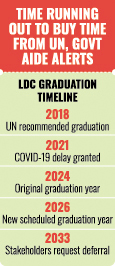
Bangladesh, along with Nepal and Laos, is scheduled to ext from the world's poor-country club in November 2026. Dr Chowdhury noted that Bangladesh was ahead of both countries in key indicators, making it harder to justify a deferral without compelling evidence.
"We need to go to the UN Committee for Development Policy (CDP) and explain why we need more time," he said.
"But how will we convince them? If Nepal and Laos are ready, why aren't we? The three-year delay already granted due to COVID shifted the timeline from 2024 to 2026. Further deferral will require very strong arguments."
He urges businesses to take the lead by lobbying independently, using their established relationships with international buyers and trade partners.
Policy Exchange Bangladesh Chairman Dr Mashrur Reaz warns that while Bangladesh is on track for graduation, the country's current vulnerabilities warrant additional preparation time.
"After reviewing the previous data, it is clear that we are fully prepared. However, there are three macroeconomic challenges - health security, food security, and energy security - that remain vulnerable."
He further explains that health security is below expected levels and energy security, too.
"We are grappling with an energy crisis that has been building since 2011 due to our dependence on imports," Dr Reaz told the meet, citing Professor Ezaz's warning of an impending 'energy famine' that could severely impact the economy.
Bangladesh faced with unique export challenges compared to other graduating countries like Laos and Cambodia.
According to Dr Reaz, foreign-exchange reserves were depleting by over $700 million per month under the previous regime. While the interim government has taken steps to stabilise reserves, it also faced over 600 instances of unrest in the past year.
He highlighted Bangladesh's poor rankings in global competitiveness, logistics, and trade-facilitation indices. "Bangladesh ranks 105 in the Global Competitiveness Index, while competitors rank below 60."
The country's share in global value chains is only 20-22 per cent, compared to Vietnam's 66 per cent, he added, emphasising the urgent need for reforms to strengthen competitiveness.
Bangladesh Knitwear Manufacturers and Exporters Association (BKMEA) President Mohammad Hatem praised Dr Chowdhury for his candid assessment. "I have never heard such a clear and direct statement on this issue before," Hatem said.
He alleged that the previous government's graduation decision was based on "false information and manipulated data".
He warns that recently graduated countries faced fewer risks than Bangladesh, which could lose substantial export earnings.
"If the European Union revises its rules, we may not even qualify for GSP Plus benefits," the export-sector leader cautions.
Hatem argues that Bangladesh, despite progress, remains in a fragile state-moving, in his words, "from ICU to life support".
He calls for at least three more years under a deferral policy and criticised the lack of communication between the government and exporters. "We remain in the dark about policy directions, as there has been no meeting with exporters so far," he said.
"We are seeking another three-year extension because, as exporters, we are not yet fully prepared to comply with the required terms and conditions," said BGMEA Senior Vice President Inamul Haq Khan Bablu.
"If we are granted time until 2033, it will help us meet those requirements. Otherwise, we risk losing markets, and recovering from that setback would be very difficult."
Drawing an analogy, he added: "It's like a war strategy - sometimes you have to retreat to come back stronger."
Bablu notes that Bangladesh is performing exceptionally well in non-traditional markets. "In the USA, LDC graduation does not pose a major concern, but in the EU, we face significant challenges."
He stresses that incentives must continue, particularly for small and medium enterprises (SMEs), to help them stay competitive during the transition period.
Chief Adviser's Press Secretary Shafiqul Alam, speaking as a special guest, reiterated that the government position on LDC graduation remained unchanged.
"No new decision has been taken," he said, while acknowledging that disputes over data and statistics are inevitable. "We must also remember that debates are often hijacked."
Shafiqul Alam urges businesses to embrace risk-taking to remain competitive. "Countries like Vietnam and Cambodia have advanced by taking risks-progress is not possible without it," he said.
Addressing the wage debate, he points out stark differences between Bangladesh and its peers. "The minimum wage for Cambodian workers is $208. In Bangladesh, even after revisions, it remains around $100."
The press secretary also stressed the urgency of enhancing the capacity of Chattogram Port to handle increased trade volumes post-graduation.
Other speakers included BAPI CEO Md Mustafizur Rahman.
ERF President Doulat Akter Mala presided over the seminar, while Secretary General Abul Kasem moderated the session.
newsmanjasi@gmail.com
© 2026 - All Rights with The Financial Express

