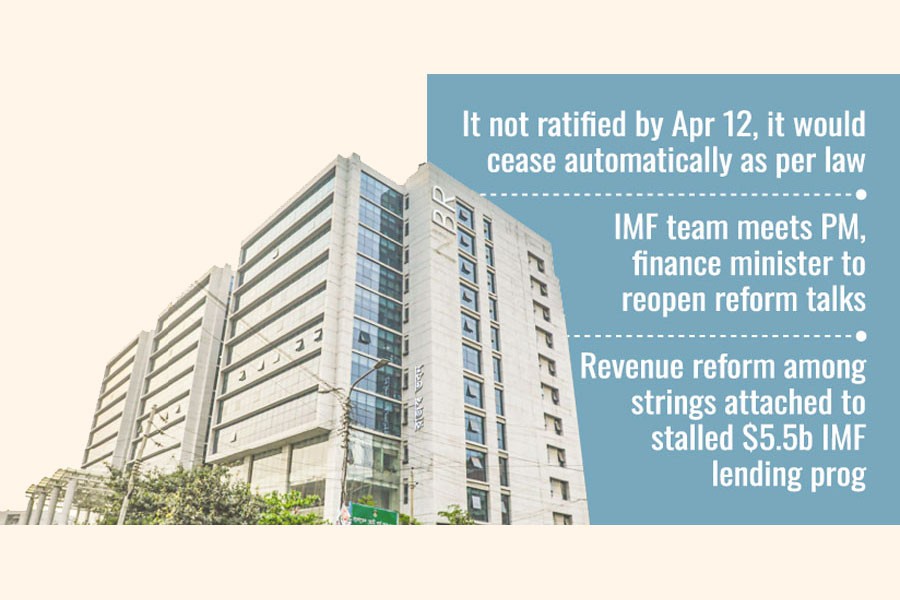
A much-contended move to bifurcate the National Board of Revenue (NBR) looks poised to cease automatically as the finance ministry finds the relevant ordinance promulgated by the interim administration incomplete.
The ordinance for splitting the NBR into two divisions -- Tax Policy and Tax Administration -- was promulgated as a part of reform agenda and following suggestion from the International Monetary Fund (IMF).
The NBR ordinance is one of raft of 133 proposed draft laws now under review by a high-powered parliamentary committee. The panel held its first meeting Tuesday.
Talking to The Financial Express, Finance Minister Amir Khasru Mahmud Chowdhury said the bifurcation move is in half-baked condition which now needs to be 'baked properly'.
"We are reviewing it cautiously. The committee is scrutinizing the ordinance and would come up with its observation," he said.
The ordinance is under study now and it must take proper shape, he added.
Though NBR bifurcation is one of the conditions set by the IMF for its loan disbursement from a package, but it is not under 'Structural benchmark' which imposes mandatory conditions to get the funds.
Meanwhile, on Tuesday, an IMF delegation led by Krishna Srinivasan met Prime Minister Tarique Rahman and Finance Minister Amir Khasru Mahmud Chowdhury to resume discussions on the stalled US$5.5-billion lending programme.
Srinivasan, who is the director of the IMF's Asia and Pacific Department, arrived in Bangladesh for a two-day visit.
"There are different interest groups who want to keep the taxation department under their control," the finance minister told the FE.
It is not about controlling or grabbing the taxation system, he reminds, stressing that the taxation policy must be framed for the sake of the economy.
"Any group's control or privilege must not get priority. Such a major policy must be framed to increase tax collection," he said, noting that domestic revenue mobilisation is extremely low.
"We are working to improve the situation. But in this fragile economic condition, I am not sure how we can mobilise higher revenue."
Increasing tax rates seems difficult at this stage. "The economy is in an extremely bad situation now. Many industries have closed, people are losing jobs, poverty is increasing, imports of capital machinery in the private sector are declining, and investment is going down," he explains the constraints.
However, the government is trying to balance and increase revenue.
"Corruption, leakage, wastage, and some policy adjustments" are among the issues the government dealing with to improve domestic revenue.
A senior revenue official says as per constitutional obligation, the government needs to accept it by April 12, 2026 without any scope to amend or it would cease automatically if not approved by parliament.
In this context, it is clearly understandable that the NBR bifurcation won't be done under the format approved by the interim government, he adds.
The original ordinance was issued on May 12, 2025. Later, the government formed a five-member advisory committee, headed by Energy and Road and Transport adviser of the interim government Dr Foujul Kabir Khan, to amend the ordinance following flare-ups at the NBR over provisions allowing other cadres to lead its policy wing.
Later, the amended ordinance fuelled resentments in admin cadres and the process on implementation of NBR separation lost steam.
doulotakter11@gmail.com
© 2026 - All Rights with The Financial Express

