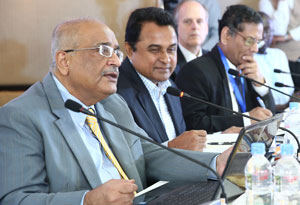
 Centre for Policy Dialogue (CPD) Distinguished Fellow Dr Debapriya Bhattacharya speaking at a two-day expert group meeting on \"Asian Partnership in Financing SDGs\" that started in the capital on Saturday. Planning Minister AHM Mustafa Kamal is also seen
Speakers at a meeting in Dhaka suggested Saturday that the poor and developing countries should mobilise more internal resources instead of depending on external assistance to attain Sustainable Development Goals (SDGs).
They also called for tapping local and foreign investments, inter- and intra-regional trades and boosting internal revenue income to bankroll the SDGs, a new global development paradigm in post-2015 period.
The Centre for Policy Dialogue (CPD), the ENDPOVERTY 2015 millennium campaign, and the Southern Voice on Post-MDG International Development Goals jointly organised a two-day expert group meeting on 'Asian Partnership in Financing SDGs', starting in Dhaka Saturday.
The current development paradigm-Millennium Development Goals (MDGs)-- set by the United Nations will expire in December 2015. After the expiry, the UN will finalise the SDGs aimed at making the world hunger-free and socio-economically strong.
Development experts, researchers, academicians, policymakers and private entrepreneurs are taking part at the expert group meeting in Dhaka.
At the opening session, Planning Minister AHM Mustafa Kamal, South Korean Ambassador in Bangladesh Lee Yun-young, UN Resident Coordinator Robert Watkins, UN Millennium Campaign Deputy Director (policy) Sering Falu Njie, Member of the Planning Commission Arastoo Khan, former Director General, South Asia Department of the Asian Development Bank Dr Sultan Hafeez Rahman and the World Bank's Poverty Global Practice Manager Salman Zaidi spoke on the occasion.
Presided over by CPD Execute Director Prof Mustafizur Rahman, its distinguished fellow Dr Debapriya Bhattacharya presented a keynote paper at the function.
The planning minister said Bangladesh needs to raise earnings from its internal taxes in addition to official development assistance (ODA) from external sources as the country has a lowest tax payers' base compared to the capable persons.
"Everybody "Every capable person should pay taxes in the country. The revenue income is imperative to develop its infrastructure and cut hunger," he said.
The Bangladesh government has taken a policy to bring all the capable persons under the tax-net in a bid to raise its tax-base, the planning minister said.
He urged the developed countries to open up manpower export market so that developing countries like Bangladesh could reap their current benefit of population dividend.
Former finance minister M Syeduzzaman said the poor and developing countries should not wait for Organisation of Economic Cooperation and Development (OECD) countries' Official Development Assistance (ODA), committed at 0.7 per cent of their Gross Domestic Product (GDP). They should rather mobilise their local resources, he added.
He believed launching of the China-based Asian Infrastructure Investment Bank (AIIB) will be very much helpful for the Asian countries to bankroll the SDG agenda.
Dr Debapriya said ODA to the South and South East Asian countries is falling. "The countries should give more emphasis on boosting local resources through raising income from remittances, expediting intra- and inter-regional trades, and boosting investment."
Mr Sultan Hafeez Rahman said: "I don't think that ODA is much helpful for development of a country. Rather, the countries using their own resources should have own policy to develop themselves."
He suggested the countries to mobilise resources from their internal sectors which could be a best input for their development.
He urged the Bangladesh government to boost tax-GDP ratio as this is one of the lowest in this region.
The Korean ambassador said Bangladesh should do some reforms in its rules and regulations.
The public-private partnership (PPP), training of migrant workers and economic reforms would be helpful for the country to facilitate increase of its resources, he added.
Mr Arastoo Khan said ODA is still necessary for the country. The OECD countries should keep their commitment to provide 0.70 per cent of their GDP as ODA for the poor countries.
Ex-president of the Dhaka Chamber of Commerce and Industries (DCCI) Asif Ibrahim urged the World Bank to provide soft loan to private sector enterprises which could be helpful for ensuring the SDGs.
kabirhumayan10@gmial.com
© 2026 - All Rights with The Financial Express

