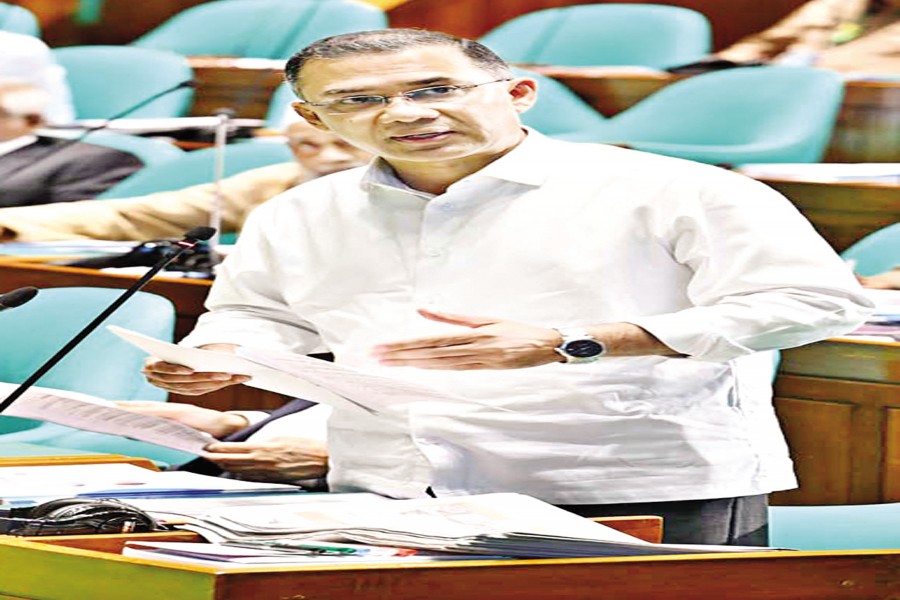
 Prime Minister Tarique Rahman
 Crammed Dhaka is set to undergo a major transformation under a multidimensional government plan on internal ecological uplift and decentralization of facilities to turn the capital into a cleaner and greener metropolis.
Prime Minister Tarique Rahman Wednesday unveiled in parliament the development blueprint that includes modern transport systems and circular economy-based waste management with foreign investment.
Responding to a written question from BNP lawmaker Md Abul Kalam, the prime minister outlined a series of initiatives targeting pollution control, urban greening and sustainable waste management.
The parliament session began at 11:00am under the chairmanship of Speaker Hafiz Uddin Ahmed.
The prime minister said authorities in Dhaka South City Corporation had launched tree-planting programmes across road medians, traffic islands and open spaces.
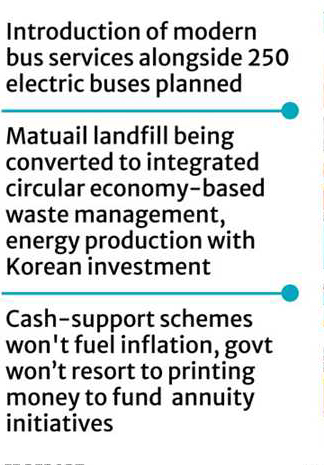
A plan is also underway to convert the Matuail landfill to an integrated circular economy-based waste-management-and energy-production facility with investment from a South Korean private company, aiming for "zero waste".
In the north of the city, Dhaka North City Corporation is expanding urban afforestation through Miyawaki forests and green coverage across open median spaces, he mentions, adding that officials have set a target of planting 500,000 trees over the next five years.
Tree planting will also take place beneath Dhaka's metro-rail corridor between Mirpur-12 and Mirpur DOHS, and under the elevated expressway from Abdullahpur to Farmgate.
He mentions that his government has prioritised pollution control, with the Department of Environment tasked with reducing contamination across the city.
Tarique says a joint initiative with Dhaka Transport Coordination Authority will introduce modern bus services alongside 250 electric buses-a move ostensibly aimed at replacing toxic fume-spewing transports.
"Authorities are continuing mobile-court drives against vehicles emitting black smoke as well as against construction activities contributing to air pollution. Efforts are also under way to shut down illegal brick kilns around the capital."
To tackle worsening air quality, he mentions, Savar upazila has been declared a "degraded airshed", where brick kilns and open waste burning are now banned.
"Industrial facilities discharging liquid waste are required to install effluent-treatment plants (ETPs), with 248 already in place and being monitored in real time through IP cameras."
The prime minister says pollution sources for 19 major canals flowing through Dhaka have been identified.
Tree-planting efforts in the capital will form part of a nationwide programme to plant 250 million trees over five years.
Despite these initiatives, he acknowledges that centripetal capital-city Dhaka's chronic overcrowding remains a long-term challenge driven by decades of centralised development.
"Unfortunately, employment, healthcare, education and most essential services have become Dhaka-centric over many years," he told the lawmakers in the newly formed parliament, now in its maiden session. "People naturally migrate to the capital in search of opportunities."
The government's longer-term strategy involves expanding industrial zones, healthcare services and educational institutions across the country to reduce pressure on the capital.
Responding to another question on urban expansion, the PM notes that infrastructure planning must adapt to rapid population growth. Even bypass roads designed to divert traffic are themselves becoming congested as development spreads.
"In many cases, a bypass now needs another bypass," he says, citing examples from district towns where urban sprawl has overtaken earlier planning.
He affirms that future development must balance land use, costs and sustainability considerations, acknowledging the constraints facing a densely populated country.
Government schemes providing financial assistance to millions of households and farmers will not put pressure on the national budget or fuel up inflation, Prime Minister Tarique Rahman tells parliament to dispel such apprehensions.
He makes it clear that his government would not resort to printing money to fund the annuity initiatives, to underpin his assurances regarding inflation and pressures on budget.
"We will not print money. This assistance is being calculated carefully so that inflation does not increase," he says in response to a question from Hasnat Abdullah, a lawmaker from the National Citizen Party, during the prime minister's question hour in the Jatiya Sangsad Wednesday.
Abdullah raised concerns about potential fiscal burden of bringing 40 million families under a "family card" programme, estimating annual cost at Tk 1.2 trillion, rising to Tk 1.34 trillion inclusive of administrative expenses.
He also notes that distributing "farmer card" to 27.5 million farmers will cost an additional Tk 70 billion.
He questions whether the funding would come from reallocating existing social-safety-net programmes or require new spending, and whether the government had assessed the inflationary risks.
In response, the prime minister said the family-card initiative-an election pledge of the Bangladesh Nationalist Party-would be implemented gradually rather than all at once.
"No government in the world can implement such a programme overnight. We must first collect data. In the initial phase, vulnerable families will be prioritised, and coverage will expand step by step."
The prime minister adds that, based on government calculations, the programme would not place significant pressure on the budget. He notes that overlapping benefits in existing social-protection schemes would be rationalised, reducing duplication rather than cutting all assistance.
"We have found that some individuals receive multiple benefits. We will streamline those gradually."
Mr Tarique argues that the cash transfers would stimulate the rural economy, as beneficiaries are likely to spend on essential locally produced goods such as clothing and educational materials.
"The money distributed through family card will circulate within the rural economy, supporting local industry and increasing employment," he explains. "This is an investment by the state that will ultimately help reduce inflation rather than increase it."
The family-card scheme aims to support low-income households by improving food security, healthcare and education through regular cash transfers. A pilot phase has already provided 37,000 families with monthly assistance of Tk 2,500.
In parallel, the government has introduced a farmer-card scheme to provide farmers with multiple benefits, also extending support to fish farmers and dairy producers.
Tarique Rahman informed the Jatiya Sangad (JS) that the Bangladesh Water Development Board already completed a survey for the implementation of the Teesta Master Plan.
"The Bangladesh Water Development Board has already completed a survey to implement the Teesta Master Plan. The study report recommended the implementation of 110 kilometers of river dredging work under the Teesta Master Plan," he said.
The Leader of the House said this while replying to a question from opposition bench lawmaker from Gaibandha-1 constituency, Md Mazedur Rahman in the House.
mirmostafiz@yahoo.com
© 2026 - All Rights with The Financial Express

