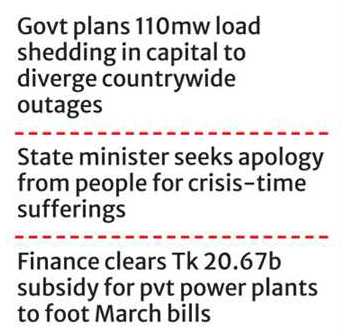
City-dwellers brace for greater power outage as the government decides to go for a trial 110-megawatt load-shedding in the capital for uninterrupted electricity supply for irrigation in rural areas amid nationwide heatwave and electricity crisis.
State Minister for Power, Energy and Mineral Resources Anindya Islam Amit announced the decision in parliament on Thursday, expressing regret over the public suffering caused by ongoing outages.
Speaking under Rule 300 during the 20th sitting of the first session of the 13th Jatiya Sangsad, chaired by Speaker Hafiz Uddin Ahmed Bir Bikram, the state minister says the move aims to reduce disparities between urban and rural electricity access.
"City-dwellers cannot remain comfortable while farmers in villages suffer. The spirit of the July uprising was to build a non-discriminatory Bangladesh," he explains government stance on power parity.
He adds: the decision was taken following consultations with the Prime Minister and the Leader of the Opposition, prioritising uninterrupted power supply for irrigation during the peak cropping season.
Explaining the ongoing crisis, Amit says the country faced a peak demand for about 16,000 megawatts Wednesday, while generation stood at only 14,126mws -- forcing authorities to carry out around 2,086-megawatt load shedding.
He attributes the crisis to accumulated mismanagement by the previous government, noting that "while installed capacity appears high on paper, actual generation remains significantly lower".
The minister also highlights a persistent gas deficit. Daily demand stands at about 3,800 million cubic feet per day (mmcfd), against combined domestic production of 2,686mmcfd and imports of 950mmcfd -- leaving a shortfall of 1,164mmcfd.
He says infrastructural limitations prevent any immediate increase in imports despite financial capacity, but assures that visible progress in gas-infrastructure development would be achieved within the government's 180-day priority plan.
Amit hopes the situation would improve within seven days, as two major power plants -- one imported and another coal-fired -- are expected to resume full production after maintenance work is completed.
"This will significantly reduce the current nearly 2,000mw load shedding."
On behalf of the government led by BNP Chairman Tarique Rahman, the state minister apologized to the people for the hardship caused.
Meanwhile, officials say, the power-supply situation is expected to improve from early May, with 1,982 megawatts of additional generation from two major plants scheduled to resume operation late this month.
The move comes as authorities grapple with rising electricity demand and persistent fuel constraints.
Despite having ample installed capacity, shortages of gas and imported fuels continue to limit output, forcing the system to operate well below potential and leading to ongoing load-shedding.
The electricity generation is set to increase from the first week of May, Umme Rehana, Joint Secretary of the Power Division, said Thursday.
The closed unit of Adani's power plant is scheduled to resume operation on April 26, followed by a unit of SS Power Plant on April 28, she told a press conference at the Secretariat.
On Wednesday, electricity demand stood at around 15,767mws, while supply was about 13,681mws, resulting in load-shedding of 2,086 megawatts, she adds.
On the other hand, Finance Ministry has approved the release of Tk 2,0.67 billion in subsidies to settle outstanding bills of private power plants for March to ease financial strain in the power sector and ramp up generation.
The subsidy will be directed to the Bangladesh Power Development Board (BPDB) to pay Independent Power Producers (IPPs) and Rental Power Plants (RPPs), a senior official of Finance Division under the Ministry of Finance told The Financial Express on Thursday.
The subsidy has been allocated from the power subsidy segment of the revised budget for the fiscal year 2025-26,
This payment will cover actual shortfalls of 85 independent power producers (IPPs) and 9 rental power plants (RPPs) for March 2026.
Previous shortfalls up to February had already been settled, says the official. The payments will, however, not cover two power plants lacking government procurement approval or electricity imports from India.
Subsidy payments to 160mw BR Power Gen Sripur and RPCL-Norinco International Power Ltd will be addressed after clarification.
Monthly shortfall details must be submitted to the Finance Division in the first week of each month and future audits will reconcile subsidies with actual liabilities.
The Finance Division also emphasizes structural reforms to control subsidy management, which include reduction in capacity charges in power-purchase agreements, maintenance of comparative records of plant-based generation and sales.
This subsidy release highlights government effort to stabilize the power sector amid recurring financial shortfalls.
By imposing conditions and emphasizing transparency, the Finance Division seeks to balance immediate relief with long-term sustainability.
mirmostafiz@yahoo.com
Azizjst@yahoo.com
© 2026 - All Rights with The Financial Express

