Bangladesh joins the global nuclear-energy community with the ceremonial commencement of fuel loading into the first unit of the Rooppur Nuclear Power Plant Tuesday, amid regulatory watch.
The loading activities, ahead of the start of power generation, were inaugurated at a ceremony held at the project site in Ishwardi, Pabna. Science and Technology Minister Fakir Mahbub Anam presided over the function.
Rehan Asif Asad, Science and Technology Advisor to the Prime Minister, Md Anwar Hossain, Secretary of the Ministry of Science and Technology and Russian for Rosatom Director-General Alexey Likhachev, along with senior government officials and international nuclear experts, attended the function.
International Atomic Energy Agency (IAEA) Director-General Rafael Mariano Grossi joined virtually and delivered recorded remarks.
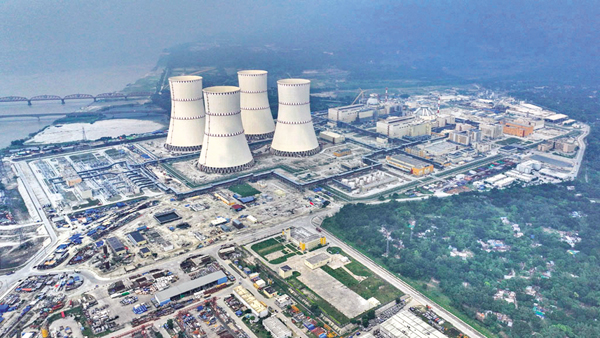
With this milestone -- in the midst of a worldwide energy crunch -- Bangladesh becomes 33rd country in the world to adopt nuclear-power technology for electricity generation.
Officials say fuel loading into the reactor core formally initiates nuclear operations, but commercial electricity generation will require several months due to a strictly sequenced process of testing, verification and commissioning.
The transition will proceed in clearly defined stages rather than a single activation. Fuel loading is expected to take around 30 days, during which 163 fuel assemblies will be inserted into the reactor core under continuous monitoring.
Each fuel assembly contains uranium dioxide pellets, which will undergo controlled nuclear fission once the reactor reaches operational conditions.
On completion of fuel loading, the plant will enter reactor-physics experiments and controlled reaction testing for about 34 days. Engineers will monitor neutron behaviour, thermal performance and system stability to ensure safe operation.
This will be followed by a gradual power-escalation phase lasting around 40 days, with output increased step by step under international safety protocols.
Science and Technology Minister Fakir Mahbub Anam described the fuel loading as a "historic milestone", marking Bangladesh's formal entry into the nuclear-power era.
"The project reflects decades of planning and international cooperation, particularly with Russia, and represents a major step toward a technology-driven, knowledge-based economy," says the minister
Rehan Asif Asad says Rooppur is not merely a power plant but a symbol of international cooperation that has strengthened Bangladesh's technological capacity.
"The project is helping build a foundation for a knowledge-based economy through technology transfer and skills development."
He adds; the implementation has been supported by Russian financing, technical assistance and bilateral cooperation, alongside safety oversight and guidance from the UN agency IAEA.
Md Anwar Hossain hopes the project will reduce dependence on imported fossil fuels and strengthen long-term energy security.
He notes that Bangladesh has already developed a skilled nuclear workforce through international training and capacity-building programmes.
IAEA Director-General Rafael Mariano Grossi describes the development as the beginning of a clean-energy transition for Bangladesh, saying that nuclear power will play a key role in supporting sustainable development.
He reaffirms continued IAEA (International Atomic Energy Agency) support to ensure safety, security and non-proliferation standards.
Experts say fuel loading is only the beginning of a complex operational process governed by strict international protocols.
A nuclear engineering expert from the University of Dhaka says the system is not a simple start-up but a sequence of controlled physics experiments.
He adds achieving first criticality at around one-percent power may take nearly 30 days after fuel loading, followed by gradual increases to higher levels with repeated testing.
Electricity supply to the national grid will begin only after the reactor reaches around 30-percent capacity. Full commercial operation is expected within about 10 months.
Officials say initial electricity generation could begin as early as August on a trial basis with around 300 megawatts of output.
Once fully operational, the two-unit Rooppur plant will generate 2,400 megawatts, covering around 10-12 per cent of Bangladesh's electricity demand.
The plant uses Generation III+ VVER-1200 reactor technology supplied by Russia, which features multiple redundant safety systems, including passive cooling systems that can operate without external power.
Used nuclear fuel will remain highly radioactive and will be returned to Russia under international supervision, with continuous monitoring by the IAEA.
The Rooppur project traces its origin to 1961, when nuclear power was first considered in Bangladesh's long-term energy planning. It was formally included in national policy in 1995.
A major breakthrough came in 2011 through a bilateral agreement with Russia, followed by a construction contract in 2015 between Bangladesh Atomic Energy Commission and Rosatom's subsidiary Atomstroyexport.
The project includes construction, equipment supply, trainings, commissioning and initial fuel supply for three years.
Officials say about 2,500 permanent jobs have been created, while up to 25,000 workers were engaged during peak construction.
Annual fuel cost is estimated at around Tk 10 Billion, significantly lower than equivalent fossil fuel-based generation.
The plant is designed for a 60-year operational life, extendable up to 90 years, with fuel cycles of about 18 months.
Project cost has risen from Tk 1.13 trillion to Tk 1.39 trillion due to currency fluctuations, pandemic disruptions, the Russia-Ukraine war and global supply-chain constraints.
Originally scheduled for completion in 2023-24, timelines have been revised, with Unit-1 expected by December 2026 and Unit-2 by December 2027. Full commissioning is projected by mid-2028.
Residents in Ishwardi describe the project as historic, citing improved infrastructure, business activity and employment opportunities, although some raises concerns about limited public awareness on nuclear safety and emergency preparedness.
Experts and officials say Rooppur marks a long-term shift in Bangladesh's energy landscape, where safety, precision and technical discipline will determine success more than speed.
jahid.rn@gmail.com
© 2026 - All Rights with The Financial Express

